
AI isn’t just for tech wizards anymore. By 2026, it runs deep through the bones of business, changing how companies make money, deliver value, and even organize their teams. What used to be simple subscriptions now look like contracts built around real outcomes. Entire lines of products have turned into data-and AI-powered services. The impact? Massive, and you can feel it in every corner of the market.
Let’s break down how this shift works, where the real value shows up, and what leaders actually need to do. Because at this point, it’s not about just plugging in a model, it’s about rethinking your whole business model.
The Big Shift: From Labor to Data to Outcomes
For decades, most businesses made money by selling time (think: billable hours), things (physical products), or attention (ads). AI blows up those old rules. Now, companies can:
Turn data and outcomes into products. Instead of just selling a gadget or a piece of software, they sell predictions, recommendations, and automation, layered right on top of what they already offer.
Automate repetitive work with AI agents. Whole workflows that used to take teams of people now run on autopilot. Less manual effort, much faster delivery.
Charge for results, not just usage. Instead of paying for hours or seats, customers pay for outcomes like “30% fewer system failures” or “higher throughput.”
These moves force businesses to rethink how they make money, what margins look like, and what really protects them from competitors.
Five Ways AI Is Flipping Business Models
1) Products Become Product + AI (Data Is Now a Feature, and a Revenue Stream)
Now, hardware and software don’t just work. They learn, diagnose, optimize, and personalize. All that data flows through the product. It’s valuable. Companies turn it into new services: analytics subscriptions, premium insights, or marketplaces where third parties tap into the data. That one-time sale? Suddenly, it’s a stream of recurring revenue.
Why it matters: Recurring revenue boosts customer lifetime value and justifies investing in custom AI models and data infrastructure.
2) Companies Turn into Platforms
If you control the flow of data, you can become a platform. That means connecting customers, suppliers, and AI models. Picture a logistics company that matches shippers and carriers while using AI to plan perfect routes. They don’t just move boxes. They orchestrate an ecosystem and collect platform fees along the way.
Why it matters: Platform fees and AI-powered matchmaking scale better and bring in more value than just owning lots of physical assets.
3) Outcomes Over Outputs: Risk and Reward Are Shared
More and more, sellers are putting their money where their mouth is, offering contracts based on results, not hours or tools. You see this in healthcare, finance, and industrial settings. AI lets companies measure and optimize constantly, so they can confidently guarantee results. But to pull this off, there needs to be trust, clear rules, and everyone’s incentives lined up.
Why it matters: When buyers pay for results, and sellers deliver, both sides win. Companies that can deliver consistently can charge more, too.
4) Agentic Automation: AI That Does the Work
2025 and 2026 are all about “agentic AI”, systems that don’t just answer questions, but take action. They book, pay, reconcile, coordinate with other systems, and follow up. Service businesses like customer support or accounting shift from being all about people power to humans overseeing and guiding swarms of AI agents.
Why it matters: Fewer people doing repetitive tasks, more people handling exceptions and oversight. The edge goes to companies that blend humans and AI most effectively.
5) Rapid Experimentation Means Faster Pivots
AI makes it easy to test prices, bundles, and new features, think A/B tests on steroids, tailored for each customer. Business models become more flexible and modular. Companies that build in tight feedback loops and use real-time data can move fast and catch new trends before anyone else.
Why it matters: Agility isn’t just a buzzword. It’s what lets companies win when the ground keeps shifting.
How This Plays Out in Real Life
Healthcare: AI sharpens diagnostics, automates paperwork, and makes remote monitoring easy. Hospitals and device makers shift from selling equipment to offering ongoing subscriptions and contracts tied to health outcomes.
Financial Services: AI tracks risk in real time and lets banks offer personalized prices. Credit and fraud detection become subscription services, not just features.
Manufacturing: Predictive maintenance and AI-driven robots let manufacturers promise performance, selling contracts that guarantee uptime, not just machines.
Retail & E-commerce: AI personalizes shopping and streamlines supply chains. Retailers use this to sell premium, curated services and guarantee delivery.
Professional Services: Consultancies and agencies aren’t just adding AI to their services. They’re baking it right in. Instead of charging by the hour, many now use outcome-based or retainer models, focusing on ongoing results and optimization.
(These trends pop up again and again in industry reports and case studies from 2025 and 2026.)
What leaders need to rethink
Redesign your revenue models. Figure out which parts of your service can be recurring or outcome-driven, then set pricing that shares both risk and reward.
Build an operating model where AI is at the center. That means strong data foundations, solid MLOps, clear model oversight, and product managers who actually own the full life cycle of AI features. The top performers aren’t just tech-savvy. They blend strategy, talent, operating models, and practical adoption.
Change up your talent mix. As routine tasks fade, people shift from just doing the work to supervising, handling exceptions, reviewing ethics, and guiding AI-focused product strategies.
Measure and govern tightly. Outcome-driven contracts and AI-driven workflows demand clear explanations, audit trails, and human checks to keep trust high and stay compliant.
Standardize modular architectures. Microservices, APIs, and model-as-a-service tools make it easy to test new ideas and roll back changes safely.
Don’t overlook these risks and trade-offs
Too much reliance on AI can dull human judgment. Some firms now require “AI-free” reviews or human validation for regulated calls.
Data privacy isn’t optional. If you’re monetizing data, you need airtight consent, anonymization, and compliance with local laws.
Model risk is real. Outcome-based deals mean sellers take on real financial risk if the models flop. Smart contract design, insurance, and fallback plans are a must.
Workforce disruptions are coming. Automating big chunks of jobs brings social and ethical headaches, so companies need real plans for reskilling and transitioning people.
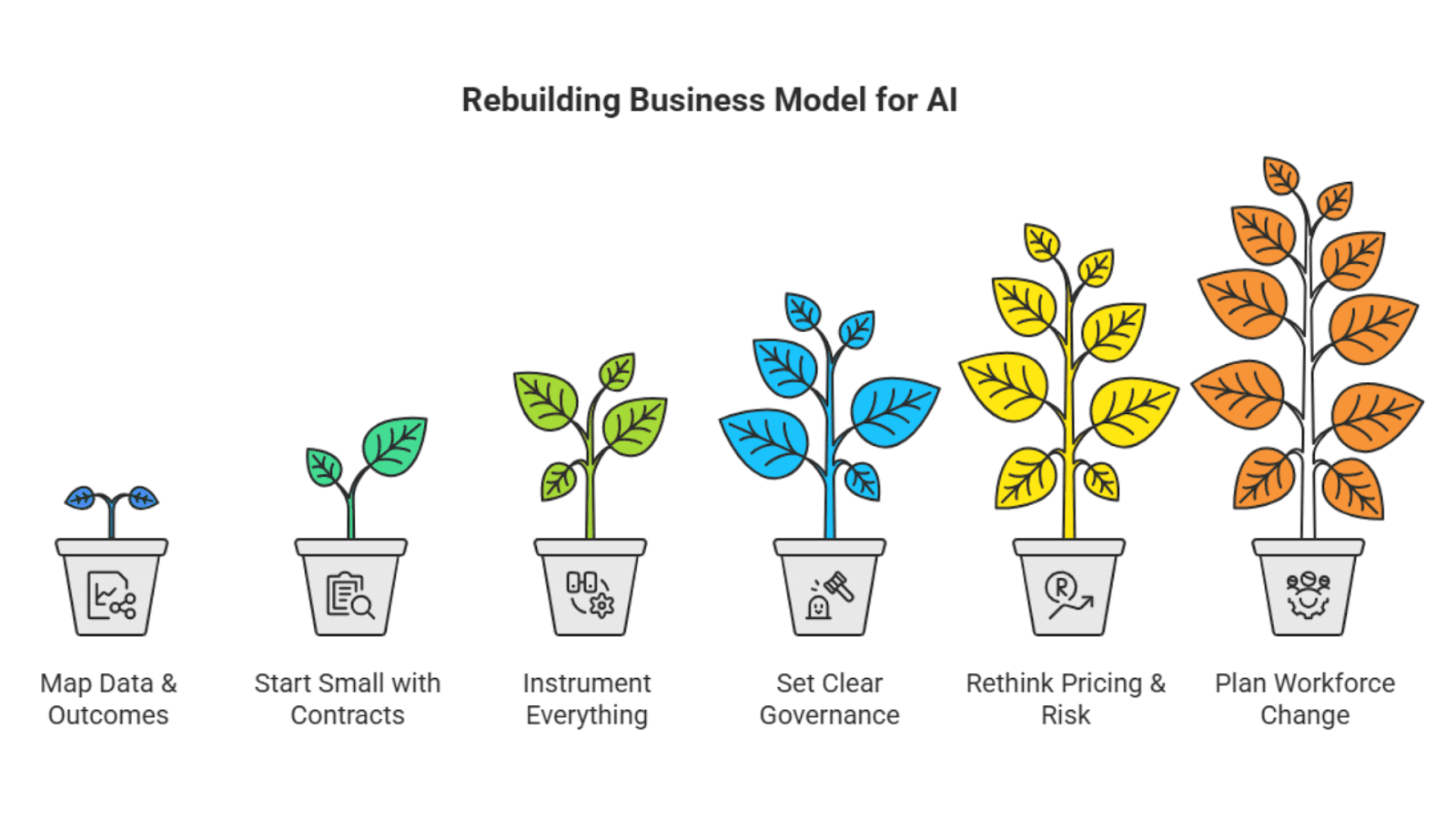
Six steps to rebuild your business model for AI
1. Map your data and outcomes. Pin down what data you actually have and what results you can reliably predict or improve.
2. Start small with outcome contracts. Try a focused, measurable outcome offer, like “reduce X by Y% in 90 days”, to test the economics before going big.
3. Instrument everything. Bake in telemetry and A/B testing so you can prove what’s working.
4. Set clear governance. Build in rules for human checks, explainability, and escalation when things go sideways.
5. Rethink pricing and risk. Use blended models, say, a base fee plus performance bonus, to keep risks in check.
6. Plan for workforce change. Figure out which roles need new skills, hire for oversight (AI ethicists, ML engineers), and support smooth transitions.

Proof from the real world (this isn’t just theory)
Large consultancies and research firms keep showing that organizations with strong AI management practices see outsized benefits. McKinsey’s 2025 State of AI, for example, found that high performers combine technical savvy with sharp management across strategy, talent, and operations.
Tech and strategy firms report a move toward agentic, process-focused enterprise apps. AI agents now handle entire workflows. Forrester and Deloitte both highlight how these digital “workers” are changing the game.
Cloud and platform providers are full of customer stories where AI-powered products lead to real business gains and steady, recurring revenue.
Bottom line
By 2026, AI isn’t just about squeezing out more efficiency. It’s changing how businesses make money. The winners won’t just tack AI onto old offerings. They’ll rethink what they sell, how they price it, how people and machines work together, and how value is shared. Pulling this off takes technical chops, strong governance, and a healthy dose of commercial creativity.