
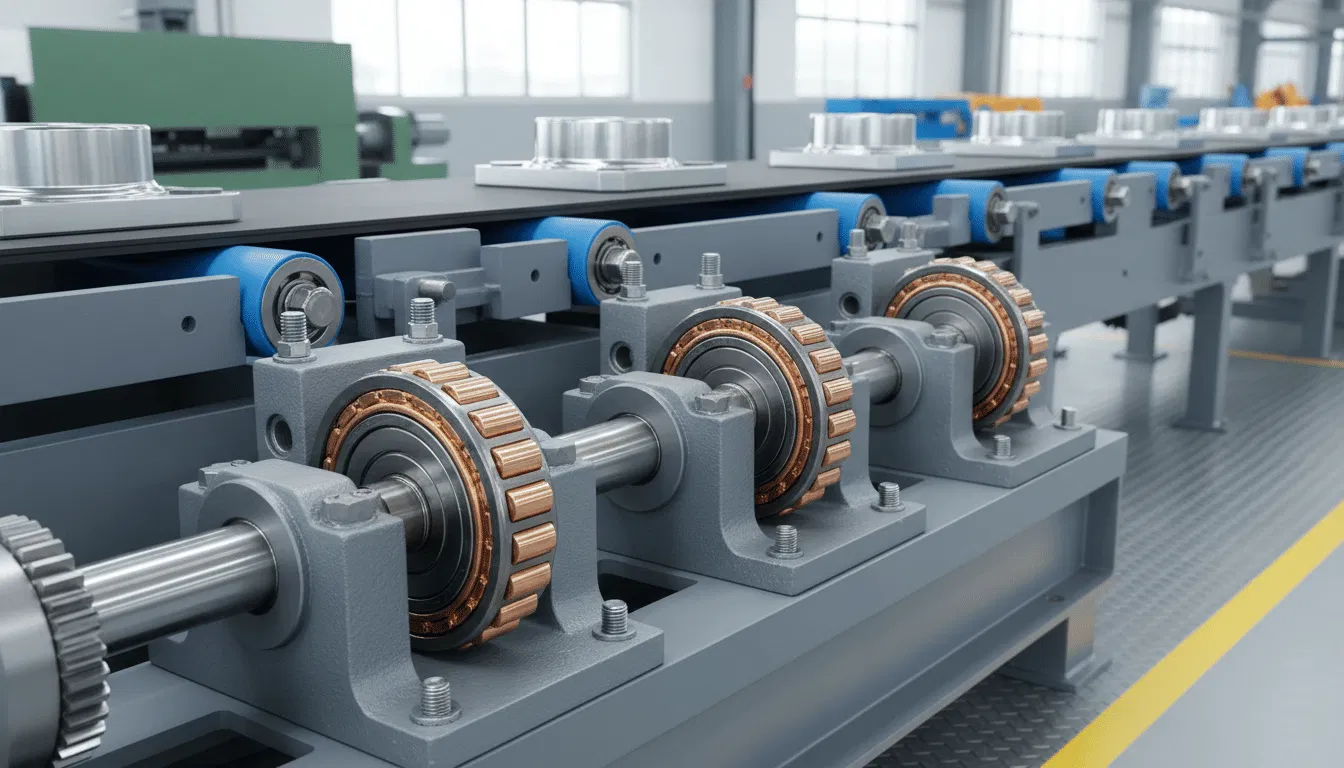
A rainy Tuesday in 2014 remains impressive in my memory. I was on a factory floor in Pune, witnessing as the massive conveyor system slowly came to a stop due to a single frozen bearing in the primary drive assembly. The procurement team, aiming at “cost optimization”, had replaced branded parts with unbranded ones, thinking a bearing is a bearing, and if it’s cheaper, it should be fine. After six hours of downtime costing the production line nearly ₹40 lakhs in lost productivity, the message was crystal clear. In the area of highly stressed, load-carrying industrial machinery, “good enough” is the surest way to disaster.
I became skeptical about mechanical components after that incident. When we talk about Taper Roller Bearings, India is currently a dominant force on the world market for both demand and production; however, a “deal” and a “disaster” can sometimes be on the other side of a sheet of industrial grease. Whether the industry you are in is automotive, mining or heavy infrastructure, these tapered cones are, in fact, the backbone of your operations.
Honestly, things are quite confusing out there. You are facing old, renowned brands, aggressive newcomers, and a “grey market” that even a seasoned engineer could be easily fooled by. A few lines of my guide are an effort to give you a clear picture. We will explore the areas that are driving the demand and, more importantly, how you could make a sourcing decision that will allow your machines to run smoothly and your CFO to be happy.
Why “Tapered” is the Secret Sauce for Heavy Industry
Let’s hold off on the “where” and “how” for now, and focus on the “why”. Why, exactly, do we become so obsessed with taper roller bearings?
Most of the time, bearings deal with forces from one direction – either pushing down or sliding sideways. But out there on real job sites? Things do not follow clean rules. Think about heavy machines twisting through dirt or drums tumbling concrete – they create push and twist together. That messy mix is where tapered roller bearings shine. Their angled design, shaped like cones fitting into matching curves, manages both pressures at once without fuss. While other types struggle, these keep rolling as if built for nothing else.
Picture how it’s shaped. With a line touching rather than a single dot, pressure spreads out better across the surface. Imagine stepping on fresh snow – wearing stilettos digs deep, yet strapping on wide shoes lets you float above. One breaks through, the other stays up.
The Automotive Surge: India’s Road to 2030
If you try to figure out the reason for the demand for Taper Roller Bearings, India’s automotive industry is an excellent example. We are not merely producing vehicles anymore; we are turning into the world’s “back office” for the heavy-duty transport sector.
Commercial Vehicles and the Logistics Backbone
Down those expanding Indian highways, big rigs keep rolling through rain, dust, and endless miles. Because roads stretch farther now, trailer numbers climb – along with demand for tough transport gear. Hidden inside each heavy truck’s wheel hub lives a small yet vital part doing silent overtime. That component? A tapered roller bearing is taking brutal pounding from shifting loads. Season after season, it handles jolts, bumps, vibrations – one rotation at a time.
I can picture the fleet managers who thought they could cut down on bearing costs by 15%, only to face a wheel-end breakdown on a mountain road. It’s not just about the part; it’s really about the driver’s safety and the cargo. Top-notch tapered bearings lower rolling resistance, which, and this is where people tend to lose track, has a direct positive impact on fuel consumption. In a world of very tight profit margins, even a saving in fuel by 1% achieved through better bearings would repay the initial cost of the part ten times over.
The Shift to Electric Vehicles
A different angle here. Most people think electric vehicles are easier to handle since there are fewer pieces inside that move. Yet reality isn’t quite so clear-cut. Without an engine like before, getting power where it needs to go turns into a bigger challenge. Efficiency matters far more now. Faster spins come from electric motors, so parts inside must handle heat more efficiently. Bearings need tighter precision because of how quickly everything moves.
In my opinion, the trend we are witnessing now is that Indian manufacturers are compelled to innovate. You can’t simply install a 1990s-spec bearing in a 2026-model electric bus. To some extent, the precision demanded from Taper Roller Bearing India is even flouting the international aerospace standards in order to keep pace with the ever-growing domestic EV market.
Industrial Heavyweights: Mining, Construction, and Beyond
Off the beaten track, Gati Shakti and other such infrastructure drives have given a huge boost to the demand for earthmoving machinery in India. Have you ever experienced how massive the force exerted on the swing gear and track rollers of a hydraulic excavator is?
Construction and Earthmoving
Contamination is stomping around in these places. Barring the occasional filter change cycle, it is practically impossible to keep out dust, dirt and slurry. Here is where the bearings “systems” concept kicks in. A lot more than steel, it is about seal technology.
While dealing with suppliers for construction, you should always keep the following in mind:
- Case-Carburized Steel: Really hard to wear on the exterior, but at the same time “tough”-meaning it can endure shocks without cracking on the interior.
- Advanced Sealing: Because a bearing is only as great as the lubricant that it can hold inside (and the dirt that it can keep out).
The Steel and Cement Sector
The steel giant number two is India. Steel plants are very difficult environments. We are talking about intense heat and uninterrupted load cycles. If the bearing of a rolling mill breaks, besides losing the part, you might even lose the whole batch of a costly recycled product. I have witnessed engineers grey prematurely, just reflecting on these machines’ maintenance schedules. In this case, the demand is for “extra-large” tapered bearings, which could be refurbished, instead of only being replaced.
The Sourcing Dilemma: Price vs. Total Cost of Ownership (TCO)
Being procurement-related, let’s put the cards on the table. First of all, there is always the supplier who tries to convince you that he can provide you with the same “quality” but at 30% less.
Frankly, I’ve been on that site. The temptation is real. But please remember that in an industrial business, the price that you pay for the equipment accounts for only a very tiny fraction (10-15%) of the Total Cost of Ownership of that equipment. So what is the rest? Maintenance, energy usage, and the biggest one, the cost resulting from the machine suddenly breaking down.
The “Questionable” Conductor… of Problems
Taper Roller Bearings India has a huge unorganized sector where such things happen. Usually, these are “reconditioned” bearings sold under the guise of new products or bearings that constitute inferior scrap steel.
Here is my supplier evaluation checklist:
- Raw Material Traceability: Can the steel be traced back to a particular, reputed mill?
- Heat Treatment Consistency: Is it their metallurgical lab that provides the test results?
- Metrology: What kind of device are they using to measure “roundness”? We are talking about changes in the range of just a few microns. A digital report if they can’t produce it, then it’s better to leave.
Such a proposition is possibly quite attractive to you, but if that is really the case, the person who cut the corner was heat-treating the product. }
Technical Pillars of a Great Bearing
You don’t want to be a mere price chaser when you meet a new potential vendor. Take a few technical points with you, so you can push for a level of understanding.
1. The Geometry of the Race
The taper’s flattening controls how a radial load and an axial load share the total capacity. A bigger angle means the bearing can take more axial load/thrust. If your bearing supplier isn’t asking you about the load profile of your application, then they are just trying to sell you “metal donuts.” They should be your technical advisers, not just your order-takers.
2. Surface Finish
Talking about my favorite stat from the given set of numbers… If you were to examine the surface of a bearing under a microscope, you would see a mountain range-like surface. The top manufacturers implement a super-finishing process that smoothens these peaks. This leads to a decrease in friction, thus also lowering heat generation. The less heat, the longer the lubricant life, and consequently, the longer bearing life. Many people overlook this, although it is a very simple formula.
3. Lubrication Grooves and Holes
How does the oil get in? At very high speeds, the way in which the bearing facilitates the flow of lubricant is a very important factor. A poorly designed cage (the part that holds the rollers) can even obstruct the lubrication, resulting in localized “hot spots.”
Navigating the Indian Market: Who Can You Trust?
India has some great national talent. At the highest level, we have NBC (National Engineering Industries), Tata Bearings, as well as the Indian subsidiaries of global players like SKF, Timken, and FAG.
However, brand names are not the be-all and end-all. It is the Authorized Distribution Network that matters.
Pro Tip: I have come across many counterfeit bearings in the “Big Brand” boxes. Packaging is flawless. The laser etching looks legit. But the steel is rubbish. You need to verify the distributor’s credentials always, and I mean always. If they won’t allow you to see the manufacturer’s Certificate of Analysis directly from the factory, you are putting your equipment at risk.
The Future: Smart Bearings and Industry 4.0
We are reaching the time when the bearing may well be able to tell you if it’s tired or not. Sensors to detect temperature and vibration integrated into the bearing, that’s exactly what I mean.
How to Pick a Partner
- Hold on. You’re about to sign the paperwork. Just pause. Catch your breath. Run through it one more time.
- When mission-critical equipment leaves the shop without stock embedded, delays happen at customs unless engineering help steps in. Because RPM and load differ per machine, an expert from a reliable bearing firm should calculate clearance needs ahead of time. Instead of guessing lifespan, they deliver the L10 figure – how many cycles most units complete before wear shows. That number tells how long nine out of ten bearings last under real stress. Without that data, surprises pile up where timing matters most.
- A big contract means you should demand they show up. Step into their workshop space. Does the temperature stay steady there? How about cleanliness – spotless or not? Dust piles on the floor where tiny bearing parts come together? Then count on dust getting trapped inside those bearings as well.
- Right off the bat, look at the cage. While most eyes go straight to the rollers, it usually fails before them. Could be pressed steel. Might be machined brass. Or maybe polymer. Since vibration damping matters, pick a polymer. When heat builds up, brass handles it well. Depending on conditions, one fits better than others. Match the cage type to where it works.
- One size fits most when it comes to parts – streamlining them cuts down clutter in storage. Still, swapping a custom fit just to reduce numbers on paper can backfire badly. Matching function matters more than neat spreadsheets if the job demands precision. Simplicity helps until it breaks under real conditions.
Conclusion:
Yeah, probably a little over the top to refer to a steel part as the “heartbeat”. But then again, after spending an entire night at a factory, I really understood how essential these little components are.
Demand for Taper Roller Bearings India is nothing but one side of the coin of our country’s development. Today, our factories produce faster, our vehicles cover longer distances, and our overall production is hitting new highs. Selecting the right bearing is more than a procurement decision; it is basically a quality and safety assurance through which a company communicates its ethos to the outside world members of it.
The temptation of a less-than-significant price difference that masks a huge operational risk of failure should never be given in. Keep to the standards. Material verification should be part of your routine. And above all, partner with a supplier who gets that their bearing is the link which separates your machines from a very costly heap of scrap metal.
It is definitely not a straightforward world. However, once you understand it, you will start to notice those little cones everywhere, from the bus you take to work to the turbines that generate energy for your very screen. They keep the world spinning, so you’d better ensure that yours are up to the task.