

While Generative AI has moved beyond hype to generating business impact rapidly, there remains a common question asked by leaders: is this worth it? How does it deliver efficiency, revenue, and improved customer experiences on a larger scale? The answer can be found in the manner in which companies produce measured ROI through the use of Generative AI, as shown by multiple real-world applications within this article.
Evaluating the Returns of Generative AI
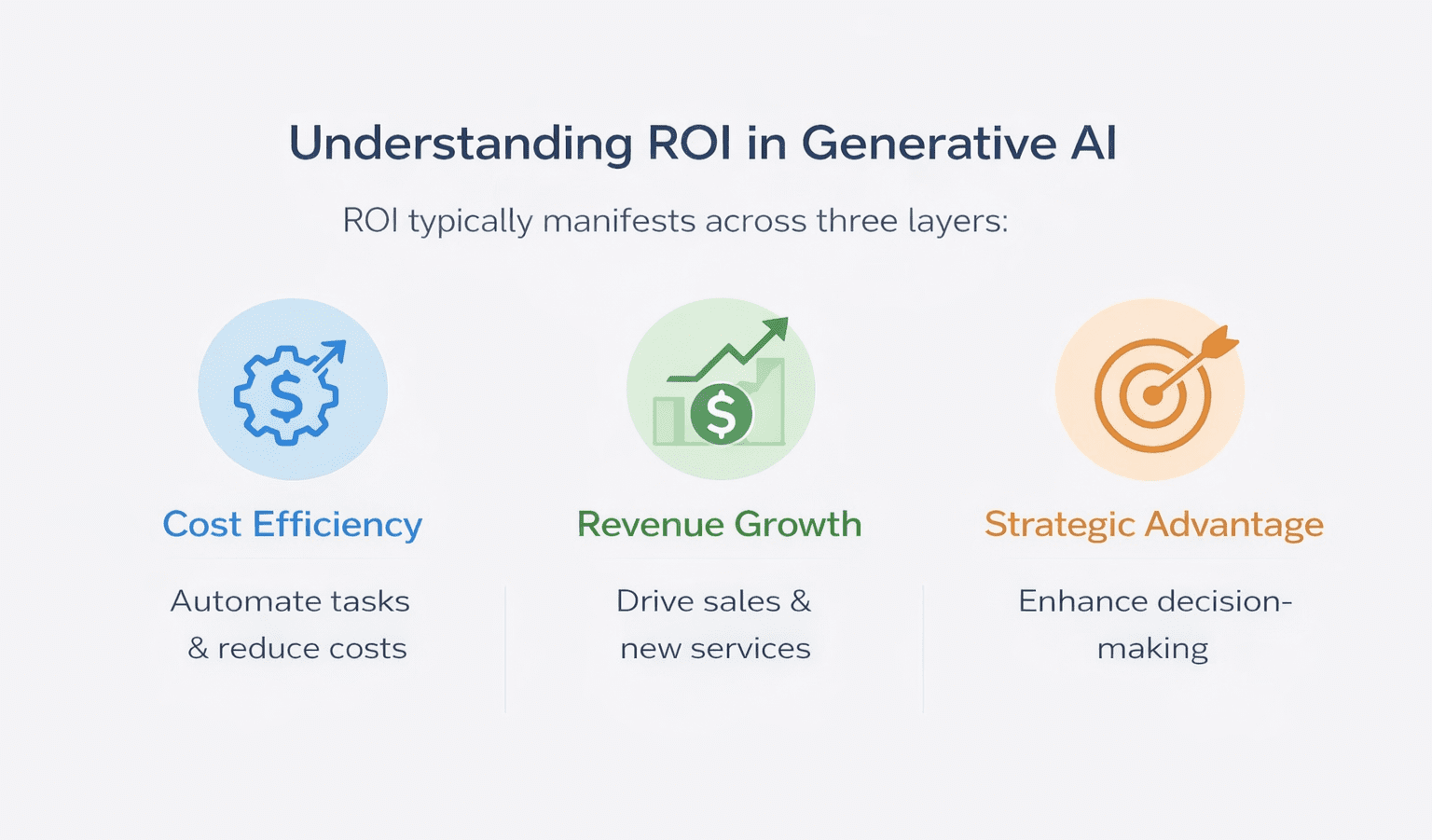
ROI for Generative AI can take different forms and will not always be realized immediately or in a strictly fiscal way. Organizations, especially those partnering with a generative AI development company, usually see some benefits to their respective operations in three layers.
1. Cost Efficiency
- Elimination of repetitive tasks through automation
- Less manual work is being performed
- Shortened time to complete tasks
2. Revenue Growth
- More customized experiences for customers
- Reduced time between product prototypes and the actual rollout of a new product
- New products/services utilizing AI technology
3. Competitive Edge
- Higher-quality decision making
- Greater capacity for innovative thinking
- Differentiate their products through unique value propositions
Organizations that successfully utilize Generative AI also have a better understanding of measuring ROI on a broad basis, rather than focusing on short-term cost savings alone.
Examples and Measured Benefit of Generative AI in Business
The true value of Generative AI will become apparent as we review the business applications on which the technology is utilized and how they produce measurable results. Here are a few examples demonstrating actual performance and effect.
Klarna – Automated customer service with AI technology-enriched agents
Klarna deployed an AI-automated assistant to manage customer inquiries with the expectation that the automated solution would assist with approximately 66% of the incoming support chats. In addition, the AI-automated solution is able to perform the duties of about 700 full-time agents and has decreased the average amount of time to resolve a support chat from minutes to seconds. This has resulted in tens of millions of dollars in annual projected savings. Additionally, customer satisfaction will increase, and support can be scaled without a necessary increase in the number of agents.
Coca-Cola – Utilizing Generative AI in Content Marketing Efforts
Coca-Cola has used Generative AI to produce great marketing efforts such as “Create Real Magic.” Generative AI is helping the company accelerate the production of creative assets for use across the globe. By reducing production timelines and costs, as well as enabling campaigns to be more interactive, Coca-Cola has seen an increase in the engagement level of consumers and a decrease in the amount of time it takes to implement campaigns in various parts of the world.
Salesforce – Productivity, Sales
Salesforce’s integration with GPT is an example of how Generative AI will streamline the sales process. With the AI, the sales team has instantaneous, personalized email and insight generation. This allows the sales representatives to reduce the time spent on administrative tasks, thus enabling them to devote more time to higher-value sales interactions and creating faster pipelines, thereby leading to increased sales conversion rates.
Morgan Stanley – Knowledge Management
Morgan Stanley has deployed an AI assistant to help its financial advisors easily access internal knowledge and research. Rather than spending time manually searching for documents, the advisors have instant access to the accurate information they need. With this time saved, their financial advisors can provide the best possible advice to clients, thus enhancing both the quality and consistency of advice being provided to clients.
Walmart – Operational Efficiencies and Internal Efficiency
Walmart utilizes Generative AI to automate product descriptions and internal documents at scale. The implementation of Generative AI dramatically reduces the amount of manual labor required by large teams in terms of process efficiency, helps reduce the time required to update product listings, and decreases costs associated with merchandising activity.
Best Practices for Growing ROI to the Highest Levels
- Starting with the Highest Business Use Cases with High Impact.
Target the ones with the highest and most measurable outcome targets.
- Test and Validate Against the Business Case First, Before You Expand.
First, validate the value before scaling.
- Integrate AI into Established Workflow Processes.
AI should enhance, not disrupt existing workflows.
- Invest in Training and Knowledge Transfer.
Give staff the tools and knowledge they require to use AI effectively.
- Measure and Optimize on an Ongoing Basis.
Continuously track performance; refine implementation whenever possible.
Ending Thoughts
Generative AI isn’t just another advancement in technology, but a way to invest in the future of your organization and change the way you operate and compete. As there are many ways to implement Generative AI, measuring the ROI of each will be different, but examples of organisations implementing Generative AI show quantifiable, measurable benefits in many different industries.
If your organisation is intentional about its use of Generative AI, and focused on achieving specific outcomes, it too will have a high level of return on investment as well as numerous other opportunities for growth and innovation.
The path to success is simply to:
- Start small
- Create a record of results from each implementation
- Build on your successes