
Writing a thesis is no joke. You spend hours researching papers, identifying research gaps, developing research questions, designing methodology, collecting data, and then writing and revising your thesis until it is right and approved.
Preparing for and defending your thesis is another challenge. However, don’t let the process intimidate you. The aim is to prepare for obstacles and learn how to overcome them as you work through the thesis writing process.
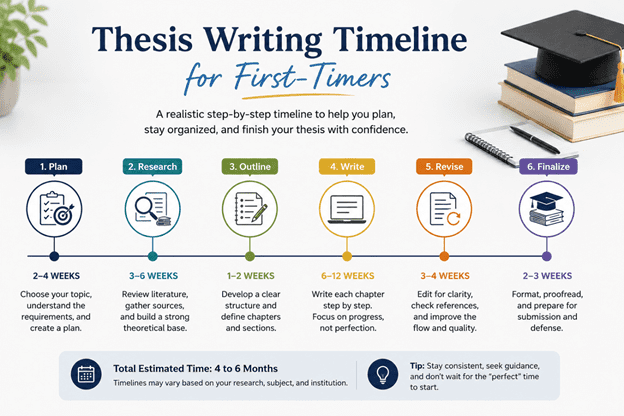
So, if it is your first time writing a thesis, then we urge you to follow one simple mantra: be patient and create a timeline. A timeline will help you keep track of everything that needs to be done, when it should be done, and give you a heads-up on what is coming up.
Hence, if you are unsure how to create a timeline for thesis writing, keep reading to understand the steps and the time required to complete each one. It will surely make your academic journey less stressful and more productive.
Step 1: Choosing A Research Topic Smartly
The first step is topic selection for your research. Initially, you can either look for thesis writing services or seek guidance from your supervisor.
This process involves an introductory literature review, where you read a few articles in the area you want to research. Then, you decide your research questions and research gap, all while having discussions with your supervisor. This can take a week or two, so it is important to start early.
Step 2: Turning a Rough Idea into a Clear Research Proposal
Once you have an idea for your topic, it is time to turn it into a proposal. In the proposal, you should include research questions, methodology, and expected results to analyze how you would carry out your research.
After that, submit your proposal to your supervisor for approval. This stage may take a few weeks or even a month, but it is better to take your time and do your research thoroughly than rush and end up confused.
Step 3: Literature Review – Read, Read, and Read
One skill you must master while doing your research is reading. At this stage, you read for various purposes, such as assessing hypotheses, developing a theoretical and conceptual framework, and referencing papers throughout your thesis where needed.
This process could take between 2 and 3 weeks, depending upon your reading capacity and speed.
Step 4: Setting Up Research Design and Methodology
Once you complete your literature review, you then decide on the methods you will use to collect data.
In research design, you carefully plan whether you require primary or secondary data, how you will collect data, and what tools you will use to analyze and interpret data.
Step 5: Predicting the Unpredictable Data Collection Stage
Data collection takes the most time to be completed, depending on the type of data you choose. If you choose primary data, you will need to visit locations, conduct interviews, or create and distribute questionnaires. This process may take 2-3 months to complete.
If your data is secondary, you need to reach out to the sources from which you derive it. If the process becomes too formidable for you, it is recommended to seek affordable thesis help to ease this stage a bit.
Step 6: Making Sense of Your Data Through Data Analysis
After you have collected your data, it is time to make sense of it by turning it into valuable insights. For this, you need to use models like PLS-SEM or SmartPLS. These models aid in handling data by running various tests.
Following the results given by your chosen model, you need to interpret them to understand how reliable and accurate your data collection and overall research are, and whether the outcome aligned with your hypothesis or not.
Step 7: Writing That Dreaded Draft
Start writing your thesis by dividing it into five chapters. These five chapters include an introduction, a literature review, a methodology, data collection and analysis, and a conclusion.
If you have started from scratch, then the draft could take a month to be written and finalized. If you have been writing since the beginning of your thesis, you would only need to add or remove information.
Step 8: Feedback and Revisions
Once you have completed your final draft, submit it to your supervisor to get it approved. You could also seek assistance from your supervisor throughout the writing process. Take your supervisor’s feedback like a champ and do not take anything personally.
And if your supervisor asks you to make minor or major revisions, then do not let it affect your sanity. This is all done to polish your thesis and make it as impressive as possible.
Step 9: Reference and Formatting Checks
Although these are smaller details, ensure that you add references in your thesis where needed and align your formatting. So that once you submit your thesis or get it published, it looks neat, crisp, and well-written.
Step 10: Defending Your Thesis
Throughout your research, you will be asked to present your thesis to internal and external evaluators. Do not be afraid. Be confident in your work and prepare in advance so that you are able to explain your thesis seamlessly.
Estimated Timeline for Thesis Writing
There is no fixed timeline to finish your thesis, as it depends on the nature of your research, field, scope, and pace. But to give you an idea, a bachelor’s thesis can range from 6 months to a whole year, while a master’s can take up to the whole duration of your degree.
A Thesis Is a Marathon, Not A Sprint
Now that you are aware of the steps involved in thesis writing and how much time it could take to complete, you can start making an achievable timeline. But keep in mind that you do not have to rush or stress if you are falling a little behind.
Research takes time, so do not worry about dedicating more time to it. With a little self-confidence and guidance, you can ace your thesis like a pro.