
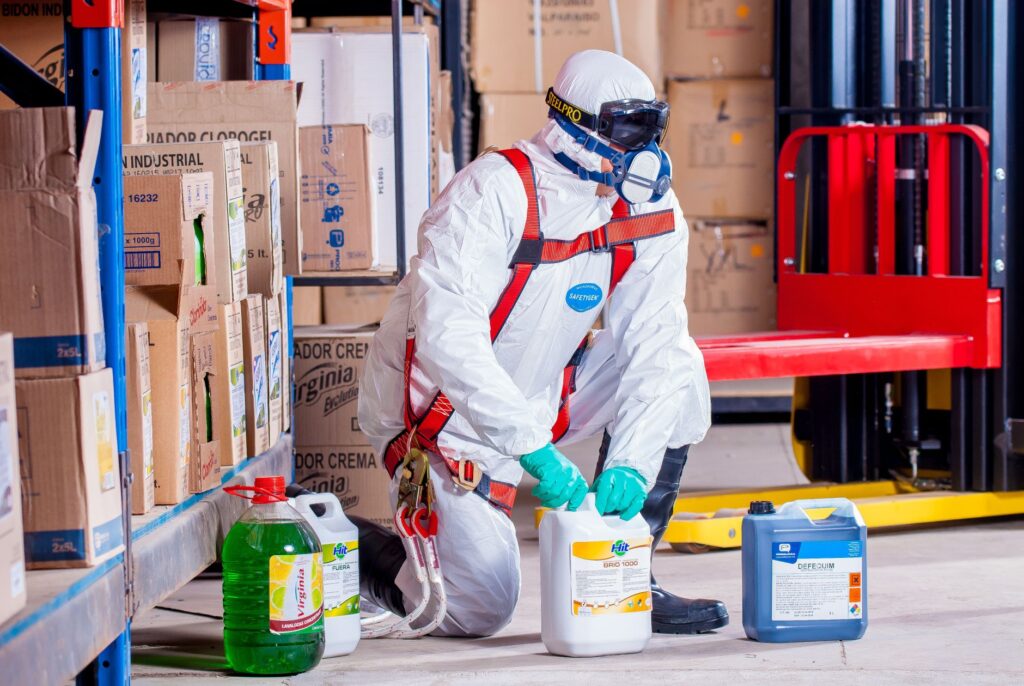
A workplace that contains acids, solvents, caustics and fuels is at risk of hazardous spills. Chemical spill kits are your first line of defence in a hazardous spill; however, if you grab the wrong chemical spill kit to use on a hazardous spill, you could be putting yourself or others at risk, or making the situation worse by creating a chemical reaction.
How do you determine the correct spill kit for your workplace? Three factors will help you determine that answer:
- The types of chemicals you use in your workplace
- The maximum amount of chemical that could be released at any one time from that chemical
- The location of the chemicals in your workplace and the location at which you will be using those chemicals
How Do I Choose A Chemical Spill Kit For My Workplace?
Chemicals are categorised by type, and each of the chemical spill kits has been colour coded based on the type of chemicals you store and use. Chemical (Hazchem) kits are yellow in colour to help you know the difference when compared to white (oil and fuel kits) and grey (general-purpose) kits.
In addition, Hazchem kits have polypropylene absorbents (pads, socks and pillows) that are chemically resistant. If your work environment is considered higher risk, you may also require a respirator; if so, ensure that the chemical spill kit you purchase contains a respirator. To ensure that you have the correct size spill kit for your expected spill, the kits are available in four different sizes – 20lt, 40lt, 120lt, and 240lt.
One last important thing to check before using any absorbents: ensure that the product you are using to absorb the chemical does not have a chemical reaction with the chemical being absorbed. For example, diatomite granules should never come into contact with hydrofluoric acid or a strong oxidiser. You cannot rely on pH alone to determine whether or not two chemicals will react with one another.
How Do You Match the Kit to the Chemical?
To use a 200-litre drum for chemical storage only provides a sufficient level of absorbing capacity if the worst-case scenario happens with regard to your chemical spillage.
When purchasing chemical spill kits, ensure they have all the correct absorbing types, such as booms and pads capable of absorbing aggressive acids, alkalis, and/or unknowns, which are very different from what a standard spill kit can absorb. Using the wrong absorbents can create heat and/or fumes or may create a completely different reaction.
Where Should Companies Keep Their Chemical Spill Kits?
Only keeping one kit near the front door of your building may not be sufficient if the chemical has leaked and is 3 rooms away from the kit. Your chemical spill kits must be located where chemicals can be spilt: Chemical Storage Areas, Decanting/Loading Zones, Laboratory, Workshop, etc.
Store your chemical spill kits, properly labelled/signposted, where they can be easily located and are easily accessible to those who may need to use them.
Inspect the contents of your chemical spill kit at least once per month to ensure they are fully stocked; otherwise, your chemical spill kit is useless. Complying with all the above requirements is also a necessity. Allowing contaminants to reach the stormwater system can result in individual fines of over $15,000.00 and huge company fines.
Summary
To protect your workers and environment, there are 3 factors which must be considered: the chemicals stored at your location, the most likely spill type and the right place to keep that chemical.
When these three conditions are met, it is likely that you will be fulfilling your statutory obligations under the WHS Act and protecting both your workers and the environment. If you would like assistance with either auditing your workplace or selecting compliant equipment, please visit Spill Station Australia for assistance.