
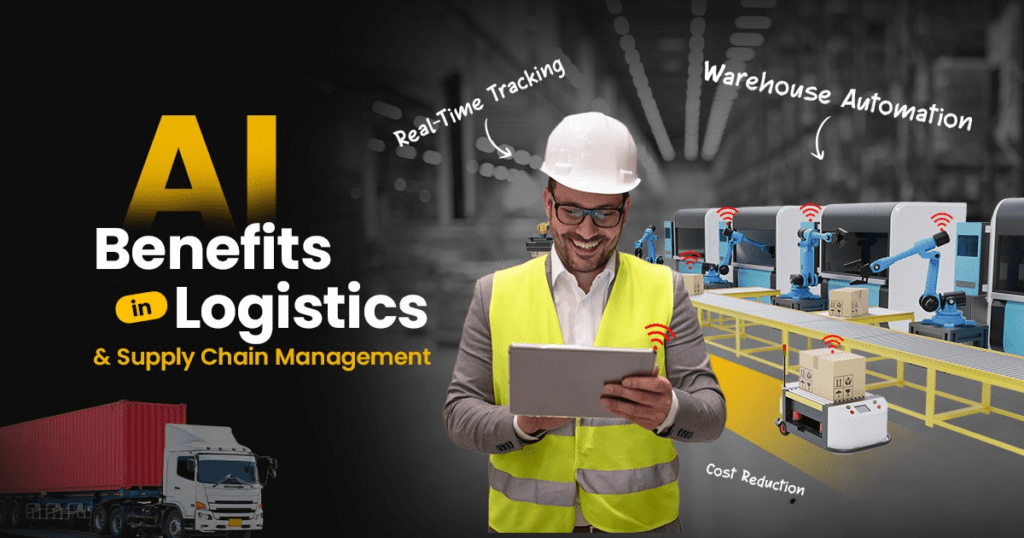
The benefits of AI in logistics are redefining how modern supply chains operate, and businesses that ignore this trend fall behind. In the logistics industry, where rising fuel costs, delays, inventory errors, and unpredictable demand often occur, Artificial Intelligence is becoming the ultimate competitive advantage. Nowadays, logistics has become increasingly complex due to the growing scale of e-commerce and global distribution systems.
So, traditional, manual practices don’t keep pace with customer demands; that’s when AI steps in. This helps optimize logistics operations, delivery routes, and decision-making to scale logistics overall. Businesses investing in advanced logistics app development are integrating AI capabilities to streamline fleet operations, automating dispatching, and also improving real-time tracking across various supply chains.
Instead of reacting to various disruptions, companies can anticipate them. From cost savings to faster deliveries, AI is transforming logistics into a data-driven ecosystem that delivers greater speed, accuracy, and scalability. In this comprehensive blog, you will get an understanding of how AI benefits logistics, its benefits in supply chain & logistics, and also how AI is becoming the future of logistics.
How AI Benefits In Logistics & Supply Chain Management?
AI is primarily used to optimize operations through data-driven insights, resulting in faster deliveries, lower costs, and greater efficiency. There are many areas where logistics enables faster, smarter workflows. The main role of AI in logistics is to generate more accurate ETA updates using both third-party and internal data, yielding better results.
According to the latest industry trends and insights, the logistics and supply chain industry has grown significantly, with an estimated increase from $34.04 billion in 2025 to $47.92 billion in 2026, reflecting a 40.8% CAGR. This indicates the growing demand for autonomous supply chain systems, real-time logistics, and expanded global supply chains. Recently, major companies have been adopting AI and supply chain systems, shifting the focus of productivity planning toward demand forecasting. Along with the AI-enabled supply chain system, AI is leveraged across various aspects of the supply chain, which also helps customer service.
Some of the Core Applications & Benefits through which AI is used in logistics and supply chain management are;
Demand Forecasting
AI analyzes historical data, trends, and buying patterns to predict future demand and reduce stockouts. This generally helps logistics operations run much more smoothly. With the use of ML & data analytics, AI-enabled demand forecasting is becoming increasingly prominent, reducing inventory costs by 30-50% and optimising warehouse and shipping capacity. Additionally, there are also greater dynamic adaptation & improved accuracy in logistics.
This approach to demand forecasting is much better and more modern than the traditional approach, which estimates future demand for products and services. By integrating AI models into logistics operations, many teams can leverage a wider range of sources, including real-time data from IoT devices, economic indicators, and weather forecasts.
Businesses that actually operate digital retail platforms are quiter increasingly combining AI-driven forecasting with eCommerce app development services to better align inventory planning, order management, and also delivery operations with the real-time customer demand and supplies. For example, one US lumber producer uses AI-powered improvements that reduce forecasting time from more than 80 hours to 15 hours, which seems very productive and impressive.
Route Optimization
Using ML & real-time data, such as traffic, water levels, and delivery windows, is one of the advantages that tend to drive logistics operations. This technological approach helps replace manual planning, minimizes fuel consumption, and enables faster delivery routes. Some of the key aspects of the route optimisation are;
Dynamic Real-Time Adaptation
The AI-enabled adaptation in route planning helps adjust routes by analysing traffic conditions, road works, and new delivery routes, thereby optimising logistics operations. Some of the key drivers of dynamic real-time adaptation are;
- Live Traffic & Incidents
- Weather Disruptions
- Driver & Vehicle Status
- Last Minute Order Changes
Predictive Analytics
Using historical data, machine learning, and AI to forecast demand, optimise routing, manage inventory, minimise costs, and improve efficiency. This is a proactive logistics approach that utilises data analytics and AI to assess potential equipment failures before they occur.
Some of the key aspects in predictive analytics in logistical operations include;
- Integration of technologies with ML & IoT Combination
- Cost Optimization
- Improved Efficiency
- Reduced Downtime
Multi-objective optimization
This is essentially in logistics, which helps minimise costs, reduce CO2 emissions, and accelerate delivery times, providing a one-stop solution for the workflow. For example, balancing economic objectives with environmental impact can reduce CO2 emissions by almost 17%, thereby enhancing sustainability.
Some of the core objectives with this approach are;
- Designing Networks
- Route Planning Process
- Green Logistics
- Reverse Logistics Process
Operational Benefits
AI is not considered a strategic layer in logistics operations, driving daily operations smoothly from warehouse floors to last-mile delivery and customer communication.
Here are the most impactful and operational benefits and applications that AI tends to create in operations.
- Warehouse Automation
- Managing Inventories
- Incorporation of Predictive Maintenance
- AI-powered Customer Support
- Enhanced Tracking & Visibility
Conclusion
AI is no longer an experimental tool in logistics, but is becoming the operational backbone of modern supply chain systems. From automating warehouse workflows to predictive maintenance to smarter inventory management, AI can improve speed, accuracy, cost efficiency, and customer satisfaction at every step.
For logistical and supply chain management operations, this transformative shift with an AI system is quite transparent, as it shifts from modern, reactive systems to predictive & automated ones. This, in turn, reduces waste, prevents disruptions, and delivers better service at higher scalability.
So, to fully unlock these benefits, businesses need scalable, smarter digital solutions built from real-time services. Partnering with an expert on-demand app development company ensures that the logistics are AI-ready, future-proof, and able to handle all the dynamic market demands, thus driving great success and productivity.