
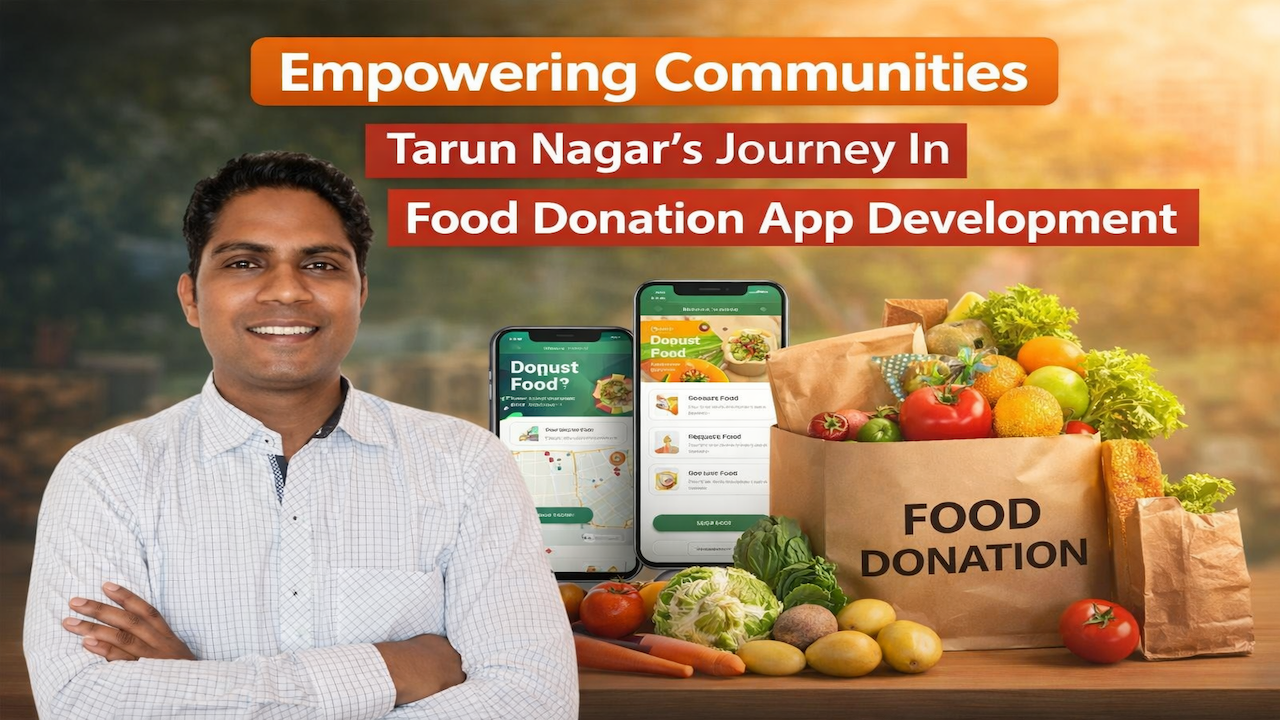
Millions of people struggle with hunger every day, while much food goes to waste. And it remains a global challenge even in today’s modern world. But in recent times, technology has emerged as a powerful tool to face this challenge. Tarun Nagar, the CEO of Dev Technosys, a leading mobile app development company, explains how they are bringing sustainable, tech-driven solutions.
Tarun Nagar understands how food donation apps are changing the way surplus food reaches those in need at the right time. Dev Technosys is dedicated to building innovation, collaboration, and scalable digital platforms. Their applications connect surplus food with those in need and ensure that excess food is redirected efficiently. In this interview, Tarun Nagar shares his perspectives on the journey of entering the food donation app development space.
Q1. Tarun, How Did Your Perspective On Community Impact Shape Your Entry Into Food Donation App Development?
Tarun Nagar:
We believe that technology must drive meaningful change to empower communities through food donation apps. During our exploration of food waste concerns, we’ve realized that accessibility is the real problem, not scarcity. In society, both surplus and demand exist at the same time. But these two have never been connected properly. This gap strongly influenced our decision to enter the food donation app development. Our goal was to create applications that help individuals and organizations contribute effortlessly beyond convenience. We aim to build a culture of responsibility, empathy, and collective action among communities.
Q2. What Unique Problem-Solving Approach Do You Apply When Designing Food Donation Platforms?
Tarun Nagar:
When we make food donation systems, we try to make things easier and deal with real-world problems. The food donation app involves a lot of different people, such as donors, recipients, and logistics suppliers, each with their own demands. So we make apps that bring all of these demands together into one system. We not only emphasize features but also focus on user journeys and practical usability. With a focus on real-life scenarios and operational efficiency, our solutions go beyond traditional apps. For instance, we ensure donors can easily list surplus food, while recipients can easily access it without facing any technical issues. To make these apps powerful tools for the community, we add smart matching and push notifications.
Q3. How Do You Balance Technology Innovation With Human-Centric Design In Your Apps?
Tarun Nagar:
The right balance between technology and a human-centric approach determines the success of food donation platforms. In our food waste management app development services, we use advanced tech like AI, blockchain, cloud computing, and more. Even though the industry is growing rapidly, most users are not highly tech-savvy. By keeping that in mind, we design apps that are simple and easy to use. We focus on an engaging interface and seamless navigation. Just with the perfect mix, we ensure that users can donate food to needy people.
Q4. What Strategies Help Increase Participation From Local Communities?
Tarun Nagar:
To increase participation from local communities, we focus on building trust and awareness among the users. Food donation apps that are highly intuitive and have lower barriers often attract more users. With tools like real-time notifications and tracking, users can see how their contributions make a difference. Working with NGOs and local groups is one of the finest methods to get people to join in. We can reach a lot more people and get more people involved in the food donation movement through educational programs and awareness efforts.
Q5. How Do Your Platforms Adapt To Different Regional Needs And Challenges?
Tarun Nagar:
Our food donation platforms effectively adapt to unique regional challenges. From social infrastructure limitations to cultural practices, each region has its own set of challenges. With highly customizable and flexible solutions, we seamlessly cater to every local requirement. Addressing primary challenges requires us to work with stakeholders and study the current ecosystem. We ensure our solutions can drive meaningful impact and change across communities.
Q6. What Role Does Data Play In Improving The Efficiency Of Food Donation Systems?
Tarun Nagar:
Data plays a critical role in the food donation industry. By analyzing patterns in surplus and demand, we build applications that can optimize food distribution. Valuable insights and data help us to identify peak times for surplus and areas with higher demand. We can better plan how to use our resources with predictive analytics. Data lets you take proactive steps to make operations more efficient and cut down on food waste. Data-driven decision-making makes sure that the platforms we make are more useful and in line with real-world difficulties by anticipating needs.
Q7. How Do You Build Trust Among Users On Food Donation Platforms?
Tarun Nagar:
For a successful food donation app, trust is the foundation. Adding a strong verification system to the app is our main way of developing confidence with users. Another crucial technique to build trust is to be honest and upfront. So we give both donors and recipients tools to assist them in keeping track of their donations and how they help the community. We do things like evaluate the quality and maintain track of expiration dates to make sure the platform is safe for food. We create trusted platforms where users feel safe and comfortable contributing by focusing on a reliable, safe environment.
Q8. What Innovations Are You Currently Exploring In Food Donation Technology?
Tarun Nagar:
Today, in the food donation sector, there are many emerging and trending innovations. The use of AI and ML in these platforms has made this journey even more exciting and innovative. To track the food conditions in transit, we’re also exploring LoT-based solutions. Real-time analytics provides actionable insights to users by studying demand patterns. As a top food donation app development company, we are at the forefront of technological advancement. With all these innovations, we develop future-ready apps that drive long-term change.
Q9. How Do You Measure The Success Of Your Food Donation Apps?
Tarun Nagar:
The success of any food donation platform is measured by the real-world impact. The success of our platforms is measured by evaluating the volume of food redistributed, the number of active users, and the reduction in food waste. User satisfaction and engagement are other key metrics to check the platform’s usability. Moreover, we study and assess how well our applications support community organizations in achieving their goals. To understand our impact, we use both quantitative and qualitative metrics. For us, the success of the platform means delivering real value to communities.
Q10. What Long-Term Vision Drives Your Work In This Domain?
Tarun Nagar:
When we think about the future, we want to make sure that food waste is as low as possible. We want to make food donation apps that help build a long-term system instead of merely solving problems right away. We use cutting-edge technology, work together across industries, and reach out to more people to do this. We hope that giving food to those in need will become common. We want to develop a global food system that is fairer and long-lasting, with reliable digital infrastructure to support it.
Q11. How Important Is Scalability When Building Food Donation Platforms?
Tarun Nagar:
The app needs to be able to manage a lot of activity from a lot of users as it grows and gets more users. This illustrates that being able to grow is very important when making a food donation app. We build the app on scalable architectures so that it can manage more users and data without slowing down. Scalable apps let us bring our solutions to new areas and communities, which cuts down on food waste. By putting scalability first, we make sure that the platforms stay stable and useful during busy times and can grow and make a difference over time.
Q12. How Do You Ensure Long-Term User Engagement On Food Donation Platforms?
Tarun Nagar:
Long-term user engagement depends on value, trust, and constant development. We want to make the platform fun and interesting so that people want to keep using it. Donors may plainly understand how their gifts have helped thanks to real-time updates and a history of their donations. Our team continually gets feedback to make the app better so that users feel more engaged in the cause. Through shared goals and collaborations, we build a sense of community to encourage repeat participation. We keep the food donation platform user-focused, dynamic, and transparent for long-term user engagement.
Q13. What Role Does Awareness And Education Play In Scaling Food Donation Initiatives?
Tarun Nagar:
For scaling food donation initiatives, awareness campaigns and public education play a major role. Most individuals fail to adopt a food donation app as they lack proper knowledge and guidance. Awareness campaigns help people understand the importance of reducing food wastage. While the educational efforts encourage them to participate in food donation programs across different communities. We build platforms that help users to follow best practices to reduce food wastage. It is important that the audience is aware of the various benefits of food donation. This will motivate more users to participate and contribute to the right cause.