
Ask anyone who has ever manned a bank’s phone line on a Monday morning. It’s brutal. People calling about balances, lost cards, loan status, branch hours. The same list on repeat.
Staff get buried fast, hold times creep up, and somewhere in that mess, a customer hangs up annoyed and doesn’t call back.
That’s the problem more banks and credit unions are trying to solve with automation right now. But many tools on the market weren’t built for banking at all. They started life as chatbots for pizza orders or retail returns, then got a new coat of paint and got sold into finance.
Picking the right AI voice agent for your financial institution means looking past the flashy demo and asking harder questions about how the thing actually behaves once real customers start calling.
This piece goes through what matters when you’re comparing options, so you don’t end up stuck with a system that looks great in the sales pitch but falls apart on the first busy Friday.
Why Does Your Financial Institution Need an AI Voice Agent?
Most calls into a bank’s support line aren’t complicated. Balance checks. Card activation. Fraud alerts. What time does the branch close on Saturday? They don’t need a human brain behind it. It just needs quick and correct information delivered without a 20-minute wait.
A purpose-built AI voice agent for financial institutions picks up those routine calls any hour, any day, no hold music required. That leaves your staff for the calls that need patience and judgment: a disputed charge, a hardship request, something with weight to it.
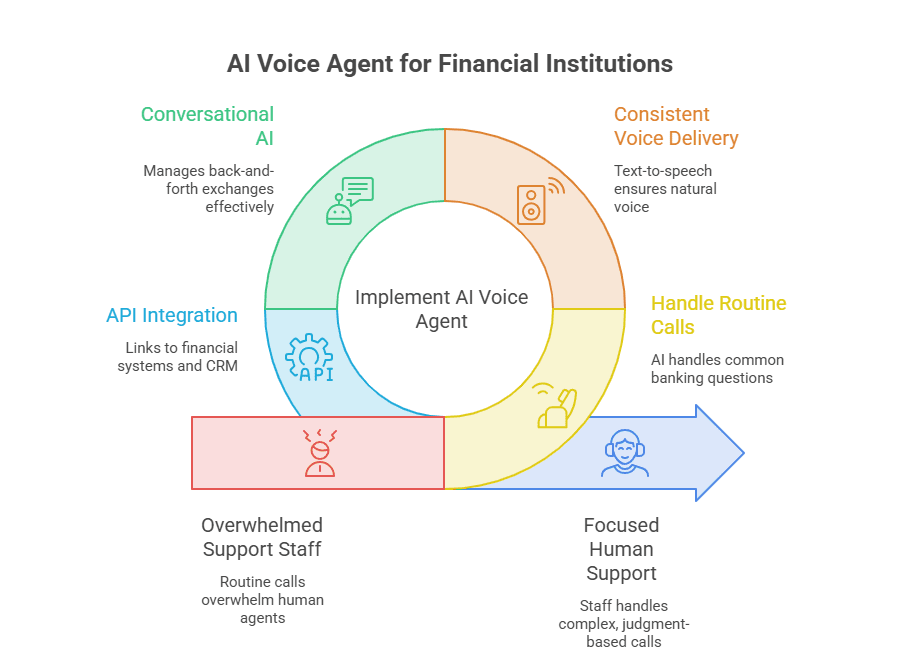
This is where broader AI voice platforms come in. Tools like the Murf voice agent sit inside a wider platform and provide capabilities such as:
- Natural-sounding and consistent voice for every call through text-to-speech
- AI speech bots that handle common banking questions without human assistance
- Conversational AI that manages back-and-forth exchanges, interruptions, and follow-up inquiries
- Voice APIs that connect your current call infrastructure, key financial systems, and CRM
Used together, these capabilities take the routine load off the queue so human reps can focus on the calls that need a human at the other end.
Some of the reasons this shift is moving so fast are:
- Wait times drop, especially on Mondays and around month-end
- Staffing costs go down without cutting hours of coverage
- Support works at 2 a.m. just as it works at 2 p.m.
- Answers stay consistent because the system doesn’t have a bad day
- Human agents spend their time where it counts
The benefits don’t appear automatically, though. Once you sit down and begin evaluating vendors side by side, the real job begins.
Key Factors to Consider When Choosing an AI Voice Agent
Banking rules are strict and for good reason. A voice tool built without those rules in mind will cause trouble eventually, usually at the worst time.
Here’s what deserves your attention before you sign anything.
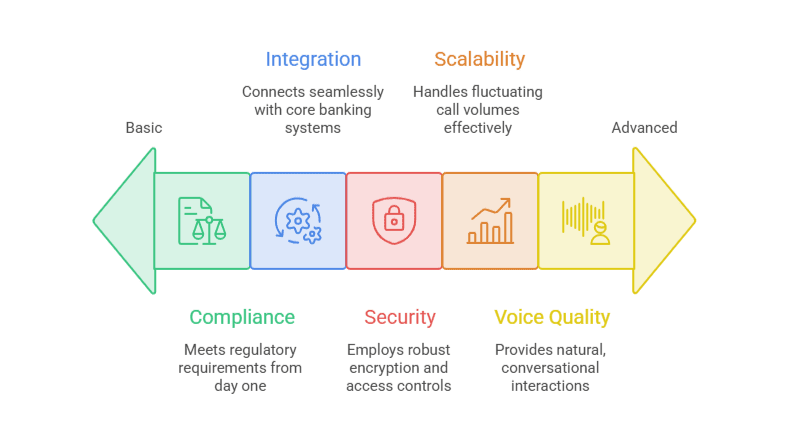
1. Compliance and Regulatory Readiness
This is where most generic voice bots tend to hit their limits.
A real AI voice agent for financial institutions has to work inside data privacy laws, recording disclosure rules, KYC requirements, and audit expectations from day one. It should not be tacked on afterward because a regulator asked.
If you want a deeper look at how automation fits into a compliance program more broadly, this piece on how AI knowledge management helps financial firms stay compliant is worth a read.
Questions to pose directly to a vendor:
- Does the platform have ISO 27001 or SOC 2 certification?
- Does it handle call recording consent the way state and federal law requires?
- Can it connect with the fraud detection setup you already have?
- Does it keep logs detailed enough for your compliance team to hand over during an audit?
Vague answers here should worry you. Push until you get a straight one.
2. Voice Quality and Natural Conversation Flow
When people are speaking to something stiff and rehearsed, they quickly figure it out. When a caller interrupts or veers off subject, a superior AI voice assistant for financial institutions should sound like a genuine person, recognize various accents, and recover without faltering.
On this, don’t rely just on the sales team. Call the demo line yourself. Cut it off mid-sentence. Throw something odd at it. See what happens, because your customers will do that on day one.
3. Security Architecture
Financial data draws attackers, plain and simple. Your AI voice agent for financial institutions needs encryption both at rest and in transit, tight access controls, and a clear answer on how long data sticks around before it’s deleted.
Ask where the data lives and who’s allowed near it. The stakes are real: the average data breach in financial services now costs $6.29 million, the second-highest cost among all industries tracked.
4. Scalability
Call volume spikes without warning. Tax season, a fraud scare, a system outage somewhere else in the bank, and suddenly your call line is swamped.
You’ll discover when you can least afford it that a technology that can manage 500 calls per day but chokes at 5,000 isn’t prepared for an expanding organization.
5. Integration With Core Banking Systems
A voice agent that can’t reach your core banking platform, CRM, or loan system isn’t much more than a glorified answering machine. It has to pull live account data securely, not just read out a canned FAQ page.
What to look for:
- Ready-made connectors for the core banking platforms you already run
- Open API access for anything custom
- Data that syncs in real time, not information sitting a day old
How Do Different Deployment Approaches Compare?
Every institution brings a different mix of budget, size, and internal IT muscle to the table.
Here’s how the common deployment models stack up against each other.
| Deployment Model | Best Suited For | Typical Setup Time | Extent of IT Involvement |
| Fully Managed (Vendor-Hosted) | Small to mid-size banks and credit unions | 2 to 4 weeks | Low |
| Hybrid (Vendor + In-House Integration) | Mid-size to large institutions with existing infrastructure | 6 to 10 weeks | Moderate |
| Fully Custom (Built In-House) | Large banks with dedicated AI/dev teams | 4 to 6 months | High |
Most community banks and credit unions land on the fully managed or hybrid route. It gets them up and running fast without needing to hire a whole engineering team.
For a broader look at what else is out there beyond voice, this roundup of the best AI tools for finance and banking teams in 2026 covers the wider landscape.
What Questions Should You Ask Every AI Voice Agent Vendor?
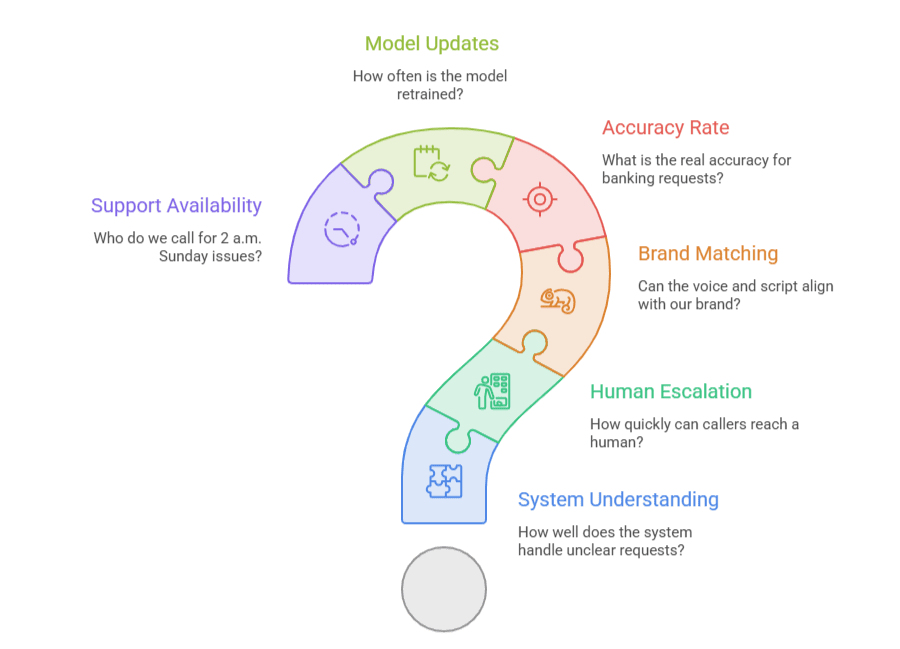
Sit down with your shortlist before signing anything, and don’t stop at the pitch deck. Ask the following questions:
- What happens when the system doesn’t understand what a caller is asking?
- How fast can someone reach a human if they ask for one?
- Can the voice and script match our brand, or are they locked into one flat tone?
- What’s the real accuracy rate on banking-specific requests?
- How often does the model behind it get retrained or updated?
- Who do we call if this breaks at 2 a.m. on a Sunday?
A vendor worth working with will answer these with real numbers and real examples.
Cost Considerations
Pricing in this space is all over the place, and hidden fees catch a lot of institutions off guard. Some vendors bill by the minute of talk time. Others charge a flat monthly rate tied to call volume tiers. And some tack on extra charges once you need integrations or custom voice training.
Here’s a simple way to compare the pricing structures you’ll run into.
| Pricing Model | How It Works | Good For |
| Per-Minute Billing | Pay based on total call minutes handled | Institutions with unpredictable call volume |
| Flat Monthly Tier | Fixed price for a set number of calls or minutes | Institutions that want predictable budgeting |
| Custom Enterprise Contract | Negotiated pricing based on scale and features | Large banks with complex multi-branch needs |
Don’t stop at the sticker price. The initial quotation you receive does not account for setup costs, integration work, or staff training time.
Common Mistakes You Should Avoid
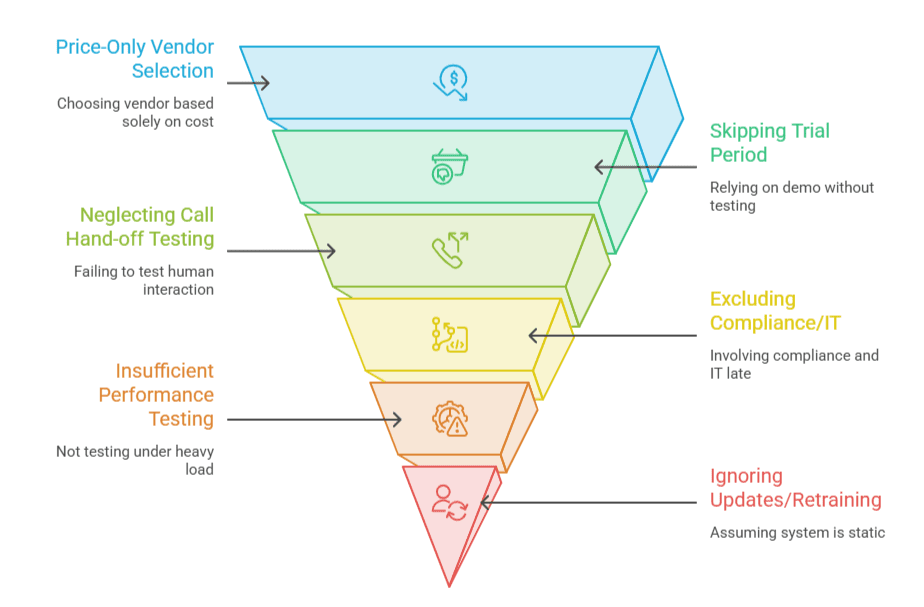
During deployment, even well-meaning teams run into the same few problems:
- Picking a vendor on price alone and skipping the compliance check entirely
- Skipping the trial period because the demo looked polished enough already
- Never testing how the system hands a call off to a human
- Leaving compliance and IT out of the process until it’s already too late to fix
- Not testing performance under real heavy call volume
- Assuming the system won’t need updates or retraining down the line
Cutting corners on any of this will cost you more later in lost customer trust and in compliance headaches.
Make the Right Choice for AI Voice Agent
Choosing the right AI voice agent for your financial institution isn’t only a technology decision. Your clients’ level of trust in the person at the other end of the phone ultimately determines the outcome. If you do it correctly, wait times and costs will go down, and your compliance team will sleep better. You will have to deal with complaints for months if you make a mistake.
Spend some time thoroughly testing it before committing to anything long-term. Ask the questions that cause you some discomfort. And remember that the best AI voice agent is built to handle your institution’s size, systems, and customers.
A careful rollout now saves a lot of cleanup later, and it sets your institution up for service that’s faster and steadier for years down the road.
Ready to find the AI voice agent that fits your institution? Visit smartmoneymatch.com and compare options built for banks and credit unions.