
Microservices architecture lets teams add new features more quickly, scale up or down as needed, and change swiftly to meet business demands. However, this flexibility makes testing more difficult. Every microservice has its own rules, dependencies, and ways of communicating with other microservices. If testing can’t keep up with fast releases, bugs go into production.
The solution is not just manual testing. It is an API and Microservices test automation designed to validate services without slowing Agile delivery.
Why Microservices Require a Different Testing Approach
Traditional apps work as one unit, while microservices work together as a network of separate services that communicate via APIs. You can install, update, or grow each service on its own.
This independence speeds up the release process, but it also raises risks like service downtime, data inconsistencies, and complex debugging. A small modification in a single service can impact several downstream services. If teams don’t test things properly, they might not find problems until users have issues.
Microservices testing is all about making sure that services work as they should, that API contracts are followed, and that systems work together. It makes sure that each item performs well on its own and as part of the whole system.
How Poor Testing Slows Agile Delivery
Many teams assume testing slows development. In reality, poor testing strategies create delays. Some common problems are:
- Manual testing cannot keep up with frequent releases
- Lack of visibility into service dependencies
- Repeated regression testing consumes time
These problems create bottlenecks.
- Developers wait for validation.
- Releases get delayed.
- Production defects increase.
Automated microservice testing eliminates these problems by checking changes immediately.
What Is API and Microservices Test Automation
API and microservices test automation uses tools and scripts to automatically validate service functionality, performance, and reliability. Tests run continuously during development and deployment.
Automated tests verify:
- API request and response accuracy
- Service logic and data processing
- Communication between microservices
- Error handling and edge cases
- Security and access controls
This ensures defects are detected early, when they are easier and cheaper to fix.
Where Microservices Testing Fits in Agile and CI/CD
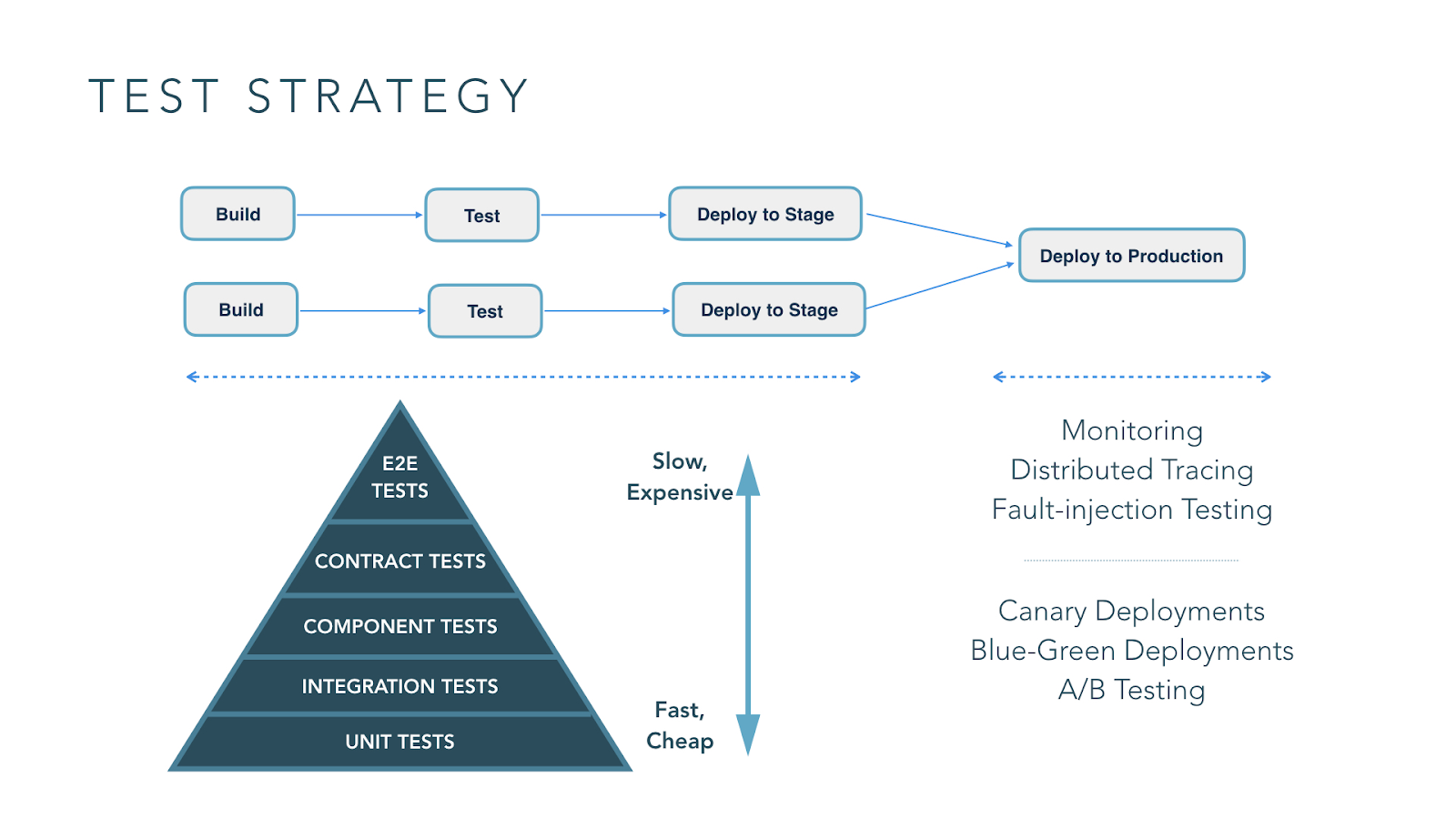
Microservices testing works best when integrated into the CI/CD pipeline. Every code change triggers automated tests.
A typical automated testing flow includes:
- Unit testing: Validates individual functions within a microservice.
- API testing: Ensures endpoints return correct responses and follow expected contracts.
- Integration testing: Confirms microservices communicate correctly with other services.
- Regression testing: Ensures new changes do not break existing functionality.
- Performance testing: Validates services under realistic workloads.
This continuous validation ensures that each release is reliable without slowing development.
Best Practices to Test Microservices Without Delays
1. Prioritize API-Level Testing
API testing is more reliable and faster than UI testing. It checks that the main features work without using user interfaces.
This helps teams find problems early and reduces testing time.
2. Automate Tests as Part of CI/CD
Every time you build something, automated tests should run. This ensures immediate feedback, and developers may address problems before products go into production, which saves time later.
3. Use Service Virtualization
Microservices often rely on external systems. During testing, certain systems might not always be available.
Service virtualization makes these dependencies look real. This lets testing proceed without waiting for external services.
4. Focus on Contract Testing
Contract testing ensures that APIs meet the compliance to communicate with each other.
This stops integration problems when services change on their own.
5. Run Parallel Tests
Automated testing can run at the same time on more than one service.
This reduces the time it takes to test everything and speeds up the release cycle.
6. Continuously Monitor Microservices
After deployment, testing should not stop. Continuous monitoring finds problems in production environments.
This ensures long-term reliability and performance.
Tools Commonly Used for Microservices Test Automation
Several tools support automated microservices testing:
- Postman for API functional testing
- Rest Assured for automated API validation
- JUnit and TestNG for unit and integration testing
- WireMock for service virtualization
- JMeter for performance testing
These tools integrate easily with CI/CD pipelines and support continuous validation.
Benefits of Automated Microservices Testing in Agile
Automated testing makes things better in ways that can be measured:
Faster releases
Automation speeds up validation and gets rid of manual bottlenecks.
Higher software quality
Continuous testing finds problems early and lowers the number of production failures.
Improved scalability
Validated services can grow without any problems.
Reduced operational risk
Early identification stops failures from spreading to other systems.
Greater developer productivity
Developers spend less time fixing bugs and more time adding new features.
These benefits directly complement Agile concepts of speed, dependability, and constant development.
Common Mistakes to Avoid
Avoid these common pitfalls when testing microservices:
- Relying too heavily on manual testing
- Testing only at the UI level
- Ignoring integration and contract testing
- Delaying testing until late in the release cycle
- Not integrating testing into CI/CD pipelines
These mistakes reduce efficiency and increase risk.
How API Testing Services Support Agile Microservices Testing
To test microservices on a large scale, you need unique skills, tools, and automation frameworks. A lot of businesses use expert API Testing Services to speed up adoption and get more coverage.
These services are useful for teams:
- Implement automated testing frameworks
- Integrate testing into CI/CD pipelines
- Improve API reliability and performance
- Reduce testing time and manual effort
- Ensure scalability and system stability
This lets teams focus on generating new ideas while maintaining high standards.
Conclusion
Microservices make it easier to come up with new ideas, but only if testing keeps up with development. Manual testing can’t keep up with modern Agile setups.
API and microservices test automation ensures everything is always tested, releases happen faster, and performance stays high without slowing down delivery. It finds problems early, lowers risk, and works with digital platforms that can grow.
Companies that want to improve their microservices testing strategy generally use API Testing Services that specialize in this area. If you’re looking for API testing Service, you can reach out to TestingXperts. With the correct tools, automation, and knowledge, they can help your teams optimize their platform without losing speed, quality, or confidence.