
Machine learning has completely left behind its academic labs and techie circles days. It has established itself in the finance sector, which is one of the most conservative industries. However, it did not do so in a spectacular way. It silently came and took consent by data, automation, and an insatiable thirst for accuracy and speed.
Currently, the machine learning technology is so deeply rooted in the financial technology industries that, without it, many modern financial goods would be considered defective products. From loan acceptance in seconds to conducting fraud checks invisibly in the background of all transactions, machine learning has become the unseen force making digital finance secure, productive, and expanding.
Let us scrutinize the transformation of fintech with machine learning and the reason why this technology is more than a trend; it is the very foundation of the forthcoming era of finance.
Why Machine Learning Matters in Fintech
The finance industry is all about two major factors: risks and information. The one who judges risks more accurately will be the winner. The one who operates on information quickly will be the winner of larger amounts.
Artificial Intelligence has great potential in both areas.
The old financial systems are based on rigid rules. For every event, there is a corresponding action to be taken. Such a framework will work until the moment when it does not. Criminals will find a way around it. The market will change its behavior. Customers will want new things. The rule-based systems will be left behind in the fast-running change.
Machine learning, however, is a great partner for change. The more input it gets, the better it becomes. It detects out of the box what is going on. The system switches to a new behavior without necessitating a complete overhaul of the system. And it does all of this at a level that is way beyond human capability.
It is that financial technology, an industry that is all about data, patterns, and rapid decisions, has become the playground for machine learning innovation through the coming of AI.
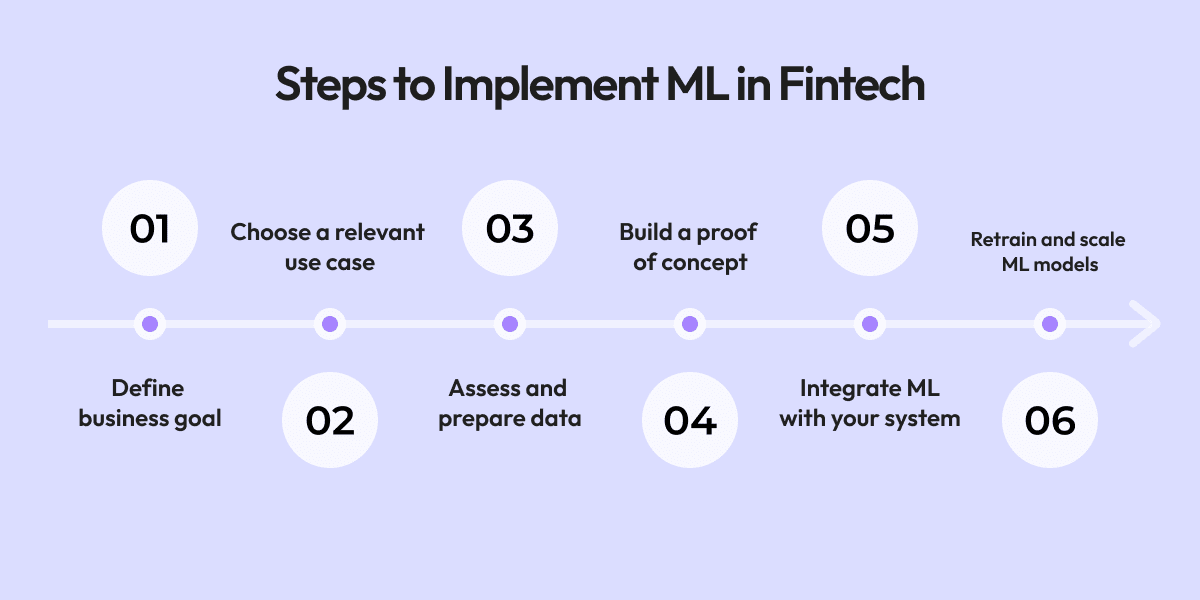
Customer Onboarding That Feels Instant
Ten years back, the process of opening an account via the internet involved going through a lot of steps, having to verify one’s identity multiple times, making phone calls, and being put on a waiting list. Now, when you decide to develop a mobile banking application for your clients, the whole procedure is commonly done in a few minutes.
Machine learning, surprisingly, is taking a considerable part of the burden on its shoulders.
When a person sends a picture of their ID or their passport, machine learning models are at work—they extract the text, authenticate it, and even take a likeness of it with the previously saved templates. In addition, the face-matching systems come in to verify whether the one taking the selfie is indeed the person in the document. The behavioral models, on the other hand, are there to find out if a human is operating the interface or if a bot is just trying its luck.
The different models are employed by fintech firms to facilitate the signing up of new clients. The more user-friendly the procedure, the greater the conversion rate—and the safer the site will be.
Moreover, the latest fintech applications are capable of even predicting with reasonable accuracy that a user is likely to quit during the onboarding process and will thus be able to automatically adjust the process by cutting out the unnecessary steps for the users who are already predicted to be drop-offs.
To put it in another way, machine learning is the main player when it comes to the impossibility of having such seamless onboarding.
Fraud Prevention That Works Faster Than Fraudsters
Fraud is a never-ending battle in finance that is like a cat-and-mouse game. Criminals always come up with new tricks, while traditional fraud systems that rely on fixed rules are sometimes too slow to respond. However, machine learning (ML) dramatically changes the scenario completely.
While humans will see a little anomaly here and there, ML models find these as tiny misses since the ML models scrutinize patterns of millions of transactions. A card that has been used in London and then just two minutes later in Mexico is an easy case to solve. But what about a user who purchases a digital service in a new app at a slightly odd time, from a device that has been used only twice, while being in a different city, and is using a card that is rarely used online?
That’s where machine learning demonstrates its superiority. It calculates a risk score for every single transaction by taking into consideration hundreds of factors. The whole operation is completed in milliseconds. That’s the reason why users do not notice the security checks while transactions feel instant.
Fintech companies are gradually upgrading these systems by using:
- Behavioral analytics: Users’ typing, tapping, or moving their device style
- Device fingerprinting: Hardware and software unique signatures
- Geolocation patterns: Comparing usual travel behavior with abnormal movement
- Merchant categorization: Matching user history with merchant profiles
- Network analysis: Uncovering connections between fraudulent accounts
Machine learning can differentiate between unusual and dangerous, a task that still confounds traditional systems that are based on rules and regulations.
Risk Management That Sees Around Corners
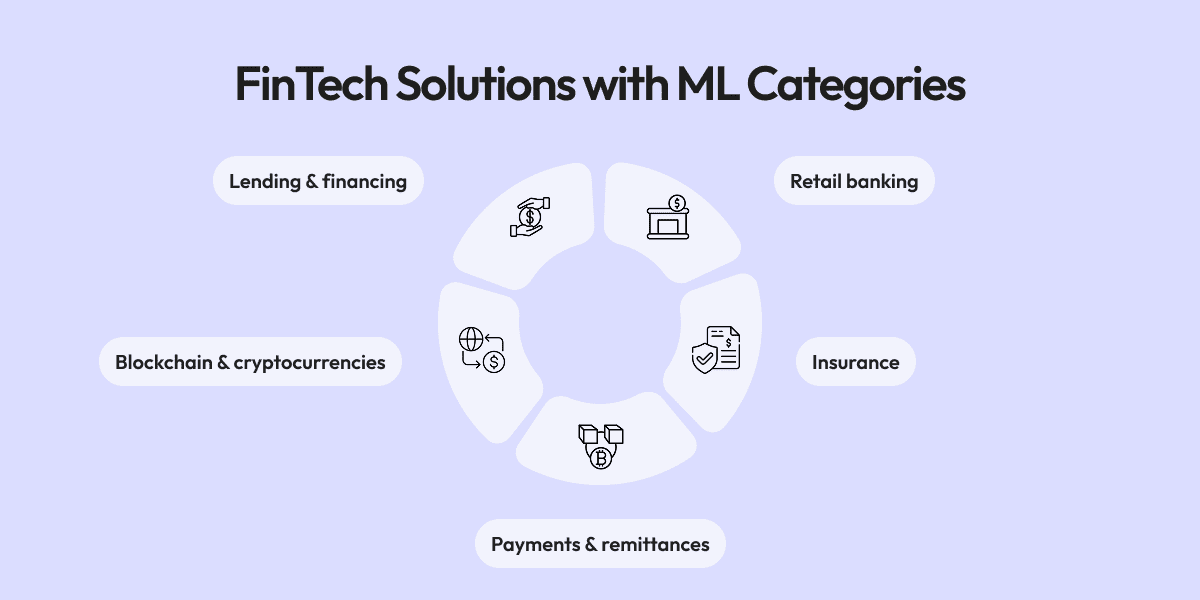
ML in lending finds out the likelihood of default, together with the most appropriate loan amount and repayment plan. In the case of insurance, ML works on the claim probability and adjusts pricing accordingly. In the area of wealth management, ML predicts fluctuations in the market and consequently changes the strategies automatically.
Fintech companies are utilizing these predictive powers in order to mitigate risk and not pursue it. Consequently, there are fewer losses, more intelligent decisions, and increased user trust.
Final Thoughts
Machine learning has had a silent impact on fintech, but it has been one of the most important factors. It is essentially behind the curtain, playing all the main roles like onboarding, fraud detection, trading, credit scoring, and customer support. A majority of these operations are not noticed by the customers as they happen behind the scenes, but they are very important in maintaining the flow and safety of the financial systems.
The advancement of technology is allowing fintech companies to come up with more intelligent, more secure, and more user-friendly financial products. People who never got the chance to experience the traditional financial systems are now being offered new ways to get involved. Finance decisions are taken almost instantly. Risk management becomes less difficult. And the market as a whole is more flexible and creative.
Machine learning is not a thing of the future for fintech; it is the present, and it keeps changing daily.
Author’s bio
Yuliya Melnik is a technical writer at Cleveroad, a web and mobile application development company. She is passionate about innovative technologies that make the world a better place and loves creating content that evokes vivid emotions.