
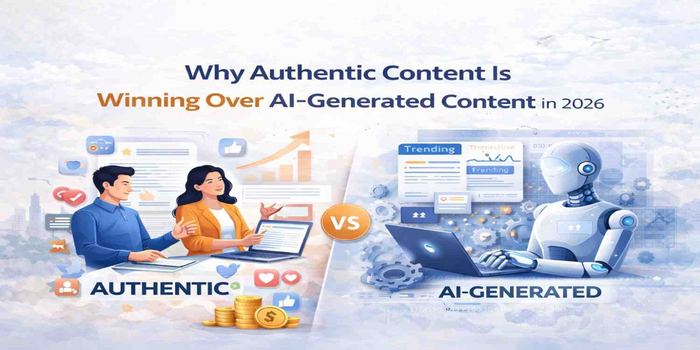
Content isn’t just about producing more but about connecting more. Artificial intelligence has made content creation faster and cheaper, but also flooded the internet with generic, repetitive material.
Studies indicate that trust in AI-generated content is moderate (approx. 3.0–3.17 out of 5), while human-created content consistently garners higher trust ratings (approx. 4.5).
Authentic, human-driven content is outperforming AI-generated content across platforms. So, what’s really going on?
Why are audiences gravitating back toward content that feels personal and imperfect, whereas the perfectly done AI content is just a click away?
Let’s explore.
Rise of AI Content and Its Limitations
In 2026, AI can create unlimited content within a matter of seconds. Tools are now able to produce correctly-structured, grammatically accurate, and SEO-optimized content in a matter of minutes. For companies, this is speed, scalability and cost-efficiency.
But here’s the catch.
Most of the AI-generated content, though it is flawless from a technical point of view, frequently falls short:
- Original perspective
- Real-life experience
- Emotional depth
- A distinct voice
Over time, readers have started to notice this pattern. When everything sounds polished but similar, content begins to feel repetitive and forgettable. It might look professional at first, but it lacks in building connections.
Authenticity Builds Trust (And Trust Drives Engagement)
Authentic content does not mean unprofessional or unplanned. It means letting your real personality, values, and people show through, rather than hiding back. The human brain craves connections that generic or AI content systematically eliminates.
Content that sparks real conversations, makes them stay, and initiates deeper interaction will definitely get a higher ranking than superficial posts. Audiences in 2026 are good at identifying content based on human experience vs. content produced from data patterns alone.
Authentic content stands out because:
- Shares real insights instead of generic advice
- Reflects a unique voice or opinion
- Connects emotionally with the reader’s problem
People not only check out for information but also look for those who understand them, their problems, and what they are really after.
Stories of businesses sharing the path they have taken, marketers telling their challenges, and creators airing their true thoughts are cases when authenticity sets the foundation for trust. Trust will eventually produce high engagement, retention, and brand loyalty.
Why “Real” Is Replacing “Perfect” in 2026
For years, the field of content marketing was focused on perfection: perfect structure, grammar, and optimization of keywords.
But today, audiences prefer:
- Real motivational and success stories
- Honest opinions over safe statements
- Human tone rather than the robotic one
Being real matters more than being perfect. It doesn’t mean quality doesn’t matter. Quality does matter, but writing yourself transforms how people respond to your content. This is considered a strong content strategy that works across social media, email, and your website. Human specialists offer a great level of knowledge and capability that mere technology cannot compensate for.
Quite strangely, the tiniest flaws in content make it even more human and so, more trustworthy.
Experience Is the New Differentiator
One of the biggest gaps that AI cannot fully bridge is lived experience.
AI can summarize what’s already known. But it cannot:
- Share personal failures
- Talk about real client challenges
- Offer insights based on hands-on work.
This is where individuals and businesses have a powerful advantage. No AI can replicate your brand’s specific vibe. A brand built on real connection survives the ever-changing tides of the Google algorithm updates.
In 2026, authenticity will outperform automation because it’s the one thing automation cannot scale.
From our point of view, working with growing brands, content featuring genuine observations, lessons, and practical insights is constantly outperforming content that simply repeats widely available information.
Why Businesses Are Re-Evaluating Their Content Strategy
Many businesses initially embraced AI content for speed and scale. But as competition is increasing, so is the volume of similar-looking content online. One original post surrounded by content will not change perceptions, but regular glimpses of the real you build familiarity over time. People start to feel like they know you even before connecting with you.
Now, the focus is shifted towards:
- Differentiation
- Brand voice
- Thought leadership
Instead of asking “How fast can we create content?”, the better question in 2026 is “How meaningful and original is our content?”
With millions of content published every day, standing out requires differentiation. AI-generated content simply blends in with the noise; however, the real one manages to draw attention.
Companies that mix AI’s productivity with humans’ artistic talents are the ones getting the best outcomes.
The Role of AI: Assistant, Not Replacement
It’s not about deciding between AI and human-based skills; instead, it is about mixing both. This doesn’t mean AI has no place in content creation, but it absolutely does.
AI works best when used to:
- Generate leads
- Structure drafts
- Improve efficiency
But the final layer, the one that truly matters, comes from humans.
Which includes:
- Personal insights
- Brand tone
- Emotional connection
- Strategic thinking
The winning formula isn’t AI vs human but AI+human authenticity.
A Human-First Approach to Content
Authenticity is no longer optional but essential as content continues to evolve.
Writers, marketers, and businesses that focus on:
- Being genuine
- Sharing real value
- Speaking directly to their audience
will continue to be distinctive in an increasingly automated environment.
Content isn’t just about words on screen but about how those words make people feel.
Conclusion
AI might be influencing the next generation of content creation, and authenticity is determining the way content is viewed. In a world full of generated content, being real is your biggest competitive advantage.
In 2026, brand and creators who win won’t be the ones producing the most content, but they’re the ones creating the most real content.
This is something no algorithm can fully replicate.
Watch how your audience responds when you show up as yourself, not as a content template.