
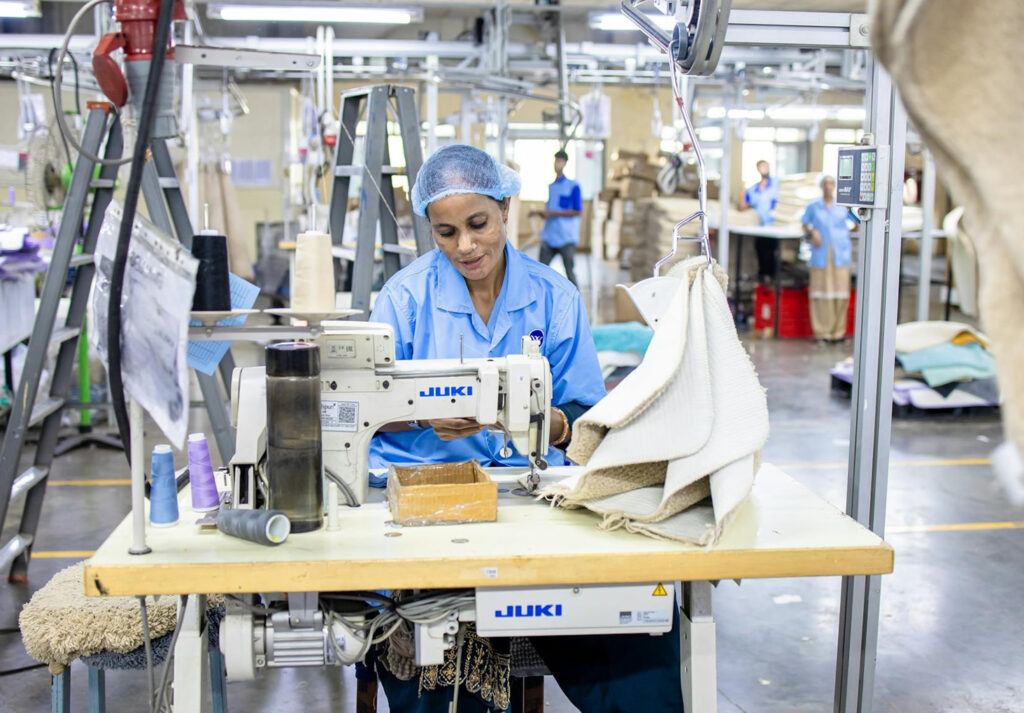
When people think about modern manufacturing, they often picture robots, lasers, and 3D printers. Rarely does a sewing machine come to mind. Yet industrial sewing remains one of the most widely used and quietly indispensable production technologies in the world. Wherever flexible materials need to be joined reliably, repeatedly, and at scale, industrial sewing machines are doing the work.
Far from being old-fashioned, today’s industrial sewing operations are highly engineered. They combine powerful machines, specialist tooling, digital control, and material science to produce everything from medical devices and vehicle interiors to safety equipment and industrial infrastructure. In many cases, sewing is not just a convenient method—it is the most effective one.
Industrial sewing: more than fabric and thread
An industrial sewing machine is designed for production environments where speed, consistency, and durability are non-negotiable. Unlike domestic machines, industrial models are built to run continuously, often for multiple shifts per day, while maintaining stitch accuracy and seam strength.
Modern industrial sewing systems typically feature:
- High-torque motors for thick or layered materials
- Precise feed mechanisms to control material movement
- Programmable stitch lengths and patterns
- Automated functions such as thread trimming, back-tacking, and tension control
- Compatibility with specialist needles and high-performance threads
These machines are not limited to lightweight textiles. They routinely sew leather, coated fabrics, technical laminates, webbing, foams, and multi-layer assemblies that would be impossible for consumer-grade equipment.
Specialist industrial sewing machine companies such as Atlanta Attachment Co. list countless sewing machine attachments on their websites, and this gives an idea of the wide range of applications the machines are used for and the almost unlimited range of products that they help to produce.
Products shaped by industrial sewing
The influence of industrial sewing extends far beyond clothing. It underpins entire sectors of modern production.
Apparel and performance wear
From everyday garments to specialist workwear and sports clothing, sewing is central to apparel manufacturing. Stretch seams, reinforced stress points, decorative stitching, and functional construction all rely on industrial machines. Even as automation increases, sewing remains essential because fabric is flexible and variable, making it difficult to fully mechanize.
Footwear manufacturing
Shoes combine curved shapes, mixed materials, and high-wear zones. Industrial sewing is used to assemble uppers, attach reinforcements, sew linings, and create structural seams that must withstand constant movement and load. In premium footwear, especially, stitching plays a critical role in durability and fit.
Furniture and upholstery
Soft furnishings depend on sewing to shape, reinforce, and finish upholstered products. Sofas, chairs, automotive seating, and office furniture all rely on strong seams that can handle repeated stress while maintaining appearance and comfort over time.
Automotive and transport interiors
Vehicles contain a surprising number of sewn components. Seat covers, steering wheel wraps, interior trim, safety restraints, and protective panels are commonly stitched. In many cases, these seams are safety-critical and must meet strict regulatory and quality standards.
Medical and healthcare textiles
Industrial sewing is vital in the production of reusable and disposable medical products. Surgical gowns, patient supports, braces, slings, and protective covers all require consistent seam quality and material integrity. Clean production processes and traceability often add further demands to sewing operations in this sector.
Personal protective equipment (PPE)
Safety gear frequently depends on sewn assemblies for strength and load distribution. High-visibility clothing, harnesses, protective vests, and industrial gloves all use reinforced stitching patterns designed to prevent failure under extreme conditions.
Outdoor, sports, and leisure equipment
Backpacks, tents, sleeping bags, sails, luggage, and climbing gear are all sewn products. These items often combine lightweight materials with high strength requirements, making seam design and stitch quality critical to performance and safety.
Industrial textiles and infrastructure
Sewing plays a key role in less visible but highly important applications such as filtration systems, bulk material bags, industrial curtains, protective machine covers, and geotextile products. These items must endure harsh environments, heavy loads, and long service lives.
Home and consumer goods
Curtains, bedding, mattresses, cushions, pet accessories, and reusable bags are all produced using industrial sewing. In high-volume consumer markets, sewing offers a balance of speed, cost efficiency, and durability that few alternatives can match.
Why sewing remains a preferred production method
With so many joining technologies available, industrial sewing continues to stand out for several reasons.
Strength combined with flexibility
A stitched seam distributes stress along its length rather than concentrating it at a single point. This allows products to bend, flex, and move without cracking or separating. By adjusting stitch type, density, and thread choice, manufacturers can precisely control seam performance.
Compatibility with diverse materials
Sewing works across an exceptionally wide range of materials and thicknesses. Where bonding or welding may struggle with mixed fabrics or variable layers, sewing remains reliable and adaptable.
Long-term durability and repairability
Stitched products can often be repaired rather than replaced. This is particularly valuable in workwear, outdoor equipment, furniture, and industrial textiles, where extending service life reduces cost and environmental impact.
Reduced reliance on heat and chemicals
Alternative joining methods often require high temperatures or chemical adhesives, which can introduce material limitations, curing times, or environmental concerns. Sewing avoids many of these issues and is less sensitive to surface treatments or coatings.
Scalable production with flexible automation
Industrial sewing supports both mass production and smaller batch manufacturing. With programmable machines and specialist attachments, factories can achieve high output while still adapting quickly to new designs or product variations.
Improved comfort and product ergonomics
In wearable and contact products, seam placement and construction directly affect comfort. Sewing allows manufacturers to shape products in ways that improve fit, breathability, and user experience—advantages that rigid joining methods cannot easily replicate.
Efficient use of materials
Sewn seams typically require minimal additional materials beyond thread. This can reduce waste compared to methods that need adhesives, films, or wide overlap zones.
Sewing alongside modern joining technologies
Industrial sewing is not in competition with other methods—it often works alongside them. Many products combine stitching with bonding, welding, or mechanical fasteners to achieve the best balance of strength, appearance, and performance. Sewing provides structural integrity and flexibility, while other techniques may add sealing, rigidity, or modularity where needed.
The future of industrial sewing
As manufacturing continues to evolve, industrial sewing is advancing with it. Digital controls, programmable stitch patterns, and data-driven quality monitoring are becoming more common. At the same time, new technical textiles and high-performance threads are expanding what sewn products can achieve.
Rather than being replaced, sewing is being refined—integrated into smarter production lines that value consistency without sacrificing adaptability.
Conclusion
Industrial sewing machines remain a cornerstone of modern manufacturing because they excel at something no other process does quite as well: assembling flexible materials into strong, reliable, and comfortable products at scale.
From healthcare and transport to outdoor equipment, safety gear, and everyday household items, sewing enables a vast range of products that modern life depends on. Its continued relevance is not a matter of tradition, but of performance. In a world that increasingly values durability, adaptability, and efficient production, industrial sewing is as essential as ever.