

Launching your own startup is among the most exciting but also very overwhelming experiences for every entrepreneur. During the initial 18 months, entrepreneurs will have to go through some of the toughest periods of their lives when they have to contend with issues such as limited budgets, skeletal staff, poor product-market fit, and the long list of tasks at hand. However, the biggest difference that prevails currently in the present situation is that entrepreneurs do not have to contend with all these problems alone anymore.
With the rise of Artificial Intelligence platforms, AI tools have become like the missing partner that startups need to grow exponentially. From helping businesses automate repetitive tasks to creating marketing content for investors to read, an adequate AI stack helps startups save time in ways they would never imagine possible before.
But all AI platforms aren’t made equally, and the wrong choices right from the start will cost you time, unnecessary expenses, and platforms that won’t be able to grow with you. This guide clears away the fog surrounding AI platforms and pinpoints the ones that provide solutions to problems that are particular to your stage of growth – from pre-revenue, through post-launch, all the way up to your Series A. If you’re already considering ways to incorporate AI technology into your product, then it’s essential to understand the AI development services marketplace.
The Real Challenges Startups Face (And Why AI Is the Answer)
It’s useful to first list out the pain points before we dig into solutions. Founders at an early stage are not grappling with general technological issues – they are grappling with specific operational pain points:
- Recruitment and scalability while avoiding runaway costs
- Content generation and marketing while working under tight budget constraints
- Customer understanding in the absence of data
- Product development or iteration without an engineering team
- Cash management, forecasting, and planning
These are not unique problems, but the biggest challenges of starting a business have recently gained a new kind of solution. Platforms using AI are mature enough to solve all these pain points independently, without needing specialized knowledge for implementation.
AI Platforms to Know – Aligned With the Pain Points of Founders
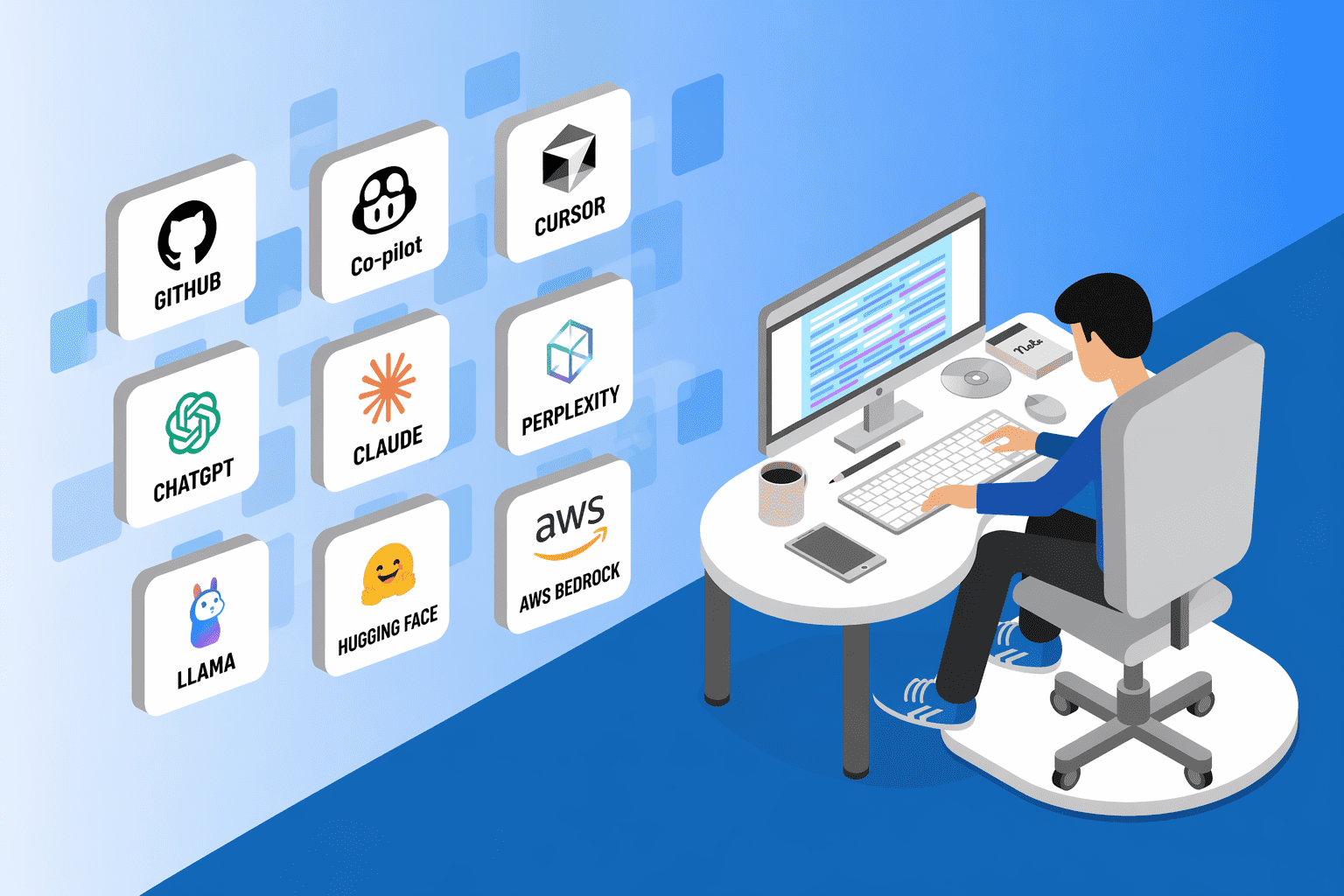
1. Developing the Product: GitHub Copilot, Replit, and Cursor
The initial challenge in building out an MVP or a minimum viable product would be its creation. AI-based development platforms are capable of reducing development timelines by half or more.
GitHub Copilot provides coding suggestions, auto-completion, logic, and error detection as a plug-in for one’s IDEs. If there were only one person to develop an MVP, it could easily double their production velocity.
Replit takes this further by offering a browser-based programming environment with artificial intelligence support built in, making it accessible to everyone, ranging from novices who know nothing about coding to technically savvy entrepreneurs. There’s no need to manage a whole set of applications during prototyping and deployment.
Cursor is fast becoming a go-to tool among tech founders due to its capability of understanding whole code bases and performing refactoring, not just suggesting completions line by line.
It has now become much easier to explore micro saas ideas because tools such as Replit make it possible for a sole founder to develop an actual application without having a full team of developers.
2. Market Validation: ChatGPT, Perplexity AI, and Claude
Prior to spending months developing your solution, you have to validate. Platforms like those based on artificial intelligence represent powerful analytical tools and are able to significantly reduce the time needed to validate the business idea.
ChatGPT (GPT-4o) may be considered one of the most versatile tools in the portfolio of a modern startup entrepreneur. It helps to generate customer interview guides, conduct competitor research, and solve other open-ended tasks, which were impossible to complete even a few years ago. This tool allows founders to validate their assumptions and build market hypotheses.
Perplexity AI works differently. It is a live engine capable of delivering results based on the information from reliable sources. This makes it an excellent option for conducting competitive analysis and identifying market trends.
Claude is another interesting tool developed by Anthropic. Unlike many others, this platform features a long context window and can help to analyze complex documents, such as a pitch deck, review a contract or synthesize lengthy industry reports.
The understanding of how to use AI to drive small business growth often starts with validating the market using these platforms.
3. Scaling Content and Marketing Operations with Jasper, Surfer SEO, and HubSpot AI
Content is the driving force behind the success of most startups in their early days. However, it can be tiring to create such content with minimal resources and personnel. Platforms leveraging artificial intelligence have become advanced enough that they can now be used for full-scale production.
Jasper AI specializes in marketing content creation. This platform creates blog posts, email campaigns, ad scripts, and more in accordance with your brand’s tone – all while integrating with SEO processes. Essentially, this platform acts as your part-time copywriter at your disposal anytime.
Surfer SEO combines AI-powered content writing with an automated SEO grading system. It helps you structure your content according to how the highest-ranking web pages in terms of your desired keywords look.
The AI capabilities built into HubSpot, from their CRM software to email and even content management features, can help a startup automate their nurture processes, generate lead scores, and personalize their approach all at once. This can make or break your marketing funnel for a CEO who wears too many hats.
In combination, these tools tackle one of the biggest problems that plagues startups: the lack of momentum in their marketing after the initial burst from launching. Unexpected startup challenges almost always include this, and AI content platforms are one of the most effective mitigations available.
4. Customer intelligence: Intercom Fin, Mixpanel, and Notion AI
Customer insights, especially in the nascent stages where the signal-to-noise ratio is high and little data is available, can help achieve product-market fit. There are several artificial intelligence tools that have made this more achievable.
Intercom Fin is an artificial intelligence agent that manages customer service conversations in an automated way. Not only does it deflect the issues raised by the customer, but it also helps in understanding what they are facing, how they struggle, and what features they want from their conversation.
Mixpanel has added an AI layer to its analytics platform, which enables founders to ask questions in plain English about user behavior. One does not have to create any custom query for such information anymore. You can just ask, for example, “Which users are most at risk of churning in the next 30 days?”
Notion AI is a productivity tool that can actually be quite handy if used to synthesize customer feedback and manage user research.
5. Operations & Financial Management Tools: Runway, Ramp & Zapier AI
Operation inefficiencies silently cripple startups. Missing follow-up calls, uncontrolled expenses, and manual processes drain startups’ precious time each week.
Runway is a software application that allows for financial modeling tailored for startups. The platform uses AI technology to assist in creating models, running stress tests, and communicating the health of a startup with stakeholders without having to hire an entire finance team.
Ramp offers AI capabilities to track expenditures through corporate cards and automate receipt matching to detect any abnormality that causes the company to lose money through unnecessary expenses.
The AI capabilities of Zapier allow for full integration of all the tools into an automated workflow. Non-technical founders can develop sophisticated automation workflows using natural language builders.
These platforms directly address the best AI tools for business automation have become non-negotiable for lean teams not as a novelty, but as a structural advantage.
Choosing the Right AI Stack for Your Startup Stage
Not every platform belongs in your stack on day one. Here’s a practical framework:
GitHub Copilot, Replit, Jasper, Intercom Fin
| Startup Stage | Priority Platforms |
| Idea / Pre-MVP | ChatGPT, Perplexity, Claude, Notion AI |
| MVP / Early Traction | GitHub Copilot, Replit, Jasper, Intercom Fin |
| Growth / Scaling | HubSpot AI, Surfer SEO, Mixpanel, Ramp, Runway |
The idea is not to use all of them, but rather to align the capabilities of the platform with the most pressing bottleneck you have at each point. Overinvesting in your stack too soon also carries its own costs.
The Competitive Advantage of Strategic AI Platform Use
That’s how startups can employ AI platforms in ways that make them better than others: where the number does not matter, the approach does. By using a set of workflows based on AI platforms instead of just testing the waters with these solutions, startups create a sustainable competitive edge.
Data is accumulated; the context of models gets richer; the accuracy of automation increases.
In the case where the concept of your product incorporates uses of artificial intelligence, regardless of whether it is a vertical software-as-a-service, an automated layer, or a consumer-oriented artificial intelligence product, then utilizing the AI development services can help you identify areas where AI platforms may play a critical role in creating value propositions.
The benefits of AI for business tend to compound only when they are part of your product DNA from scratch.
Final Word
For startups in their nascent stages, the best AI platforms are not the most advanced or flashy, but rather the ones that solve the costliest problem(s) you have now while minimizing the need to learn new things.
Find a couple of platforms to start, cultivate good habits, and build from there. The entrepreneurs building resilient businesses in 2025 and onward won’t be spending their competitors into oblivion; they’ll be outleveraging them using just the right AI platforms.