
Running a Shopify store is exciting, until it isn’t.
What starts as managing a few products and a handful of orders quickly turns into a full-time juggling act. You’re uploading products, replying to customers, chasing suppliers, processing returns, fixing listings, and somehow supposed to find time to actually grow the business. Most store owners hit a ceiling not because their product isn’t good, but because there aren’t enough hours in the day.
That’s exactly where Shopify virtual assistant services come in.

A Shopify VA is a remote professional who handles the day-to-day operational work your store demands, so you can stop putting out fires and start building something bigger. Whether you’re a solo founder managing a growing DTC brand or a small team running multiple product lines, delegating the right tasks to the right person can completely change how your business feels and performs.
This guide breaks down what Shopify virtual assistants do, when you should hire one, and how they help you move from constantly busy to actually scaling.
What Is a Shopify Virtual Assistant?
A Shopify virtual assistant is a remote professional who supports eCommerce store owners by handling operational, administrative, and customer-facing tasks.
Unlike a general virtual assistant, a Shopify VA understands the platform, how the admin panel works, how orders flow, how products are structured, and how apps connect. They’re familiar with the rhythm of eCommerce and can step into your store without needing months of hand-holding.
Their work typically covers:
- Store management, keeping products, collections, and pricing up to date
- Order processing, making sure orders move through the system correctly
- Customer support, responding to inquiries, handling complaints, processing refunds
- Inventory tracking, monitoring stock levels and flagging issues before they become problems
- Marketing support, uploading banners, scheduling emails, updating promotions
- Admin work, reports, spreadsheets, data entry, and the hundred small tasks that eat up your day
They work in the background so you don’t have to.
Why Shopify Store Owners Struggle to Scale Alone
Scaling a Shopify store on your own isn’t just difficult; it’s structurally limiting.
When you’re the only person doing everything, every new order, every new product, and every new customer query adds more weight to your plate. Growth doesn’t free you up; it buries you deeper.
Here’s what that looks like in practice:
- Product uploads take hours. Formatting titles, writing descriptions, adding images, setting variants, assigning collections, it’s repetitive, and it takes time every single time.
- Customer messages pile up. Inbox overload leads to slow replies, and slow replies lead to refund requests and bad reviews.
- Order issues fall through the cracks. When you’re stretched thin, mistakes happen. Wrong addresses, missed fulfillments, and slow communication with suppliers.
- Inventory gets messy. Without someone monitoring it consistently, you end up overselling, underselling, or missing low-stock situations entirely.
- Marketing gets pushed to “later.” You know you should be running email campaigns, updating your homepage banner, or testing new ad creatives, but you never have the bandwidth.
- Strategy becomes impossible. When you’re doing everything operationally, there’s no mental space left to think about where the business should go.
This is the bottleneck most Shopify store owners describe: the business needs them for everything, which means the business can only grow as fast as they can personally run.
How Shopify Virtual Assistant Services Save Time
The most immediate benefit of hiring a Shopify VA is time, specifically, getting back the hours you’re currently spending on tasks that don’t require you personally.
Think about the tasks you repeat every week:
- Uploading new products or updating existing ones
- Writing or reformatting product descriptions
- Responding to customer questions about shipping, returns, or product details
- Processing or flagging orders with issues
- Tracking inventory across SKUs
- Updating discount codes and promotional banners
- Monitoring and responding to reviews
- Pulling weekly sales or customer service reports
None of these tasks requires you. They require consistency, attention to detail, and familiarity with your store, all of which a good Shopify VA can develop quickly with the right onboarding.
When those tasks move off your plate, you get your time back. And when you have time, you can focus on the things that genuinely move the needle: product development, marketing strategy, supplier negotiations, and brand building.
Core Tasks a Shopify VA Can Handle
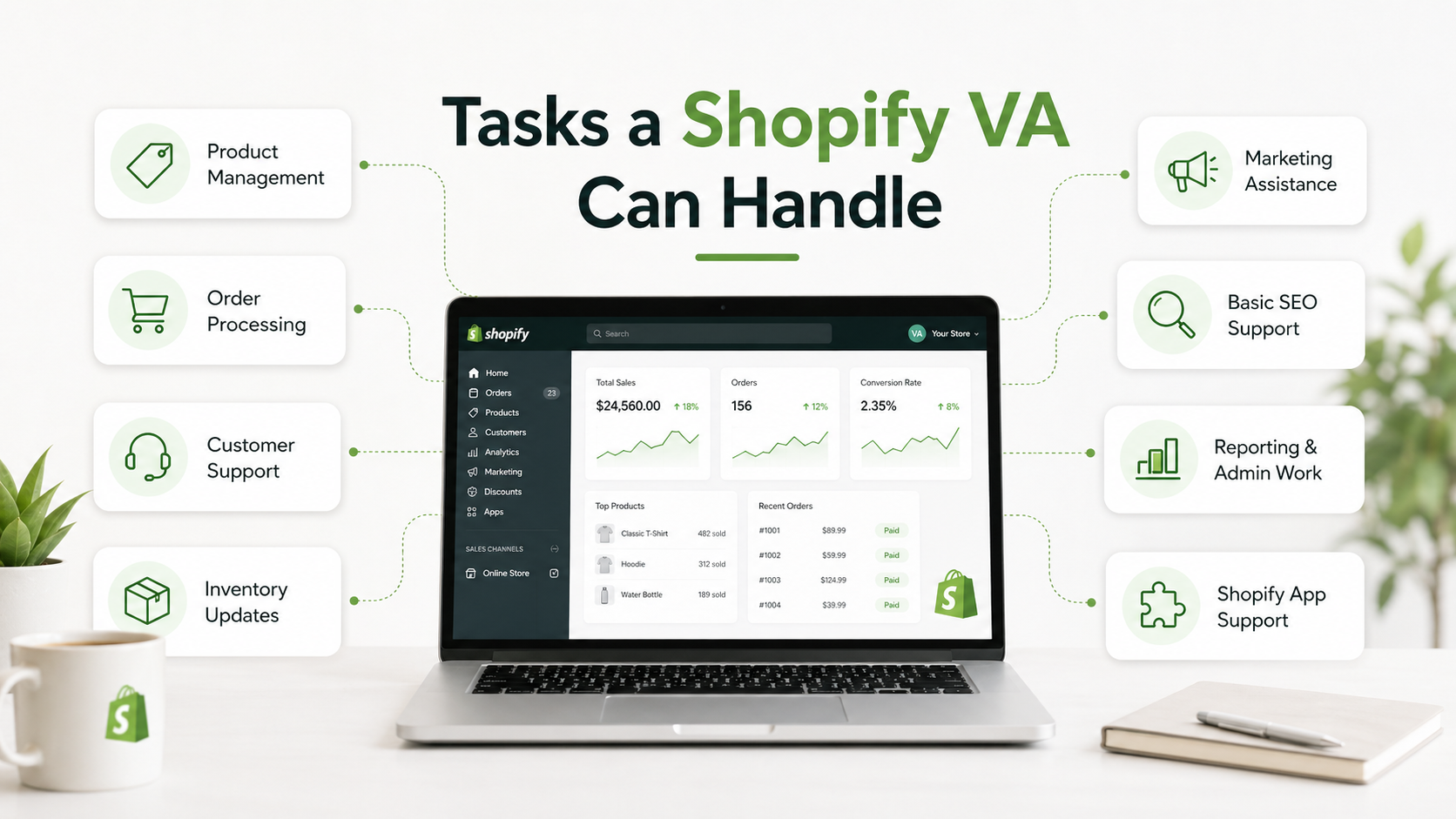
Product Management
A Shopify VA can upload new products from scratch, writing or formatting titles and descriptions, adding images, setting up variants (sizes, colors, bundles), assigning tags and collections, and making sure everything looks clean before it goes live. They can also update existing listings when prices, details, or availability change.
For store owners with large or frequently changing catalogs, this alone can save several hours a week.
Order Processing
Your VA can monitor your order queue, flag any issues (failed payments, address problems, high-risk orders), coordinate with fulfillment teams or suppliers, and ensure orders are moving through properly. During high-volume periods, this becomes especially critical.
Customer Support
Customer inquiries don’t need to wait in your inbox. A VA can handle standard questions about shipping timelines, product details, return policies, and order status, using templates you approve. They escalate anything that genuinely needs your input.
Fast, consistent customer communication improves satisfaction and reduces the likelihood of chargebacks or negative reviews.
Inventory Updates
Keeping track of what’s in stock, what’s running low, and what’s out of stock entirely is ongoing work. A VA can monitor inventory levels, update quantities, create alerts for low-stock SKUs, and coordinate with your supplier or warehouse contacts when restocking is needed.
Shopify App Support
Most stores rely on several apps, review tools, upsell widgets, email integrations, and loyalty programs. A VA can manage the day-to-day setup and maintenance of these apps: updating settings, adding products to flows, pulling reports, and troubleshooting basic issues.
Basic SEO Support
This doesn’t replace a dedicated SEO strategy, but a VA can handle on-page basics: filling in meta titles and descriptions, adding alt text to product images, fixing broken links, and ensuring product pages follow a consistent structure.
Marketing Assistance
Your VA can upload email campaign content to your ESP (email service provider), schedule social media posts, swap out homepage banners for new promotions, and update seasonal sale sections. They keep the storefront looking current without you needing to log in every day.
Reporting and Admin Work
A good VA can pull regular reports from Shopify, sales summaries, refund rates, traffic overviews, and format them so you can review them quickly. They can also handle supplier communication, maintain spreadsheets, and keep your internal documentation organized.
How a Shopify VA Helps Store Owners Scale Faster
Scaling isn’t just about more revenue. It’s about building systems that can handle more without breaking down.
Here’s where a Shopify VA makes a real difference:
Faster product launches. When you have someone ready to upload and publish products quickly, you can get new items live faster and respond to market trends in real time rather than weeks later.
Better customer response time. Response time directly affects conversion and retention. A VA monitoring your inbox means customers hear back quickly, which builds trust and reduces friction.
More consistent store updates. Promotions that go live on time, banners that get swapped correctly, seasonal sales that don’t overstay their welcome, these details matter more than most people realize.
Cleaner backend operations. Fewer order errors, accurate inventory, organized product catalog. When the back end is clean, scaling is smoother.
Better use of the owner’s time. The hours you’re spending on operational tasks right now? That’s time you could spend on supplier relationships, marketing partnerships, new product research, or simply thinking clearly about strategy.
Support during busy seasons. Black Friday, Q4, product launches, these are exactly when operational load spikes. A VA who already knows your store can absorb that pressure without you needing to scramble.
When Should You Hire a Shopify Virtual Assistant?
There’s no universal threshold, but these signs usually mean it’s time:
- You’re spending 2+ hours per day on repetitive tasks that someone else could do
- Customer replies are taking more than 24 hours on a regular basis
- Product updates are falling behind because there’s never enough time
- You’ve had order or inventory mistakes, you know, that were caused by being stretched too thin
- Your marketing is basically on pause because operations are taking everything
- You feel like the business is stuck because you are the bottleneck
If two or more of those apply, you don’t need more tools; you need more capacity.
What to Look for Before Hiring a Shopify VA
The right VA makes this easy. The wrong one creates more work for you.
Look for:
- Shopify experience, ideally someone who has worked inside a Shopify admin, not just someone who has heard of the platform
- Attention to detail, product listings, order notes, and customer replies all require accuracy
- Clear communication, if they can’t communicate well during the hiring process, that won’t improve afterward
- Ability to follow SOPs, you need someone who works within your documented processes, not someone who improvises constantly
- Discretion, they’ll have access to your store data, customer information, and potentially financial details
- Basic app and tool knowledge, familiarity with common Shopify apps (Klaviyo, ReCharge, Gorgias, etc.) is a real advantage
Start with a defined task list and a trial period before giving broad access.
Common Mistakes to Avoid
Hiring without clear instructions. Your VA can’t guess what “good” looks like for your store. Create simple, documented processes (SOPs) before you hire.
Not building SOPs. A standard operating procedure doesn’t have to be long. Even a short Loom recording of how you want products uploaded is enough to start.
Giving full access too early. Use staff accounts with limited permissions and expand access as trust is established.
Expecting perfection from day one. Any new hire, virtual or otherwise, needs a ramp-up period. Give feedback clearly and consistently.
Not tracking task performance. Without any visibility into what’s getting done, problems pile up silently. A simple shared task tracker or weekly check-in goes a long way.
How Bidbat Can Help
If you’re ready to delegate but not sure where to find someone reliable, it’s worth looking at services built specifically for eCommerce store owners.
Bidbat offers Shopify virtual assistant services designed to help store owners get real operational support, product management, order processing, customer support, and more, without the overhead of hiring in-house. If you’re at the point where you know you need help but want a vetted, eCommerce-focused option, it’s a practical place to start.
Conclusion
The honest truth about Shopify store management is this: doing everything yourself works until it doesn’t.
At some point, the daily volume of repetitive tasks stops being a sign of success and starts being a ceiling. Shopify virtual assistant services exist precisely to remove that ceiling, giving store owners the operational support they need to run a cleaner, faster, more consistent business.
Delegating is not a sign that your store is too complex to manage. It’s a sign that your business has grown enough to need a team. The store owners who scale past that inflection point are usually the ones who figured out how to let go of the tasks that don’t need them and doubled down on the work that does.
If you’re spending your best hours on product uploads and inbox management, it might be time to rethink how you’re using them.