
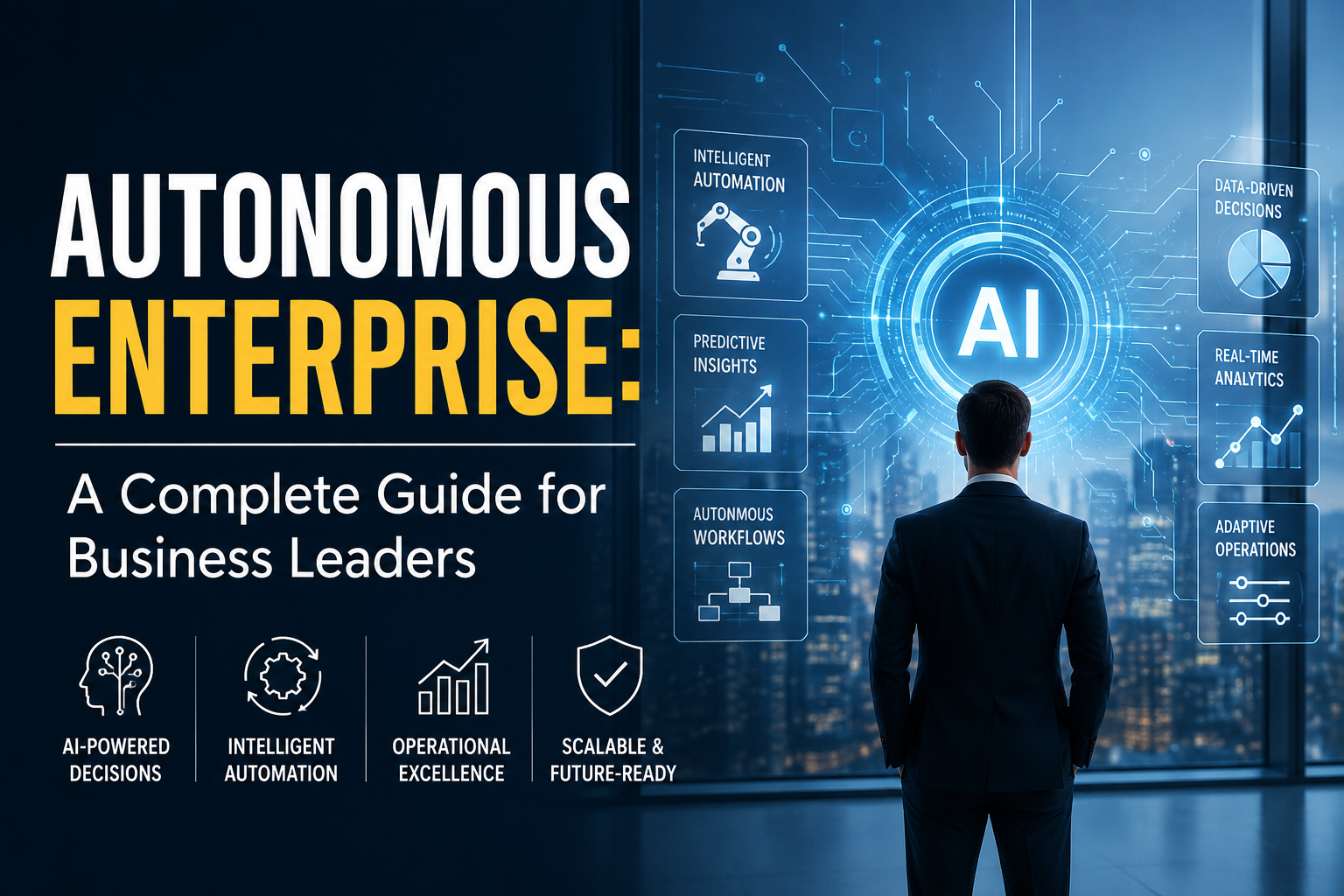
The next generation of business transformation is moving past merely digitizing – it’s becoming autonomous. The nature of automation across business and from one industry to another is changing. It is shifting away from traditional automation to intelligent systems that can learn, adapt and make decisions without human input. For business leaders, it’s changing the nature of business growth, efficiency and sustainability.
An Autonomous Enterprise is one where artificial intelligence, data and other advanced technologies are utilized to improve the operation, decision-making, and to increase the agility of the organization. In the above-mentioned model, business executives may employ it in order to reduce operating costs, accelerate innovation and strengthen the business’s resilience.
What Does an Autonomous Organization Look Like?
Fundamentally, an autonomous enterprise is about linking people, technology and data into an evolutionary ecosystem. This is more than simply putting parts together; it is an intelligent enterprise where the systems are connected across the organization.
Imagine finance tools identifying anomalies before audits, supply chains rerouting automatically during disruptions, or customer support resolving common issues without manual intervention. This is no longer future-state thinking; it is already happening.
Enterprises that adopt automation early are gaining tremendous strategic leverage as it is freeing employees from mundane tasks to utilize their skills for higher value-creating activities.
Why Business Leaders Are Prioritizing Autonomy
In today’s world, businesses are operating under tremendous pressure-growing customer demands, shortage of talent, intense competition around the globe, operational complexities, and so on. Traditional automation solves only part of the issue since it relies heavily on predefined rules.
Independent systems expand on that by permitting the use of AI-driven business operations that self-optimize. Rather than a person detecting an inefficiency in the operation and implementing a solution, the system itself identifies the pattern, recommends an improvement, and performs an accepted modification.
This shift changes leadership priorities. The conversation moves from “How do we automate one process?” to “How do we create an intelligent operating model?”
The Core Pillars of an Autonomous Organization
1. Intelligent Data Infrastructure
Autonomy depends on trusted, accessible, real-time data. Without clean and connected data, even advanced systems fail.
Organizations have to possess adequate data governance and analytics abilities that can support automatic decision systems. The automatic decision systems need data that is credible to make decision/action automatically.
Leaders should focus on building centralized visibility across departments, not isolated data silos.
2. Process Intelligence
Companies need visibility into what is actually going on before they can automate. Process intelligence solutions will uncover the waste and delays.
This sets the basis for the automation of business workflow. It requires manual, time-consuming processes to be converted into quicker, more robust, electronic workflow procedures.
Done correctly, this not only improves efficiency but also reduces operational risk.
3. AI-Driven Execution
The next step is embedding intelligence directly into operations. This is where organizations start going into AI-enabled enterprise operations. Systems can actually do tasks, work in priority and initiate the next best action.
Examples include:
- Predictive maintenance in manufacturing
- Dynamic pricing in retail
- Automated underwriting in insurance
- Smart procurement in the supply chain
This level of execution creates speed humans alone cannot match.
4. Human + Machine Collaboration
Autonomy does not replace people—it amplifies them.
Employees will transition from performing tasks to strategic and creative roles or the handling of exceptions. The most successful autonomous workflow enterprises have developed systems where humans are responsible but machines handle the scale.
That balance builds trust and drives adoption across teams.
Key Benefits for Business Leaders
Faster Decision-Making
Companies utilizing autonomous decision-making systems will be more able to adapt to the fluctuating market trend due to the fact that the decision is made through real-time intelligence rather than by delayed reports and the conventional reporting loop.
Higher Productivity
When daily tasks are eliminated, teams can be reallocated to problem-solving or providing customer service. It is here, where business workflow automation provides its most tangible return.
Better Customer Experiences
Self-service organizations are quicker and more personalized, which is why they speed up delivery time while increasing customer loyalty.
Greater Business Resilience
Unexpected disruptions, economic, operational, or environmental, can be addressed faster when systems adapt automatically.
Common Challenges to Expect
Building autonomy is not without obstacles.
Legacy Technology: Older systems often cannot support modern intelligence layers, making integration difficult.
Change Resistance: Employees may fear job displacement or distrust AI-driven recommendations.
Governance Risks: When clear guidelines and supervision aren’t present, these intelligent systems can create compliance and liability problems.
That is why strong governance must accompany AI-enabled business operations, ensuring transparency and ethical deployment.
A Practical Roadmap to Becoming Autonomous
Step 1: Start Small
Identify one high-impact process with clear inefficiencies—finance approvals, HR onboarding, or customer support are strong candidates.
Step 2: Build a Strong Foundation
Invest in data quality, integration, and scalable enterprise automation platforms.
Step 3: Introduce Intelligence Gradually
Add AI where it creates immediate value—forecasting, prioritization, anomaly detection, or recommendations.
Step 4: Scale Across Functions
As success grows, expand into broader autonomous workflow enterprises across departments and business units.
Step 5: Create Leadership Alignment
It is not an IT project; it must be championed by top management in operations, finance, HR and technology functions.
Industries Leading the Way
Several sectors are already proving what autonomy can achieve:
- Healthcare: Faster diagnostics and automated patient workflows
- Banking: Fraud prevention and intelligent risk scoring
- Retail: Dynamic inventory and personalized experiences
- Manufacturing: Self-monitoring production environments
- Logistics: Real-time route optimization and predictive delivery planning
These examples show how an AI-driven enterprise can create operational agility at scale.
The Future of Enterprise Leadership
Tomorrow’s market leaders will not simply use AI tools; they will redesign their businesses around AI-enabled enterprise operations.
That means leadership itself must evolve. Executives will have to stop managing tasks and start managing smart systems.
Final Thoughts
It is not about replacing man with machine in the pursuit of autonomy, but about systems that augment people, speed up growth and enable decisions.
Those firms that get started today-through pilots, modern architectures and sensible governance-will be able to position themselves to lead over the next decade.
The future belongs to organizations built for speed, adaptability, and intelligence, and that future starts with embracing truly autonomous operations.