
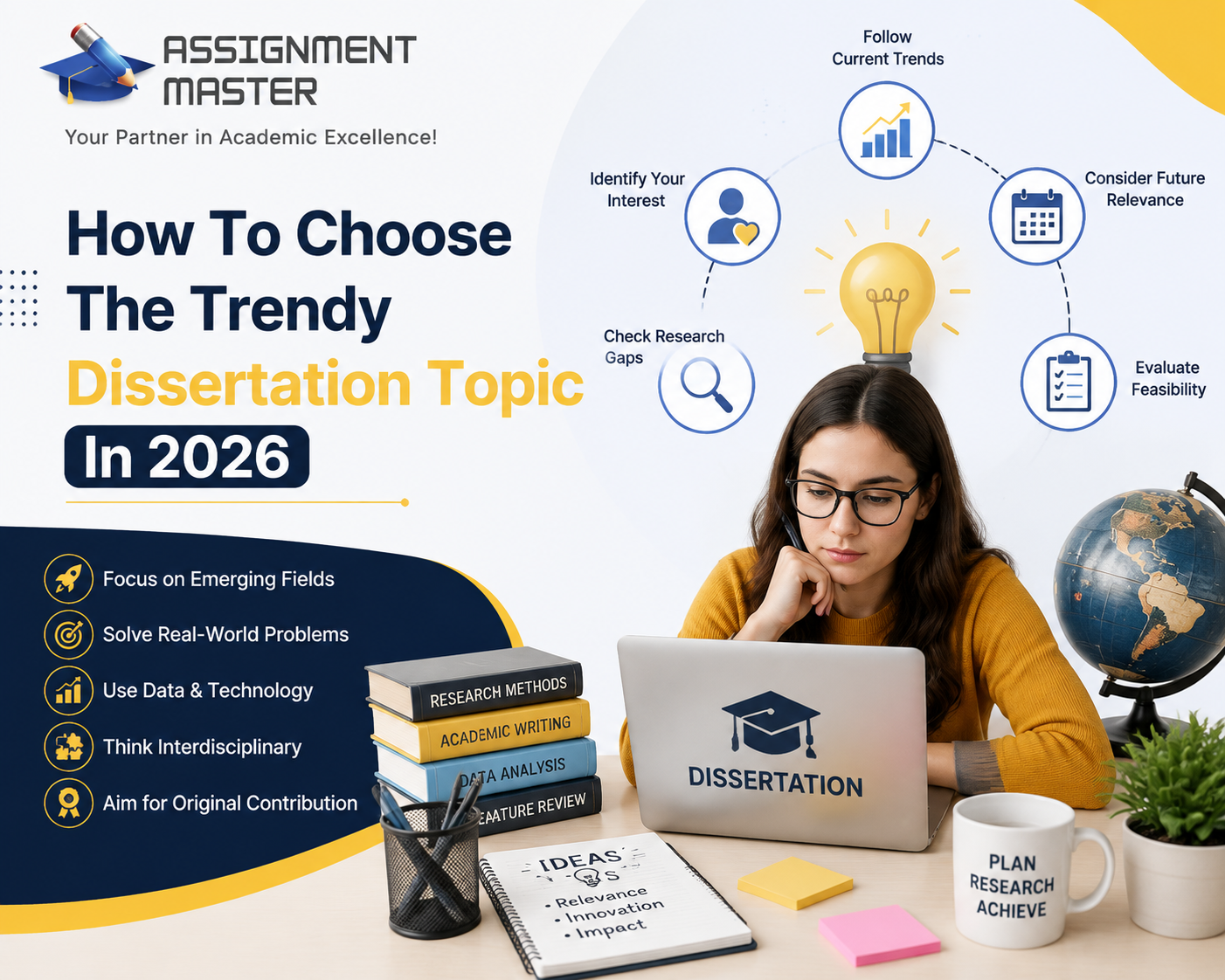
Choosing a dissertation topic can be an intimidating task. A dissertation is something that you have to spend months working on, and it carries significant weight in your degree. It is different from many typical assignments, so choosing the right topic is often stressful.
You need to choose the right topic that reflects your curiosity and aligns with your strengths. It will become an opportunity to dive deeper into a subject that you are genuinely interested in and demonstrate what you are capable of achieving. This guide will walk you through the definition of a dissertation, the importance of topic selection, key considerations before choosing a topic and steps to choose the right dissertation topic.
What Is A Dissertation?
A dissertation is a deep piece of academic writing that depends on original research that you carry out. It is generally the final step, and you submit it to complete the degree. Writing an effective dissertation involves thoroughly discovering a particular question or topic, doing independent research, collecting, analysing, and interpreting data, and then sharing these results in a structured way. If you cannot figure out what it is or feel stuck halfway through your draft, then there is always the choice to go for dissertation writing services.
The Importance Of Topic Selection
A well-chosen topic will help you demonstrate subject mastery that contributes meaningfully to your field and potentially establish a foundation for future research or career specialisation. Your decision should balance personal interest, long-term professional value and academic rigour. This also involves negotiating institutional expectations, supervisor input and the evolving landscape of research trends.
Key Considerations Before Choosing A Topic
Choosing a dissertation topic is not an easy task, but before jumping into the process, you must consider some factors.
● Institutional And Supervisor Expectations
You must read and clarify your university’s requirements and your supervisor’s preferences. This includes disciplinary boundaries, word limits, ethical constraints, and methodological frameworks.
● Career Goals
You should choose a topic that is aligned with the type of work or research you envision pursuing after graduation. For example, if you are planning a career in government or consultancy, then a policy-oriented dissertation is ideal for you.
● Research Trends
You must stay informed about the recent developments and gaps in your field. If you choose a trending area, it often receives more attention, publication opportunities and funding, but you should still approach it critically.
● Originality And Academic Contribution
Must aim for a topic that can fill a research gap or provide a novel perspective. Review literature to ensure that your topic is not saturated and still presents the scope for original contribution.
● Feasibility And Resource Availability
You should analyse whether you can realistically conduct the research within the time, financial and data access constraints of your program. You can also get help with a thesis writing service for resource and feasibility availability.
Steps To Choose The Right Dissertation Topic
Below are the steps that you must follow to choose the right dissertation topic that is relevant for 2026. Do not skip any step as it can lead to mistakes.
1. Interests And Expertise
The best dissertation topic is the one that emerges at the intersection of your personal academic interests, gaps in the literature, and your existing knowledge. Start with listening to the modules or subjects you feel most engaged in your coursework. Identify the industry problems that you have observed in your professional experience (especially relevant for MBA students). Check for methodological approaches that you are confident in using and willing to learn. See questions that arise as you read and things that existing literature did not fully explain.
2. Conduct A Systematic Literature Search
You must know the field before identifying a gap. Now conduct a structured literature review across:
| Google Scholar | It offers broad coverage across disciplines and is best for initial exploration. |
| Web of Science | You can get high-impact journals, systematic reviews and citation analysis. |
| PubMed/ Medline | It offers articles for health sciences, medicine and biology. |
| Scopus | It provides peer-reviewed journals, citation tracking and is highly reliable. |
| JSTOR | It includes humanities, arts, and social sciences. |
| SSRN | It includes economics, management, finance and law with preprints and working papers. |
You should focus on the articles that are published in the last 5 years. Must-read abstract, conclusion and future research. There you can identify gaps.
3. Identify The Research Gap
A research gap is a question, problem or context that existing scholarship has not addressed. The most common types of research gaps include:
➢ Population Gap: It is a theory that is tested on Western publications. Testing this in an Indian or Asian context is original.
➢ Temporal Gap: These are existing studies which are 10+ years old. A current replication or update is required.
➢ Theoretical Gap: It contains two established theories that have never been applied together in a single study.
➢ Methodological Gap: It is a topic that has only been studied quantitatively. A qualitative or mixed-methods study can provide you with new insights.
➢ Contextual Gap: This concept has been studied in large firms, but not in SMEs or in urban settings, nor in rural ones.
4. Narrow Your Topic
| Too Broad | Narrowed |
| Impact of social media on youth | Impact of Instagram use on body image satisfaction among female college students. |
| Climate change and agriculture | Adaptive strategies of small-scale farmers to climate variability: a case study approach. |
| Challenges of remote working | Managerial challenges of hybrid work models in IT firms post-COVID: a qualitative study. |
| AI in healthcare | Patient trust in AI-assisted diagnostic tools in urban private hospitals: a mixed-methods study. |
5. Validate With Your Supervisor
Before you commit to a topic, you should arrange a meeting with your supervisor and present 2-3 possible topics. You must discuss the genuine originality of the topic, appropriate literature to engage with and analyse whether the supervisor has the expertise to guide this specific topic. You should also consider the feasible methodology and the realistic access to data within your timeframe.
Frequently Asked Questions
1. How to make a dissertation topic unique and highly impactful?
You can make your dissertation topic highly impactful and unique, but you must aim to explore the research gap. For example: instead of researching general “Employee productivity at work,” you should focus on particular aspects like employee well-being measures or remote collaborative tools.
2. What happens if I cannot get any resources for my dissertation topic?
Insufficient sources are a sign of a dissertation topic that is underdeveloped or too obscure to be a completed dissertation. You might need to adjust your dissertation focus.
3. Can I update my dissertation topic afterwards?
Yes, you can easily change or modify your research topic, but only in the early phase. Frequent changes might delay your overall development, and they demand additional approvals.
Final Comments
The choice of your dissertation topic is not just an academic requirement, but it can open doors for your future research, scholarly contributions and employment. You must consider some factors before choosing a dissertation topic, including institutional and supervisor expectations, research trends, career goals, originality and academic contribution, availability of resources and feasibility. First, analyse your interest and expertise, conduct a systematic literature search, and identify the research gap. Then narrow your topic and validate it with your supervisor.