
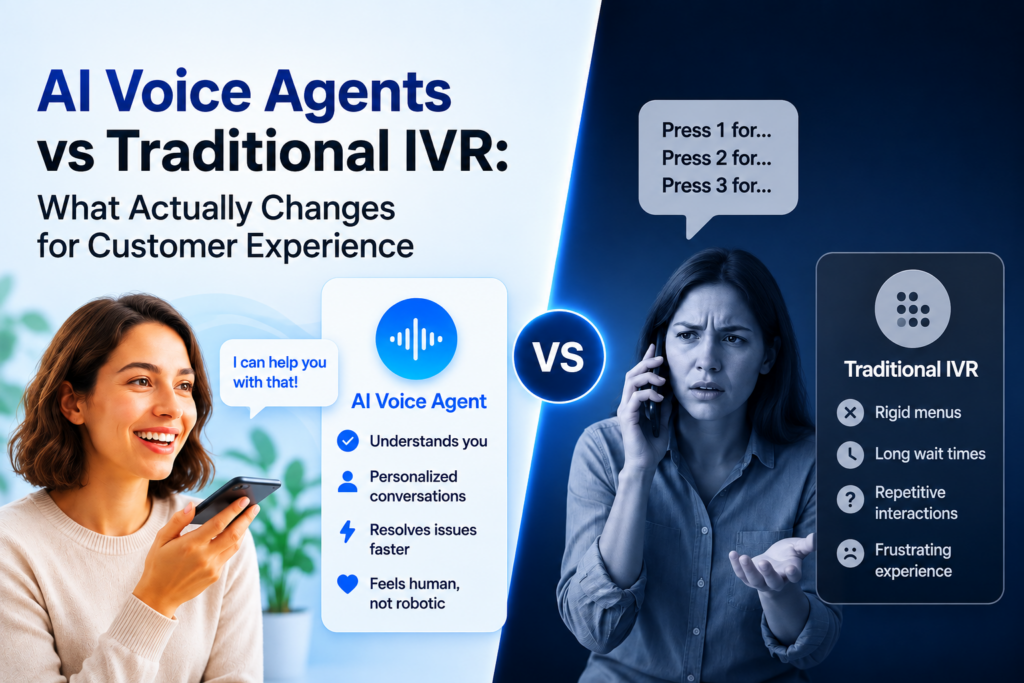
Most businesses evaluate phone systems based on efficiency. Customers evaluate them based on the effort they had to put in to get help. An IVR may successfully route thousands of calls every day or hit its service target. Yet customers remember something entirely different: how many steps it took before the problem was resolved. Getting to the right department, navigating through all menus, repeating information, and then waiting to talk to the right person become obstacles between the customer and the purpose of their call.
With the growing prominence of AI voice agents, businesses are questioning whether customers really need to spend their valuable time navigating the system or letting the system do most of the work.
Where Traditional IVR Creates Customer Friction
Traditional IVRs were designed to address a business issue: dealing with massive call volumes without requiring additional support. However, it becomes challenging when the process requires the customer to adapt to the system not the other way round. That friction usually appears in a few familiar ways:
Menu-based navigation: Customers are forced to make choices from a given list of options, despite their problem not falling within the scope of the menu.
Repeated information: The information that is provided using IVR has to be entered again when the customer finally reaches the right staff.
Multiple transfers: Sometimes an incorrect choice may lead the callers to go through various departments to reach the correct one.
Longer resolution paths: Customers spend time navigating the menu before they can begin addressing the reason for their call.
Lack of flexibility: Traditional IVRs function well only when customers take any of the expected options from the menu.
Individually, these issues may seem minor. Together, they increase the effort required to get help. Over time, they need additional efforts that often become part of the customer experience itself, shaping it long before their problem is resolved.
What Changes When AI Voice Agents Handle the Conversation
Customers still want answers, resolutions, and assistance, so the goal hasn’t changed. Unlike forcing the customer to fit into the existing process, multilingual voice AI agents are designed to fit in with the customer. And there are several ways this is done:
Intent-driven conversations: Customers say what they want in their own words without going through the hassle of the menu loops and preset choices.
Context-aware interactions: An AI voice agent for business can establish context with customer information, conversation history, and workflow data to continue the interaction with fewer repeated questions.
Fewer transfers and handoffs: The AI agent can identify the purpose of the call first, gather information and then route customers to a human assistant if needed.
Greater flexibility: Customers need not follow a predefined call path. Conversations can adapt to different requests, follow-up questions, and unexpected situations.
Resolution-focused experiences: Modern enterprise voice AI solutions are designed to move customers toward outcomes rather than simply guide them through routing processes.
AI Voice Agents vs Traditional IVR: A Customer Experience Comparison
1. First Contact Experience
Conventional IVRs always offer a menu that customers must choose from when interacting with the system. Customers have to navigate through the options first before describing the purpose of their call. This experience is built around directing calls efficiently rather than understanding intent immediately.
AI voice agents start the interaction differently. Customers can freely describe their issues in their own words from the very beginning. It makes the interaction natural and reduces the number of interactions needed to initiate the process.
2. Effort Required from the Customer
Traditional IVR systems lay much of the burden on the customers. Callers are supposed to pick from a given set of options and follow a specific path before they can even state their problem. Every additional step increases the effort required to get help.
An AI voice agent assumes more of that workload. The interaction is customized according to customer response instead of following the menu-based interaction. Therefore, customers do not spend much time understanding the procedure and can focus on addressing their problem.
3. Context and Personalization
Traditional IVR interactions are often limited to predefined rules and available menu options. They typically have little understanding of previous conversations or customer history. This results in multiple repetitive questions as well as fragmented communication.
An AI voice agent for business can use customer records, interaction history, and workflow information to add context to the conversation. Customers are less likely to repeat information that the system already knows. The interaction feels more connected and relevant.
4. Problem Resolution
The primary role of a traditional IVR is routing. Its job is usually to direct customers to the right destination as efficiently as possible. Actual problem resolution often begins only after a human agent becomes involved.
AI voice agents can handle many requests directly within the conversation. Customers can receive answers, complete routine actions, or move through processes without waiting for a transfer. Thus, reducing the time taken for problem resolution.
5. Scalability and Availability
Traditional IVR systems can operate continuously, but high call volumes can still impact customer experience. More callers end up waiting in queues that become more noticeable during busy periods. Availability does not always guarantee responsiveness.
Modern enterprise voice AI solutions can manage large numbers of conversations simultaneously. Customers do not have to compete for limited agent availability before the interaction begins. This helps maintain a more consistent experience even during peak demand.
Conclusion
Comparing IVR and AI voice agents as competing technologies misses the bigger picture. Customers don’t evaluate support by how advanced your phone system is. They remember whether they had to repeat themselves, whether they were able to get help quickly, and if the process was effortless. This explains the shift from automation to experience. The best businesses adapt to changing customer needs. And that is what has led to AI voice agents replacing IVR systems, not because they’re newer technology.