
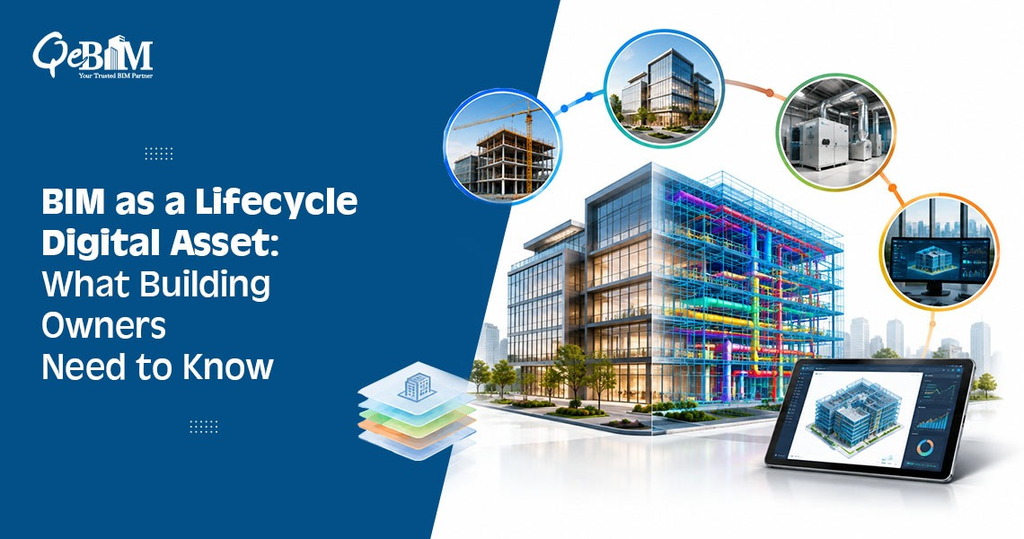
For years, BIM was primarily viewed as a design and construction technology. Architects used it to develop coordinated models, engineers used it for analysis, and contractors used it for coordination, quantities, and construction planning.
But that definition is changing.
For building owners, the real value of BIM may begin after construction is complete.
A well-structured BIM model can become a long-term digital asset containing information about the building’s geometry, systems, equipment, materials, spaces, relationships, and documentation. Instead of treating the model as a project deliverable that is archived after handover, owners are increasingly treating it as an information resource that can support operations, maintenance, refurbishment, and future capital projects.
The National BIM Standard-US describes BIM as a digital representation of a facility that can serve as a shared knowledge resource for decisions throughout its lifecycle. ISO 19650 similarly positions information management as a lifecycle process extending from planning and design through construction, operation, maintenance, refurbishment, and end-of-life.
So, what makes a BIM model a long-term digital asset?
1. It Preserves Building Knowledge Beyond Handover
One of the biggest challenges for building owners is information loss between project delivery and operations.
A building may pass through architects, engineers, contractors, subcontractors, suppliers, commissioning teams, and facility managers. Each stakeholder generates information, but without structured information management, critical data can become fragmented across drawings, spreadsheets, PDFs, equipment manuals, emails, and disconnected systems.
A properly developed BIM model can bring much of this information into a structured digital environment.
For example, an MEP asset in a model can contain its location, system relationship, equipment type, manufacturer information, specifications, and other relevant attributes. This creates a digital record that can remain useful well beyond the construction phase.
Research into BIM-enabled handover has specifically explored using BIM to capture and retrieve facility information and generate operation and maintenance deliverables.
2. BIM Connects Physical Assets With Their Information
A BIM model is valuable not simply because it represents the building in 3D, but because its objects can carry structured information.
A facility manager looking at an air-handling unit, for example, should ideally be able to identify:
- Where the equipment is located
- Which system it belongs to
- Its technical specifications
- Associated documentation
- Maintenance requirements
- Relevant manufacturer information
- Replacement or servicing history, where integrated
This changes BIM from a visual model into an information interface for the physical building.
buildingSMART notes that BIM can define the identity, characteristics, relationships, location, and other information associated with physical building components.
3. It Supports Facility Management and Maintenance
Operations and maintenance represent a major part of a building’s lifecycle. Yet facility teams frequently struggle with incomplete or outdated asset information.
A lifecycle-oriented BIM strategy can provide a more structured starting point for maintenance planning.
Instead of searching through folders to locate an equipment drawing, a facility manager could identify the asset within the model and connect it to the relevant information.
This is particularly valuable for large facilities such as hospitals, airports, commercial campuses, data centers, universities, and industrial buildings, where thousands of assets may need to be monitored and maintained.
The goal is not to make facility managers “operate a BIM model.” The goal is to make reliable building information easier to access within the systems they already use.
4. It Creates a Foundation for Digital Twins
A BIM model and a digital twin are not the same thing.
BIM primarily provides structured information about the asset, while a digital twin can extend that information by connecting the digital representation with operational data, sensors, analytics, and real-world conditions.
This distinction is important for owners.
A reliable BIM model can provide the spatial and asset-information foundation upon which a more dynamic digital twin can be developed. Autodesk describes digital twins as evolving digital reflections that can integrate BIM information with construction data, operational sensor data, simulation, and analytics.
In other words:
BIM can establish the information foundation.
Digital twins can build operational intelligence on top of it.
5. It Reduces Information Re-Creation During Renovations
Buildings rarely remain unchanged.
Spaces are renovated. MEP systems are upgraded. Equipment is replaced. Tenants change layouts. Extensions are added.
Without a reliable digital record, every major intervention can require teams to recreate existing conditions through surveys and manual documentation.
An accurate as-built BIM model can reduce this duplication by providing a documented starting point for future work.
When combined with laser scanning or point-cloud data, BIM can also be updated to reflect existing conditions before renovation or refurbishment projects.
The result is a continuously useful digital record rather than a model that becomes obsolete after project completion.
6. Open Standards Make the Asset More Valuable Over Time
Long-term digital assets cannot depend entirely on one software platform.
This is where interoperability becomes important.
IFC, developed by buildingSMART, is an open international standard for representing and exchanging information about buildings and infrastructure. Its scope covers the information needed across the lifecycle and also supports archiving and long-term preservation of project information.
For owners, this matters because the building may outlive the software used to create its original model.
A lifecycle BIM strategy should therefore consider:
structured information + open standards + controlled revisions + accessible documentation.
7. The Owner’s Requirement Must Come First
The biggest mistake is creating a highly detailed model without defining what information the owner actually needs.
A model can be geometrically impressive but operationally inefficient if it contains unnecessary detail while missing critical asset information.
The better approach is to define information requirements around actual business and operational use cases.
ISO 19650 emphasizes structured information management, including requirements, organization, versioning, approval, delivery, and availability across the asset lifecycle.
That means owners should ask:
What information will we need five, ten or twenty years from now?
The answer should influence what gets modeled, what properties are included, how assets are classified, how information is validated, and how the final model is handed over.
From Project Deliverable to Digital Asset
The most important shift is conceptual.
A BIM model should not be viewed simply as something produced for architects, engineers, or contractors. For owners, it can become part of the building’s long-term information infrastructure.
The value increases when the model is:
Accurate → Structured → Verified → Interoperable → Maintainable → Connected to operations.
This is also changing what owners should expect from a BIM Company. The objective should not be merely to deliver a visually complete model, but to create reliable information that remains useful after construction.
Similarly, effective BIM Services should be aligned with the owner’s lifecycle requirements—not just the immediate modeling requirements of a project.
The future of BIM for building owners is therefore less about creating a “3D model” and more about creating a trusted digital record of the asset.
When maintained and connected to operational workflows, that record can support maintenance, renovation, asset management, decision-making, and eventually digital-twin applications.
The building may be physical. But its information can become a long-term digital asset.