
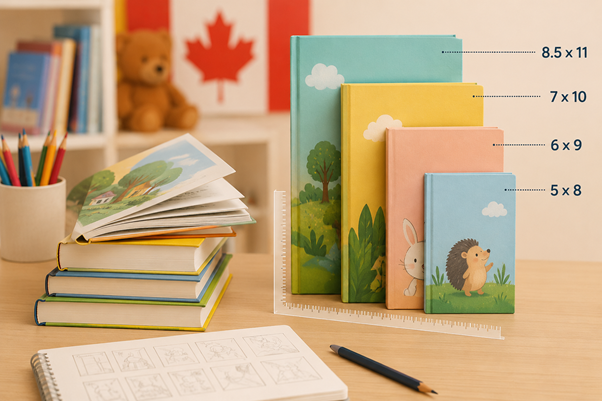
If you are an author, have you ever found yourself searching for the trim sizes of the hardcover of the book you are planning to present to the world? If not, then you have just found the right guide.
Many individuals assume that trim size is a publishing detail, but when it comes to children’s books, paying attention to these intricacies matters a great deal. It is one of the first things that children notice and emotionally connect with.
In the Canadian publishing industry, trim size is simply the final physical measurement of a book after printing and trimming. It is often expressed in inches. An incorrect trim size can affect the layout, typography, and artwork of a book. So, deciding which one aligns with the overall theme of your children’s book is important.
What Is Trim Size in a Real Book-Printing Sense?
Trim size is the final cut size of a printed book, as finalized before the start of printing. When it comes to children’s books, the standard trim sizes in the hardcover publishing market are not dictated by design considerations, but rather by industry norms in Canada and North America. Most children’s book publishers use the following standard hardcover trim sizes:
➔ A standard square picture book is 8 × 8
➔ Storybook and educational format books have a hardcover range of 8.5 × 11
➔ Premium illustrated hardcover can be 10 × 10
➔ Compact version available for younger children, 7 × 7
➔ Early reader or text-forward hybrid format comes in size 6 × 9
What Steps Do Publishers Take to Determine the Correct Trim Size Step by Step?
● Choosing the right trim size is less about personal preference and more about matching the story, target audience, and production requirements.
● First of all, publishers evaluate the density of illustrations. Larger format stories, such as 10 × 10 or 8.5 × 11, are preferred if they are heavily reliant upon the images. For a more text-based story, smaller sizes like 6 × 9 are better.
● Another key factor is the age group that you are aiming at. Younger children will benefit from lightweight books with shorter stories, and older childrens will benefit from larger books or more complex books.
● Lastly, publishers assess the production costs and distribution needs. These books are larger, and that makes printing and shipping more expensive, which has a direct impact on the publishing pricing strategy and placement strategy for children’s books.
● Printing efficiency, binding strength, and illustrations’ layout are among the factors influencing these sizes. The larger the trim size, the more immersive the illustrations and page spreads become. On the other hand, smaller trim sizes are often easier for young children to handle and read comfortably, and the more portable it will be.
So, Which Trim Sizes Are Preferred in Canada These Days?
The Canadian children’s publishing industry has no single set of rules, but there are definite trends. If we talk about the most popular trims these days, they are,
· 8 × 8 square format → most popular size used for retail picture books for children.
· A4 portrait format is 8.5 × 11 → it is widely used in schools and libraries.
· Large 10 × 10 premium format → high-quality illustrated hardcover releases.
The most commonly used formats are square, as they provide visual balance, particularly when using bilingual or image-driven stories. It is especially important in Canada, where children’s books are used for both educational and recreational purposes. These sizes tend to match the most efficient sizes for printing from a production perspective, which can help publishers manage production costs. Those savings can then be reinvested into other crucial parts of the publishing process, such as affordable book marketing services that will help increase visibility and reach for a book.
What Actual Impacts Can Different Trim Sizes Have on the Reading Experience?
It is useful to observe how each trim size operates in actual reading scenarios rather than considering trim sizes in principle. When these factors are carefully considered during production, authors are more likely to create a book that meets both reader expectations and market demands.
| Trim Size(Inches) | Commonly Used in Children’s Literature | Reading Experience | Ideal for the Age Group |
| 6 × 9 | Hybrid chapter books for early readers | Lightweight, text-focused, and portable | 5–8 years old |
| 7 × 7 | Toddler or board-style books | Small, straightforward layouts, quick interaction | 3-6 years old |
| 8 × 8 | Typical format for picture books | Text flow and images are balanced | 4–8 years old |
| 8.5 × 11 | Storybooks with illustrations and education | Excellent visual clarity and suitability for the classroom | 3–9 years old |
| 10 × 10 | High-end picture books in hardcover | An incredibly engaging illustration experience | 4–10 years |
| 11 × 8.5 Landscape | Books with lots of scenes or a cinematic feel | Dramatic images and extensive storytelling stretches | 4–10 years |
When considering the choice of the right trim size for your child’s book, this comparison will help authors find a guide to children’s book illustration services and production budgets. Just a simple trim size adjustment can make a huge difference in the way that visuals will be received and in the flow of readers through the pages.
FAQs
Which trim size is most popular for children’s hardback books in Canada?
In Canada, 8 × 8 is the most popular trim size, particularly for picture books intended for young readers. It provides a well-balanced layout that is suitable for both text and graphics.
Does the quality of an illustration depend on trim size?
Indeed, the way illustrations are framed and viewed on the page is strongly impacted by trim size. Wider scenes and more detail are made possible by larger trims, which enhance the immersion of the images.
What makes square books so well-liked in Canada?
Square forms like 8 × 8 are popular because they naturally balance text and images. Additionally, they seem contemporary and manageable for kids.
Conclusion
The reason behind many of your favourite books being so successful is that the authors and the publishing team consider the minor intricacies like the trim size of the hardback of the books, very carefully. They are aware of the fact that engaging children in this highly digitized era is quite challenging, so they make sure to determine every factor of their books in a manner that catches the attention of these young readers right away.