
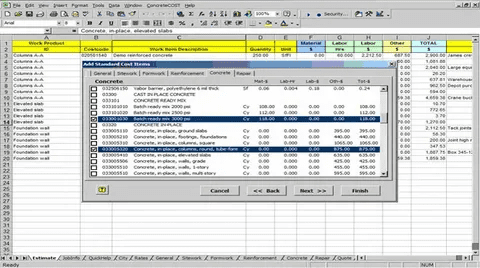
The budgets have shrunk, while the requirements of a project have increased, leading to an increase in the complexity of construction projects. Contractors have to deal with the volatility of material costs, labor costs and the time requirement and still stay competitive. Meanwhile, clients are looking for precise estimates and transparency in expense reporting. The need for detailed estimating is now more critical than ever in the construction industry, as it is being faced by the challenges mentioned above.
Numerous companies depend on digital systems for their project cost organization as well as to optimize the estimating process. Today, accurate forecasting is a crucial element of project planning and preparing bids. Construction cost estimating software offers a structure to do cost estimating calculations and keep a history of costs and budgets applicable to your project. Estimating, as a construction operation, is continuously changing, and software estimating is becoming a vital investment.
The Changing Economics of Construction Projects
Rising Material Price Volatility
The market conditions, economic factors and disruptions of the supply chain can cause the prices of materials to fluctuate. The fluctuations create problems for contractors and project owners when it comes to budgeting.
When estimating, construction companies need to consider the uncertainty of prices. Any slight difference in cost can have a significant impact on the profitability and feasibility of a project.
Labor Cost Challenges
Labor costs continue to be a major cost item in construction projects. Labor shortages and wage changes pose more budgeting difficulties for contractors.
Labor availability, skill requirements, and regional market conditions are important factors to take into account when determining the amount of manpower required. These are factors that are leading to more complex project forecasting.
Competitive Bid Environments
There is more competition in the construction industry. It is essential to be able to provide accurate and realistic bids to win projects.
However, if costs are overestimated, this can have a negative effect on competitiveness, and if they are underestimated, then there can be financial risk. As a result, contractors look to ensure that they are able to make reliable cost estimates and financial forecasts.
How Construction Estimating Has Evolved Over Time
Traditional Estimating Methods
Traditionally, construction estimating was done using printed plans, manual calculations, and spreadsheets. Estimators took a great deal of time in reviewing the documents and gathering costs for the project. These methods are still well known but can be labour-intensive and attention-consuming.
Limitations of Manual Processes
Manual estimating can lead to inaccuracies in calculations and the handling of data. Additionally, multiple stakeholders involved in project planning can cause version control problems with spreadsheet-based systems.
To overcome these shortcomings, many companies switched to construction cost estimating software, which set up more streamlined estimating processes.
Emergence of Digital Estimating Systems
Digital estimating software is a system that brings together project information and cost data. These sites offer quicker and more convenient communication to project information without relying on isolated spreadsheets.
Digital estimating is becoming increasingly prevalent in the pre-construction process as the use of technology continues to grow in the construction industry.
What Construction Companies Expect From Modern Estimating Software
Accurate Cost Projections
One of the main goals of contemporary estimating systems is to be able to accurately predict costs. Accurate data is crucial for estimators when calculating the costs of labour, materials, equipment and subcontractors. Cost elements can be organized and analyzed using structured methods in software systems.
Faster Bid Preparation
It takes quite a lot of time to prepare bids and coordinate. Contractors are required to work under time constraints and deal with a plethora of job opportunities.
Digital estimating software saves time and effort for calculations and documentation. The efficiency enables estimating teams to better respond to bids.
Consistent Estimating Standards
There is great significance in consistency in construction estimating. Standardized procedures for the entire project and across project teams.Consistent procedures throughout project teams and estimates.
There is an increasing trend towards software platforms to ensure consistency in budgeting and estimating activities within companies.
The Business Value of Software-Based Estimating
Better Financial Visibility
Construction companies should have transparency about their financial performance and project expenses. Cost breakdowns and budget information can be accessed from the estimating platforms. This visibility enables decision makers to have more confidence in assessing project opportunities.
More Reliable Project Forecasting
To predict future expenses, it is crucial that accurate information from the past and up-to-date pricing is available. Today’s estimating tools contain these data sources in a structured environment.
Construction cost estimating software is one of the reasons that many firms invest in it, due to the higher chances of it providing them with a more reliable estimate of the cost of the project.
Improved Decision-Making
There are a lot of decisions that have to be made in relation to finances throughout the planning and execution of the construction project. Accurate estimating data also helps to make better decisions on project feasibility and resource allocation. Planning has come to rely on data inputs as a critical aspect of construction operations in the modern world. ‘Studio’ is the common term for an architectural studio. An architectural studio is what is normally called a critical features construction firm.
Critical Features Construction Firms Commonly Evaluate
Quantity Takeoff Functions
Estimators can use quantity takeoffs to determine the materials needed for a project directly from the project files. These calculations are used to make many estimates of construction. Precise quantity determinations help to better plan projects and budgets.
Cost Database Capabilities
Cost databases have a range of cost information, including labour rates, material costs, and information on previous projects. These resources assist estimators in setting up realistic estimates. Integrated databases also help to ensure consistency among different projects and estimating teams.
Reporting and Documentation
Platforms for estimating often have reporting functions, which produce summaries, cost breakdowns and bidding documentation.
Construction cost estimating software often gets used by various groups as it helps in the documentation and makes each and every piece of information accessible to every stakeholder.
Impact on Different Construction Stakeholders
Estimators
Estimators use good information to create project budgets and bid proposals. Digital estimating platforms deliver project data and cost references in one place. These types of systems also lessen the time spent on manual calculations that can be time-consuming for administrative tasks.
Project Managers
Estimating information helps the project manager to track the budget and manage the project’s resources. Project planning and communication during the project will be more effective with accurate estimates. Cost visibility has been an integral aspect of project oversight.
Business Owners and Executives
The executives assess the strategic opportunities of the projects. Financial forecasting and profitability analysis have an impact on business decisions and planning for growth.
A lot of organizations use construction cost estimating software to boost their finances and project evaluation.
Common Mistakes Companies Make When Selecting Estimating Software
Focusing Only on Price
When picking software, there’s more to it than just the initial price tag. But functionality, scalability and long-term value are also factors to take into account. The lower-cost solution may not be adequate for future use.
Ignoring Scalability
Construction companies tend to grow over the years. The software systems need to be scalable to handle an expanding amount of work and an expanding organization. One of the key factors to take into account while assessing software is scalability.
Overlooking User Adoption
Having a user who adopts and can use the implementation is essential to success. If teams have difficulty implementing them in the daily workflow, even high-tech systems might face difficulties handling them. Long-term software effectiveness is related to training and accessibility.
Future Direction of Construction Cost Estimating
Artificial Intelligence and Predictive Estimating
AI is still shaping the construction technology landscape. Predictive analysis tools analyse the past and forecast future trends to give cost insights. These capabilities help to enhance forecasting processes.
Cloud-Based Collaboration
Using cloud technology, project teams can have access to information from different locations. A centralized solution makes it easier for estimators, managers and executives to work together. In recent years, this accessibility is gaining in significance in modern construction.
Data-Driven Construction Planning
More and more construction firms use information to make decisions about planning. Analytics offer greater insights into project performance, cost trends and operational trends.
With the rise in adoption, construction cost estimating software is expected to play a vital role in digital construction practices.
Conclusion
In an increasingly complex market, construction companies are under increasing pressure to be able to control costs accurately. Accurate estimates are important for bidding, project planning, and implementation. The use of construction cost estimating software is continuing to grow, as the construction industry continues to prioritize accuracy, consistency, and data-driven decision-making. With the continuous advancement of technology, estimating platforms will remain an important part of the construction planning and financial management process.
FAQs
What is construction cost estimating software?
Construction cost estimating software is an application that helps to generate construction estimates, maintain the budgeting data, and estimate the costs of a construction project.
What is the reason for construction companies to use digital estimating systems?
The digital estimating system is used by companies to enhance accuracy, streamline processes, and improve the management of project costs.
What factors would be crucial in estimating software?
Some of the common features are quantity takeoffs, cost databases, reporting and project budgeting.
In what ways does estimating software impact project budgeting?
Estimating software offers a structured cost analysis, forecasting tools and a centralized financial data that helps to improve the reliability of budgeting processes.