
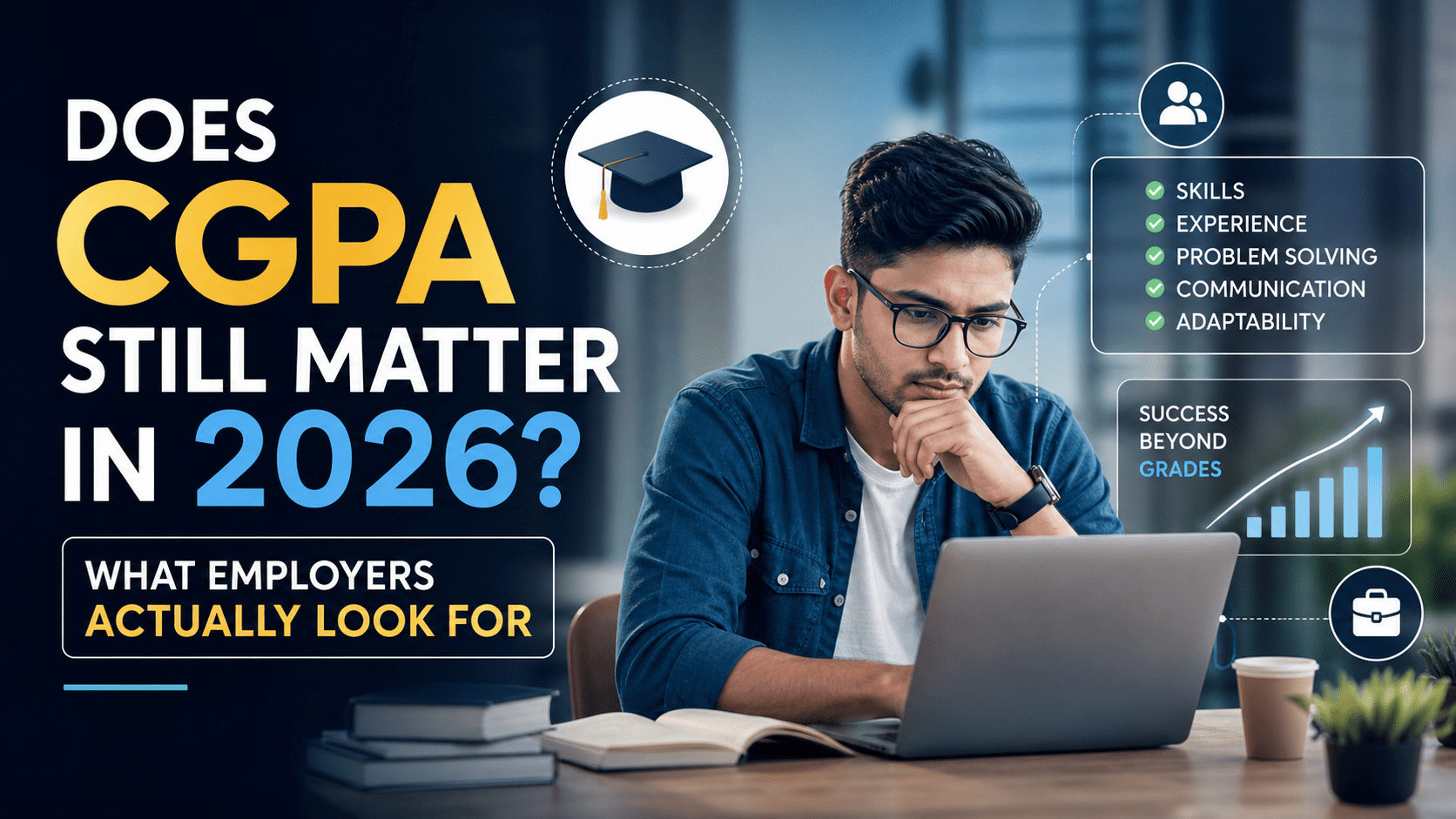
In an era defined by artificial intelligence, remote work, and rapidly evolving industries, students are increasingly questioning the value of traditional academic metrics. At the center of this debate is one familiar number: CGPA (Cumulative Grade Point Average).
For decades, CGPA has been treated as a core indicator of academic success and future potential. It influenced everything from scholarships and internships to job placements and career trajectories. But in 2026, the hiring landscape has changed dramatically—and so has the role of CGPA.
Today, students are not just chasing grades—they are actively analyzing and optimizing their performance. Many rely on tools like a CGPA calculator free to track progress, predict outcomes, and make smarter academic decisions. This shift reflects a broader transformation: education is no longer just about achieving high scores, but about understanding and improving performance strategically.
So, does CGPA still matter?
The answer is not as simple as yes or no. It depends on context, career goals, and how well you balance academics with real-world skills.
The Traditional Importance of CGPA
To understand its current relevance, we first need to understand why CGPA mattered so much in the first place.
Historically, CGPA served as a standardized benchmark that allowed institutions and employers to evaluate students at scale. It was simple, measurable, and easy to compare.
A high CGPA typically signals:
- Strong subject knowledge
- Discipline and consistency
- Ability to meet deadlines
- Academic commitment
For employers receiving thousands of applications, CGPA became a convenient filtering tool. It helped them quickly shortlist candidates who appeared reliable and capable.
In many ways, CGPA functioned as a proxy for potential.
But here’s the problem: potential is no longer enough.
What Changed in the Hiring Landscape?
The biggest shift in 2026 is not the disappearance of CGPA—it’s the expansion of what employers consider valuable.
Modern organizations operate in environments shaped by:
- Rapid technological advancements
- Constant industry disruption
- Global competition for talent
- Increasing reliance on practical skills
As a result, hiring has become more holistic.
Employers are no longer asking:
“How well did you perform in exams?”
They are asking:
“What can you actually do in real-world situations?”
This shift has reduced the dominance of CGPA and elevated other factors that better reflect job readiness.
What Employers Actually Look For in 2026
1. Practical Skills and Execution Ability
The most important factor in modern hiring is skill application.
Employers want candidates who can:
- Solve real problems
- Use relevant tools effectively
- Deliver measurable outcomes
For example:
- A developer who has built working applications
- A marketer who has run real campaigns
- A business student who has analyzed real case studies
These signals are tangible and far more predictive of job performance than exam scores alone.
2. Proof of Work
In 2026, “show, don’t tell” has become the standard.
Employers expect candidates to provide:
- Portfolios
- Project work
- Internships
- Freelance experience
This proof of work demonstrates:
- Initiative
- Practical understanding
- Ability to execute ideas
A student with a moderate CGPA but strong project experience often outperforms someone with perfect grades but no real-world exposure.
3. Consistency and Discipline
Despite all the changes, CGPA still carries meaning—especially as a measure of consistency.
Maintaining a strong CGPA over multiple semesters reflects:
- Time management
- Work ethic
- Ability to handle pressure
Employers recognize that achieving consistently good grades requires effort and discipline. While it may not guarantee success, it still acts as a credibility signal, particularly for fresh graduates.
4. Learning Agility
In a world where skills become outdated quickly, the ability to learn is more valuable than what you already know.
Employers now prioritize candidates who:
- Adapt quickly to new tools
- Learn independently
- Stay updated with industry trends
This “growth mindset” is often more important than static academic achievements.
5. Data-Driven Thinking and Self-Awareness
One of the most underrated qualities in modern students is the ability to analyze their own performance.
High-performing individuals treat their academic journey like a system. They:
- Track GPA trends
- Identify weak areas
- Plan improvements strategically
For instance, students in structured education systems often use tools like the HSC GPA Calculator BD to accurately calculate expected grades and make informed decisions about their studies.
This approach mirrors how professionals operate in the workplace—using data to optimize performance.
When CGPA Still Matters
Although its role has evolved, CGPA is far from irrelevant.
Entry-Level Hiring
For students with little to no experience, CGPA remains one of the few measurable indicators available.
Many companies still:
- Set minimum CGPA requirements
- Use grades as a shortlisting criterion
In these cases, a low CGPA can limit opportunities, regardless of potential.
Competitive Industries
Certain fields continue to place high importance on academic performance, including:
- Finance
- Consulting
- Law
- Academia
In these industries, a strong CGPA can significantly improve your chances of getting noticed.
Higher Education and Scholarships
If your goal includes:
- Studying abroad
- Securing scholarships
- Pursuing postgraduate programs
Then CGPA remains a critical factor.
Universities and scholarship committees rely heavily on academic performance to evaluate candidates.
When CGPA Matters Less
Skill-Driven Industries
In fields like technology, design, and digital marketing:
- Skills are king
- Experience outweighs grades
Many successful professionals in these industries have average CGPAs but exceptional practical abilities.
Freelancing and Remote Work
The global freelance economy has shifted the focus entirely to:
- Output
- Client satisfaction
- Results
Your academic record is rarely considered.
Entrepreneurship
For entrepreneurs, success depends on:
- Execution
- Creativity
- Risk-taking
CGPA has little to no direct impact on building a successful business.
The Smart Strategy for Students in 2026
The most successful students today don’t choose between CGPA and skills—they optimize both.
Maintain a Strong Academic Base
You don’t need a perfect CGPA, but maintaining a solid and consistent score keeps opportunities open.
Build Skills Alongside Studies
Start early:
- Learn industry-relevant tools
- Work on real projects
- Gain practical experience
Treat CGPA as a Performance Metric
Instead of seeing CGPA as just a number, treat it like a system you can manage and improve.
Track:
- Progress over time
- Subject-wise performance
- Areas for improvement
Develop a Growth-Oriented Mindset
Focus on continuous improvement rather than short-term results.
Build a Strong Personal Profile
In 2026, your online presence matters:
- Portfolio websites
- Personal branding
These elements can significantly influence how employers perceive you.
The Bigger Picture: Beyond Grades
The most important realization for students today is this:
CGPA is not your identity—it’s just one part of your profile.
A high CGPA without skills limits your opportunities.
A low CGPA with strong skills still creates possibilities.
But the most powerful position is a balanced one:
- Decent CGPA
- Strong skills
- Real-world experience
This combination makes you competitive in any environment.
Conclusion
CGPA still matters in 2026, but its role has shifted from being the ultimate measure of success to a supporting indicator of discipline and consistency. It can help you get noticed, especially early in your career, but it is no longer enough on its own to secure meaningful opportunities. Employers today are looking for individuals who can apply knowledge, adapt to change, and deliver real results in dynamic environments. The most successful students understand this balance—they maintain a solid CGPA while actively building skills, gaining experience, and thinking strategically about their growth. In the end, CGPA may open the door, but it is your abilities, mindset, and execution that determine how far you go.
FAQs
1. Is CGPA still important in 2026?
Yes, especially for fresh graduates and academic opportunities, but it is no longer the only factor employers consider.
2. What CGPA is considered good for jobs?
A CGPA above average (around 3.0 or equivalent) is generally safe, while higher scores can improve competitiveness in certain fields.
3. Can I succeed with a low CGPA?
Yes. Strong skills, real-world experience, and a solid portfolio can compensate for a lower CGPA in many industries.
4. Do employers value skills more than CGPA?
In most modern industries, especially tech and digital fields, skills and practical experience are more important than CGPA.
5. How can I improve my CGPA effectively?
Track your academic performance, identify weak areas, plan improvements, and use tools to calculate and predict your results for better decision-making.