
Key Takeaways
- Automated brazing can reduce variation caused by manual flame placement and inconsistent heating.
- Auto Brazing Systems offers equipment for aluminum and copper coil applications, including condenser and evaporator production.
- Its in-line evaporator system is designed to process approximately three to four coils per minute in suitable applications.
- A detailed request for a brazing machine helps determine whether a standard, modified, or custom system is appropriate.
Manufacturers producing HVAC, refrigeration, automotive, and heat-exchanger coils often face the same operational barriers: inconsistent joints, labor-intensive brazing, slow cycle times, and costly rework. An automated brazing machine can help address these challenges by providing greater control over flame application, material handling, temperature monitoring, and production flow.
Auto Brazing Systems designs automatic equipment for aluminum-to-aluminum brazing, copper brazing, condenser and evaporator coils, and related heat exchanger applications. Its systems are intended for manufacturers that need a more repeatable process than manual brazing can provide, while still accounting for coil geometry, material selection, production targets, and available floor space.
Why Do Manufacturers Struggle With Manual Brazing?
Manual brazing depends heavily on operator technique. Flame position, heating duration, filler-metal flow, component fit-up, and cooling can vary from one joint to another. In high-volume production, those differences can create avoidable rework, uneven quality, and difficulty maintaining a predictable production schedule.
Working with aluminum coil is particularly challenging due to the need for careful control of heat exposure and filler behavior. As a result, manufacturers must assess the entire process, not only the burner.
How Automation Addresses Process Variation
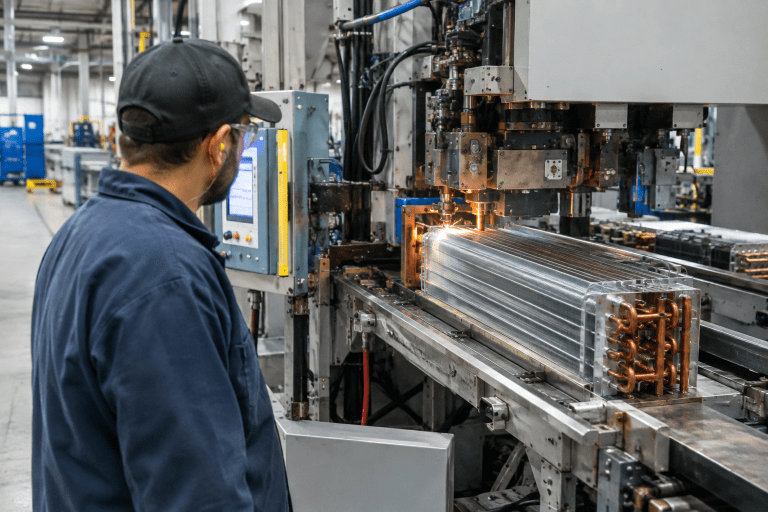
Auto Brazing Systems describes equipment that uses mass flow control for burner zones, controlled air-and-gas mixing, temperature measurement, and adjustable exhaust management. These controls are designed to help maintain more stable heating conditions as coils move through the brazing process. Automated handling can also support more consistent positioning from cycle to cycle.
What Makes Auto Brazing Systems Different?
Auto Brazing Systems focuses on automated production equipment rather than standalone manual workstations. Its core specialization is aluminum-to-aluminum brazing for evaporator and condenser coils, while it also provides copper brazing solutions and custom machine designs. This combination matters when a manufacturer needs an integrated process that aligns brazing, material flow, cooling, and downstream handling.
- Aluminum coil specialization: Equipment is designed around aluminum evaporator and condenser applications.
- Copper capability: The company also offers automated options for brazing copper coils.
- Custom engineering: Systems can be configured around product dimensions, production requirements, and assembly constraints.
- Line integration: In-line equipment supports automated manufacturing environments with repeatable movement and positioning.
- Service support: Maintenance, repair, consultation, and system sales are available for ongoing production needs.
How Do Auto Brazing Systems Support Aluminum Coil Manufacturing?
Aluminum coil brazing requires a controlled relationship between heat, timing, filler alloy, component position, and cooling. Auto Brazing Systems offers low-heat burners for return bends with wall thicknesses of 0.042 inches or thinner, according to its equipment information. This type of application-specific design can be important when excessive heat could affect thin-walled parts.
Potential applications include aluminum evaporator coils, condenser coils, return bends, HVAC heat exchangers, refrigeration assemblies, and automotive thermal-management components. The goal is not simply to braze faster. It is to build a repeatable process around the specific component being manufactured.
How Can Automated Equipment Increase Production Capacity?
Auto Brazing Systems states that its ABS Gen VI in-line evaporator system is designed to produce approximately three to four coils per minute. That is equivalent to about 180 to 240 coils per hour, or roughly 1,440 to 1,920 coils during an eight-hour shift before accounting for changeovers, planned maintenance, material supply, inspections, or unplanned downtime.
Those figures are useful planning references, not guaranteed outputs. Actual capacity depends on coil size, the number of burner zones, loading and unloading methods, product mix, operator involvement, inspection requirements, and the final system configuration.
Production Factors to Review
- Target coils per minute, hour, and shift.
- Current labor hours devoted to brazing, inspection, and rework.
- Coil dimensions, tube materials, rows, and return-bend details.
- Required loading, cooling, degreasing, and leak-testing steps.
- Expected changeovers between product types.
Which Equipment Options Should Manufacturers Consider?
Equipment selection should begin with the manufacturing problem to solve. For high-volume condenser production, an in-line condenser system may be appropriate where continuous operation, automated handling, and accurate coil positioning are priorities. For aluminum evaporator production, the ABS Gen VI in-line evaporator system accommodates coils ranging from 12 to 52 inches plate-to-plate, according to Auto Brazing Systems.
The company also offers an In-Line Commercial Brazer for copper and aluminum condenser or evaporator coils. Its equipment information describes copper coil capability for one to four rows and coil heights from 36 to 120 inches plate-to-plate, with limited adjustments needed to transition to aluminum applications. Custom designs are available when a standard configuration does not meet production requirements.
Why Are Temperature and Filler Control Important?
Consistent joints depend on a stable heating profile and appropriate filler behavior. Auto Brazing Systems describes laser-based temperature measurement, burner-zone mass-flow controls, and VFD-driven exhaust dampers for monitoring and regulating brazing conditions. In its evaporator process, the company also describes cooling coils to approximately room temperature before thermal degreasing and handling.
Joint design and manufacturing methods can influence system reliability.
What Should Be Included in a Brazing Machine Request?
A complete brazing machine request gives Auto Brazing Systems the information needed to assess the application and recommend a suitable solution. Include the following details:
- Material type, including aluminum, copper, or mixed-material assemblies.
- Component type, such as an evaporator, condenser, radiator, or heat exchanger.
- Coil height, width, depth, tube dimensions, rows, and return-bend specifications.
- Current brazing method, production rate, quality concerns, and rework volume.
- Available propane or natural gas, compressed air, electrical service, ventilation, and floor space.
- Required automation for loading, unloading, cooling, inspection, and downstream handling.
- Installation schedule, training needs, maintenance expectations, and future capacity plans.
How Does Long-Term Support Affect the Investment?
Buying equipment is only one part of an automation project. Auto Brazing Systems also offers maintenance, in-house repair support, consultation, and replacement guidance. Routine inspections and timely repair planning can help manufacturers avoid disruptions that affect throughput and delivery schedules.
The best evaluation approach is practical: document current output, scrap, rework, labor needs, coil range, and utility constraints. Then compare those requirements with the proposed system’s automation level, controls, service needs, and expansion options. That process helps ensure the brazing solution supports both current production and future manufacturing goals.