
Most growing businesses don’t fail because of bad products or weak demand. They fail because their teams are running in different directions with different information.
Sales tracks leads in spreadsheets. Marketing lives inside campaign tools. Support works from tickets and inboxes. Everyone is busy, but no one sees the full picture. Customers repeat themselves. Follow-ups slip. Opportunities quietly die in the gaps between systems.
This disconnect isn’t new—but today, it’s completely avoidable.
Modern companies are realizing that alignment doesn’t come from more meetings or more tools. It comes from one shared system that gives every team the same view of the customer, in real time.
The Real Problem Isn’t Teams — It’s Fragmented Information
Sales, marketing, and support usually want the same thing: better customers and better relationships. The problem is that each team collects data for its own needs, not for the business as a whole.
- Marketing knows where a lead came from, but not what happened after.
- Sales knows deal value but not customer history.
- Support knows the pain points but not the original promise that was sold.
When data lives in silos, teams make decisions in isolation. That’s when customers feel like they’re dealing with three different companies instead of one.
This is where the conversation naturally turns to what is CRM, not as a textbook definition, but as a practical answer to a messy reality. In real business terms, CRM is the shared memory of the company. It’s where every interaction, decision, and signal about a customer comes together, so teams stop guessing and start acting with context.
One Customer, One Story, One Source of Truth
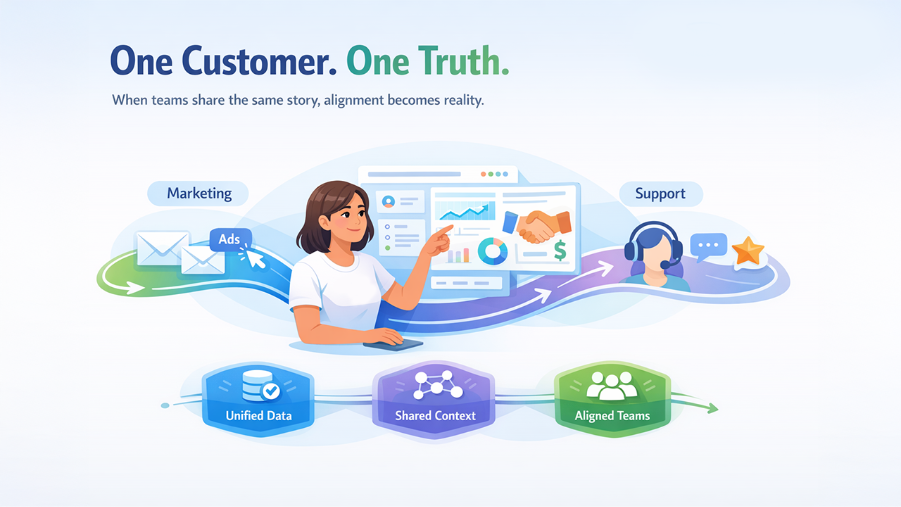
When sales, marketing, and support work from one system, something important happens: the customer journey becomes visible.
Instead of fragmented snapshots, teams see a continuous story:
- How the customer first discovered the brand
- What messages influenced their decision
- What was promised during the sale
- What questions or issues appeared after onboarding
This shared view changes behaviour.
Marketing ceases to look only at vanity metrics and begins to consider their effect on downstream revenue, resulting in Marketing no longer pursuing clouded vision or vanity metrics. Support stops reacting to all customer inquiries without fully understanding customer value and expectations.
This shift will allow Alignment to move from being a stated goal to the norm.
From Static Records to Living Systems
Traditional CRM tools were built mainly for record-keeping. They stored contacts, logged calls, and tracked deals. Useful—but passive.
Today’s businesses need more than storage. They need systems that think, adapt, and assist. This is where a Smart CRM enters the picture.
Your contemporary customer relationship management system (CRM) doesn’t focus solely on storing information; rather, this type of system connects that stored data.
It identifies trends in the data, enables automation for the regular jobs that need to be completed, and delivers the most relevant intelligence at the time it is most useful.
For example, rather than staff seeking out information on their dashboard, the CRM alerts staff (when leads are warming up, when there may be issues with customers, and what marketing strategies are producing sustainable results).
The difference isn’t technology for its own sake. It’s clarity at speed.
How Each Team Benefits from One Shared System
When teams work from the same platform, each function gets stronger without adding complexity.
Sales: Improved Assigned Times, Improved Conversations
Sales representatives enter conversations prepared, rather than having no idea. They have an understanding of the lead’s engagement history and the conversations held with prospects around their pain points, as well as their growing interest. They know what relevant conversations to plan, but every follow-up is no longer the same repetitive follow-up.
Marketing: Reality-Based Feedback Loops
For the first time, marketing has an understanding of the downstream impact of clicks on campaigns based on tracking revenue and retention instead of just viewing traffic to the site. Marketing messages are now created with actual results in mind.
Support: Context Over Chaos
Support agents don’t just solve tickets—they understand customers. They know the relationship history, deal size, and previous conversations. That context leads to faster resolutions and better experiences.
Clean Data Is the Quiet Hero
A unified system only works if the data inside it is accurate and current. Bad data doesn’t just slow teams down—it erodes trust in the system itself.
That’s why many companies pay attention to how information enters their CRM in the first place. For example, an Email Extraction tool can help collect verified contact details from trusted sources, reducing manual entry errors and duplicate records. Used correctly, tools like this support data hygiene without becoming the focus of the system.
Clean data isn’t glamorous, but it’s foundational.
Why CRM Positioning Matters (Without the Sales Pitch)
A CRM Company entering the market today faces the same expectation: it must unify teams, not just store contacts. Businesses no longer look for isolated features; they look for platforms that connect workflows across departments and scale with growth.
The winning systems are the ones that disappear into daily work—quietly enabling alignment instead of demanding constant attention.
What Alignment Actually Feels Like
When sales, marketing, and support work from one system, the shift is subtle but powerful.
- Less internal emails asking for updates
- Fewer customer complaints about repetition
- Quick decisions with less debate
- Clear ownership without finger-pointing
People stop defending their tools and start focusing on outcomes.
And perhaps most importantly, customers feel it. They experience consistency. They feel understood. They trust the business more because the business finally acts like one entity.
The Bigger Picture
Working from one system isn’t about control or surveillance. It’s about shared understanding.
When businesses expand, they naturally acquire a number of entailments resulting in a rise in overall operational complexities. There is no requirement, however, that as an organization matures, disconnects must occur within the organization.
An effectively utilized customer relationship management (CRM) system – particularly one designed around contemporary business workflow structures and processes—will serve as a foundational source of support for collaborative efforts of all departments within the organization by transforming:
• The various, inconsistent, and disjointed individual actions into aligned organization-wide processes and systems;
• The isolated accomplishments of various departments into a humanly sustainable enterprise growth initiative.
The future belongs to teams that don’t just work hard, but work together—on the same data, in the same system, with the same clarity.
That’s not a tool upgrade.
That’s an operating mindset.