
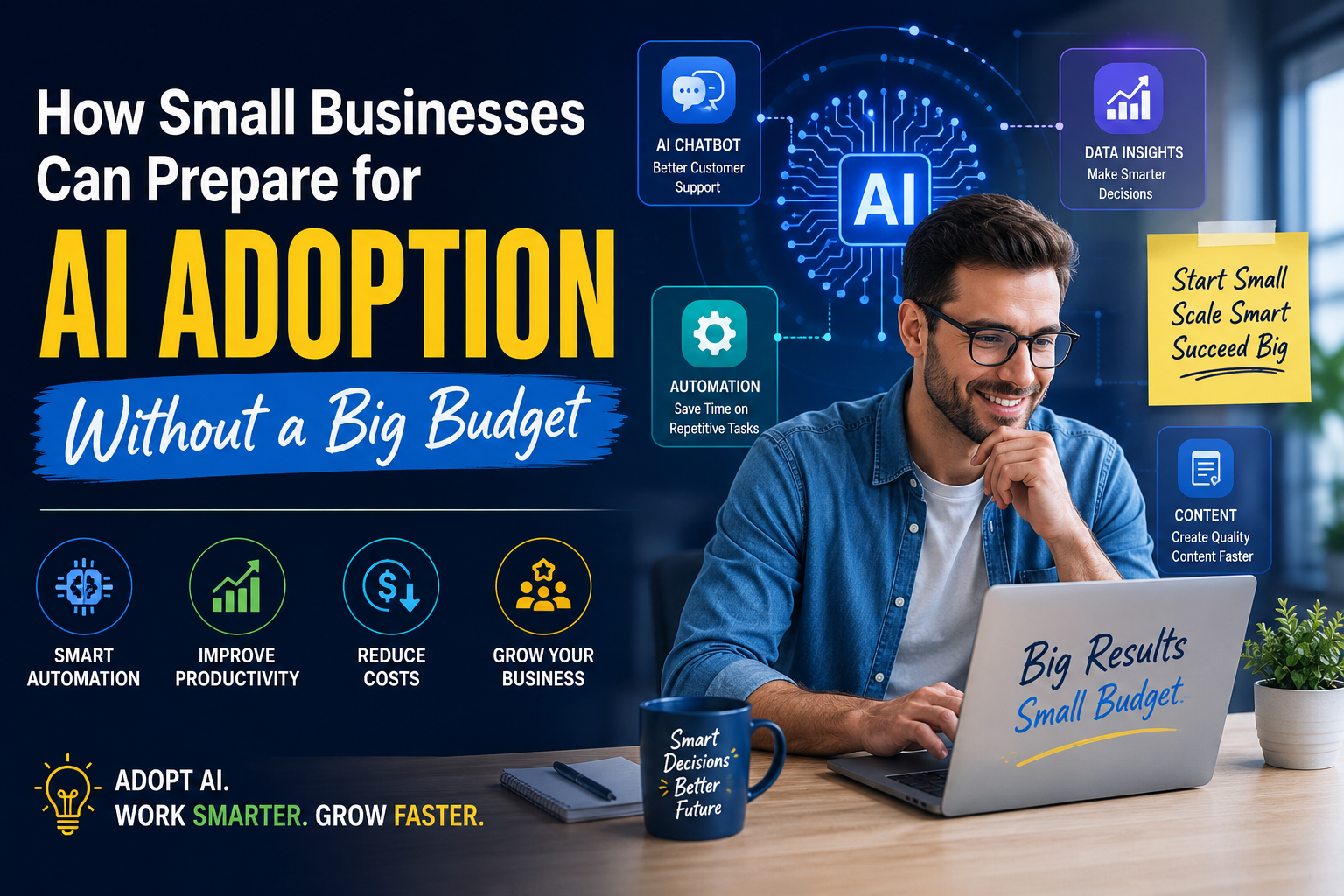
Artificial intelligence is not just for big companies anymore. Small businesses can use AI today to improve everyday work, increase productivity and reduce manual work.
Many business owners think that implementing AI is difficult and expensive. But this is no longer the case. Cheap subscriptions and free platforms and cloud-based AI tools mean businesses of all sizes can now tap into AI.
The real challenge is not to purchase AI. It is getting your business ready to use it well.
Small businesses can get started on their AI journey with the right strategy, without a big investment.
This guide will take you through practical steps to prepare for AI adoption—without breaking the bank.
What Is AI Adoption?
Adopting AI means integrating artificial intelligence into your business’ daily operations.
AI doesn’t replace employees, it helps them do repetitive work better. It can analyze data, answer customer questions, generate reports, automate workflows and help you make better decisions.
“Small businesses should think of AI as a business tool, not a replacement for people.
When done well, it improves productivity and frees up employees to do higher-value work.
Read more: AI Readiness Checklist: What Every Organization Must Know Before Scaling AI
Why Small Businesses Should Start Preparing Now
Artificial intelligence is becoming part of modern business.
Companies that begin learning today will be better prepared for future competition.
Small businesses often have few employees and limited resources. That’s why every hour matters.
AI can help cut down on repetitive work, speed up response times, and make many jobs more efficient on a day-to-day basis.
Starting early also gives businesses a chance to understand the technology before scaling up its use.
1. Identify Repetitive Business Tasks
The first step is understanding where AI can provide the greatest value.
Review your daily operations
Identify recurring employee responsibilities.
The most common are: Responding to frequent customer inquiries, making appointments, data entry, report creation, invoice management, writing standard emails. Such activities often eat into precious working hours.
First, by identifying the repetitive processes, organizations can deploy AI where they can get the fastest payoff.
Don’t try to automate everything; pick one problem to solve.
2. Build a Strong Digital Foundation
AI performs best when business information is already organized.
Look at the digital systems you already have in place before you add AI.
“Ask yourself a few questions.
- “Do you have computerized customer records?
- Do you have a system for the business papers?
- Is critical data backed up and safe?
- Do your employees already use software that is based on the cloud?
If the answer is no, then improving your digital infrastructure should be your first priority.
AI is built on good data.
Poor quality data usually results in poor quality results.
Keeping your digital world clean and organized makes AI tools much more effective.
3. Start with Low-Cost AI Solutions
Many business owners think AI requires expensive software.
Luckily, that is no longer true.
Many reputable AI platforms have free plans or low-cost monthly subscriptions.
Small businesses can get started with cloud-based solutions instead of spending thousands on custom AI systems.
AI tools, for example, include: Content writing, Support, Help with email, Synopsis of documents, Transcription of meetings, and automating workflows. These solutions require little technical knowledge and can often be installed in minutes.
This allows businesses to learn AI gradually while minimizing financial risk.
4. Prepare Your Team Before Using AI
Technology alone does not improve a business.
People have to know how to use it.
Before you start introducing AI tools, explain why you’re using them. Show employees that AI can help them do their jobs better, not take their jobs away.
Provide basic training courses.
Begin with tools that are easy to learn so that employees can learn quickly.
Show, for example, how you can use AI to write emails, summarize documents or organize meeting notes.
Comfort with new technology increases the likelihood of employees adopting and effectively using it.
5. Protect Business Data
AI systems work with information.
This is why you should always prioritize data security.
Before using any AI platform, check how it stores and protects your business data.
Choose tools that support data encryption, cloud storage for data safety, access control for users, privacy & policies, and compliance with industry standards. Before you upload any sensitive customer data, make sure you know how the platform is treating your data.
Good security practices keep you and your customers safe.
6. Choose AI Tools That Address Real Problems. Today, you have hundreds of AI tools at your fingertips.
But having too many tools can be confusing.
Instead of downloading a bunch of popular apps, choose your business needs.
Choose tools that solve specific business problems. For example: – The use of AI chatbots can greatly enhance customer support services through swift responses and assistance. – AI writing assistants assist marketers in crafting engaging content and campaigns. – Invoice Processing Automation – Improves efficiency and accuracy for finance teams. AI-enabled CRM systems can help sales teams improve customer relationship management and increase sales. – AI productivity tools can assist project managers in optimising task management and workflows. “It’s better to choose tools based on business objectives rather than chase after technology trends.”
7. Start with a Small Pilot Project
There is no need to transform the entire business overnight.
Often the safest way is a small pilot project.
Choose one department or one business process.
Experiment with AI for a few weeks and see how it works. You can use AI to write the weekly business reports or automate the customer support emails. And employee feedback is critical in this prototyping phase to know what’s working and what’s not working. A successful AI pilot will reduce risk and build confidence before the AI is rolled out across the organization.
8. Measure the Results
AI should create measurable business value.
After implementation, monitor key performance indicators.
These may consist of: Time gained, running costs, customer reply time, productivity of employees, customer satisfaction, reduced errors. What has been the business performance since the adoption of AI?
If the results are positive, consider expanding AI into other business areas.
Regular review means your investment keeps delivering value.
It also helps identify opportunities for further improvement.
9. Avoid Common AI Adoption Mistakes
Many small businesses are excited about AI. However, many businesses tend to make similar mistakes when starting out. One option is to try and automate everything all at once. This can confuse employees and cause unnecessary headaches. Another mistake is selecting AI tools without a clear purpose. A tool may have many features, but it will not help if it does not solve a real business problem.
Some businesses also ignore employee training. Even the best AI software cannot deliver good results if people do not know how to use it.
Finally, never depend completely on AI. It can save time and increase efficiency, but human judgement still has its place. Employees should always fact-check all AI-generated content, reports and business decisions before acting.
10. Build a Long-Term AI Strategy
AI adoption is not a one-time project.
As your business grows, so will your AI needs. Create a well-defined plan for the future benefits of AI for your business. This plan should cover: – The business goals you want to reach. – AI productivity boosters – Methods of training employees – Measures for data security. – A budget for future AI investments. As your business evolves, be sure to review and revise this plan regularly. A long-term strategy for AI allows companies to take a manageable, cost-effective approach.
AI Is an Investment, Not an Expense
Many business owners focus only on the cost of AI.
Think instead of the value it generates.
If you can save your team hours a week with AI, cut down on manual errors and improve customer service, it quickly becomes an investment that helps your business grow.
We are not trying to replace staff.
The goal is to help them work smarter.
Even rudimentary AI tools can make you more productive without breaking the bank.
Final Thoughts
Artificial intelligence is no longer limited to large enterprises.
These days, small businesses can harness AI without a big financial hit.
“The secret is to start small, solve one business problem at a time and get your team and your data ready before you introduce new technology.”
By establishing a solid digital foundation, selecting the right tools, and measuring results, companies can mitigate risk and realize long-term value.
Furthermore, prior to deploying AI into your organization, it is useful to utilize a structured AI Readiness Checklist to identify gaps in technology, data and business processes. It is easier to adopt AI when you have a plan to do so.
Companies that begin to prepare now will be in a stronger position to compete, innovate and grow in the years ahead.
Increase your website DA – Justblogo
Frequently Asked Questions
What is AI adoption for small businesses?
Artificial Intelligence can help you to improve your day-to-day business operations. It helps to automate repetitive tasks, analyze data, improve customer service and increase overall productivity.
Is AI expensive for small businesses?
None. Many AI tools have free versions or low-cost monthly plans. “For small businesses, the entry point can be affordable cloud-based solutions that can scale with the business.
What is the first step before adopting AI?
The first step is to identify repetitive tasks that consume time. Once companies know what the tasks are, they can select AI tools that solve those particular problems.
Can AI replace employees in a small business?
No. AI is here to help employees, not replace them. “It does the routine work, and people still make decisions, solve problems and build customer relationships.
Why is an AI readiness plan important?
An AI readiness plan helps companies assess their technology, data, business processes and employee readiness before they roll out AI. That’s lower risk and higher likelihood of adoption.”