
The healthcare sector is among India’s largest and most diverse employment industries, with career options ranging from hospitals, diagnostic centres, pharmaceuticals, research facilities, clinics, to digital health organizations. However, recruiting the right talent for specialized positions remains a difficult task for both recruiters and prospective applicants.
Conventionally, job recruitment processes involve job portal websites, recruitment agencies, referrals, as well as the traditional application process. Although such methods are helpful, they fail to take the unique nature of the healthcare recruitment process into account. An organization looking for a critical care nurse will have many more requirements than simply a person with nursing certification. Such an institution might require an individual who has worked in critical care environments before, holds certain certifications, has preferred locations, and desired working days.
Digital technology is revolutionizing this practice. Creating an ecosystem of healthcare professionals and recruiters through such technology can make recruitment more relevant, efficient, and professionally oriented. This becomes especially true of Healthcare Jobs in India where there is a need to discover talented professionals in an improved way.
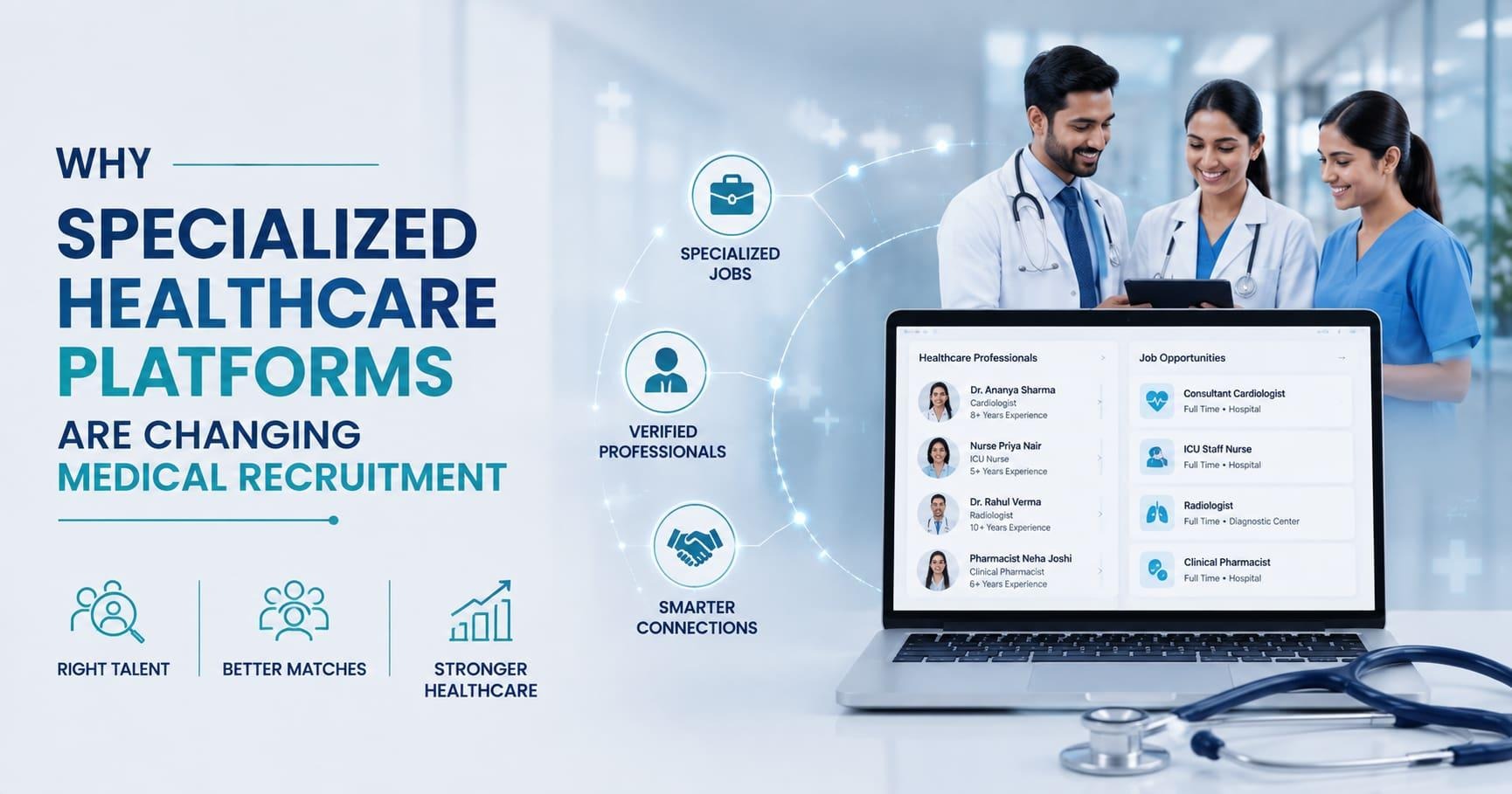
Why Healthcare Hiring Requires a Specialized Approach
Recruitment for the healthcare industry is different from other recruitment processes since the qualification and technical expertise of the candidate play an important role.
The suitability of the candidate can be determined based on:
- Education qualifications
- Specialization in clinical practice
- Professional certification
- Experience
- Registration/license requirements
- Tech skills
- Location
- Shift availability
- Healthcare industry experience
While in the general recruitment process one can use job title and skill as a basis to find suitable candidates, for healthcare it is required to provide more detailed information.
On the same note, while finding jobs, healthcare professionals can face problems since, even though they are qualified, the lack of specialization in the general recruitment process makes it harder for them.
Healthcare-specific recruiting platforms are used to solve this problem.
General Job Portals Have Their Limitations
General purpose job sites give you access to a vast number of openings, but this doesn’t always guarantee relevance.
An applicant from healthcare trying to find a job will see thousands of offers in unrelated fields. Even in the field of healthcare, these jobs will be missing important details on specialization, certification, clinical duties, or working conditions.
From the point of view of recruiters, it’s quite the contrary – they may receive lots of applications, but have difficulty finding suitable candidates.
It becomes an old recruitment problem – too many applications, but no relevant ones.
Specialized job sites lower the level of noise and create an environment for interaction between professionals and employers within the scope of the industry.
Healthcare Platforms Can Improve Candidate Matching
The best strength of specialized recruitment websites is better candidate matching.
Whereas every healthcare professional might not be a standard job seeker, the specialized website will help arrange profiles based on the profession, specialization, experience, skills, qualifications, and career interests.
For instance, when an organization is looking for a radiologist, it should seek an individual with certain imaging skills, instead of any other medical practitioner.
In a similar vein, where an organization seeks a pharmacist, they should go for someone with hospital pharmacy skills rather than a retail pharmacist.
This can easily be done through a specialized recruitment website.
More Relevant Opportunities: Professionals get an opportunity to learn about job openings that suit their skills.
Better Candidate Pools: Organizations can easily filter out individuals who fit particular requirements of the job.
Less Recruitment Noise: Time spent searching for non-relevant vacancies/applications is reduced.
Digital Professional Profiles Are Becoming More Valuable
The conventional CV is increasingly becoming just one aspect of a professional’s digital identity.
Healthcare-specific platforms enable professionals to build a complete profile with information on their education, work experience, certification, specialization, accomplishments, and career interests.
A complete profile helps an employer understand much more about the professional than a CV sent for a job application.
It also makes it possible for professionals to be visible even if they are not actively applying for positions. An employer searching for someone with a particular set of skills will be able to find the right person via his or her profile and contact them.
This means that the recruitment process becomes more than just a job-application-based process.
AI Can Make Specialized Platforms Even Smarter
Artificial intelligence can also enhance the importance of healthcare recruitment sites.
AI-based matching can analyse the needs of the company and find potential matches from professional profiles, using multiple criteria instead of just keywords match.
These may include such criteria as:
- Experience
- Specialization
- Certification
- Skills
- History of work
- Location preferences
- Career interests
In this way, candidates who would otherwise go unnoticed can be found for recruitment.
On the other hand, artificial intelligence may also assist professionals by recommending various job offers according to their career profiles.
As candidates gain additional skills or experience, recommendations may become more relevant.
The idea is not to replace the whole decision process.
AI is going to reduce search routines and supply better information.
Specialized Platforms Can Strengthen Professional Networking
Healthcare career choices are dictated by more than job openings.
Healthcare professionals gain from mentoring, learning, networking, collaborating, educating, and communicating within the industry. Such professional networking features could be easily integrated into specialized healthcare networking sites with the addition of recruiting services to form a more holistic environment.
A doctor could network with a fellow healthcare professional on some clinical innovation. A nurse could learn about a career opportunity from a peer. A pharmacist could network with organizations seeking their expertise.
Such interactions could create career opportunities that would not necessarily arise from conventional methods of searching for employment opportunities.
Creating a Better Experience for Employers
Recruiting technology should benefit both sides of the employment process.
There is a need for tools that will facilitate recruitment for the recruiting organization.
Specialized healthcare platforms allow organizations to:
- Target professional communities
- Customize their vacancies
- Find qualified applicants
- Create talent pipeline
- Capture better communication from applicants
- Limit unwanted applications
- Achieve more visibility among candidates
For healthcare organizations competing for talented people, having access to a talent pool becomes a huge competitive advantage.
Why Healthcare Startups and Smaller Organizations Can Benefit
The large hospital groups typically have a recruitment department, established employer branding, and a strong hiring network. This may not be the case for small healthcare organizations.
The specialized platforms will help the smaller organization in levelling the recruitment playing field through access to the relevant audience of professionals.
The developing diagnostics centre, healthcare startup, or specialized clinic will be able to promote its offerings to interested professionals instead of joining the competition in the general job market.
Specialized recruitment technology can thus become very useful for organizations that are expanding their teams or entering new markets.
Trust and Verification Will Become Increasingly Important
As digital recruitment becomes more popular, the issue of trust will become very important.
The employers want to be sure about the accuracy of the candidate information and the professionals – about the legitimacy of the job offer.
The specialized platforms will be able to leverage the additional layer of trust in the form of improved profile information, employer details, professional credentials, and responsible use of the candidate data.
It should not substitute human evaluation but provide a good base for it.
Specialized Platforms Can Improve Hiring Efficiency
Future healthcare recruitment will increasingly depend on how effectively organizations manage to identify, evaluate, and engage skilled professionals. The development of specialized platforms will be able to facilitate multiple steps of the process, from identifying candidates to communicating with shortlisted applicants.
A specialized recruitment environment will also allow employers to establish talent pools that they can tap into when new vacancies open up. Organizations will be able to maintain contact with potential candidates rather than start from scratch each time they need to find a professional for a new vacancy.
Remote and Flexible Healthcare Roles Are Expanding
The development of telemedicine and the healthcare field as a whole will also lead to increased possibilities of working remotely for many healthcare professionals.
There are certain jobs that can now be carried out either partly or completely via digital tools, including teleconsultation, medical documentation, healthcare administration, medical coding, patient coordination, and certain jobs within the healthcare technology sector.
Specialized platforms can help professionals to explore these new job possibilities while at the same time allowing organizations to contact candidates not just in their immediate geographical vicinity.
It is especially important for a large country like India where the concentration of healthcare talent and healthcare demand does not always coincide.
Skills-Based Hiring Will Become More Important
Employers in healthcare are starting to look beyond titles and degrees to gain insight into what applicants can really do.
Skills-based recruitment enables the recruiter to assess certain competencies in combination with educational background and experience. Two specialists can have similar basic qualifications, but the level of their competency in digital health systems, specific equipment, clinical documentation, or patient coordination can be totally different.
Specialized platforms will help to see these differences as they will give professionals an option to indicate their skills, certifications, and specialties.
For the applicant, this implies that it can be crucial to maintain a precise and detailed digital portfolio.
Professional Growth and Recruitment Can Work Together
The main benefit of specialized healthcare platforms is the possibility of combining recruitment with professional development.
With the platform, one can find a job offer as well as network, get educational material, read industry discussions, and learn about various career opportunities.
It helps to form sustainable relations between the professional and the healthcare system.
Rather than coming to the platform only when applying for a new position, the professional will be active on the platform throughout his career. The employer will be able to build such relations even before recruiting needs arise.
The Role of MedConnect in the Evolving Healthcare Ecosystem
The trend towards specialization within the healthcare community is leading to the development of platforms that will be designed specifically based on the needs of healthcare professionals.
One such platform is MedConnect, which puts healthcare professionals within an ecosystem that allows career growth and networking, among other things, within the same space as other resources within the industry.
The result is that there will be a reduced distance between the professionals and organizations that require their services.
Rather than being a one-time process, such specialized platforms will allow ongoing engagement with the professionals.
What Healthcare Professionals Should Do Now
The development of specialized recruitment platforms allows professionals to take certain actions to enhance their online career presence.
Keep Professional Profiles Updated: It is essential to review and update professional experience, educational background, certifications, skills, and specialization.
Highlight Specialized Skills: Job seekers need to promote the skills that make them different from other professionals, especially specialized clinical, technical, or digital skills.
Build Professional Connections: Networking with colleagues, recruiters, companies, and healthcare professionals helps professionals get visibility and access some unadvertised job opportunities.
Continue Learning: Healthcare is an ever-changing sphere. It is possible to enhance professional profiles by engaging in continuous education, getting certifications, attending workshops, etc.
What Employers Should Look for in a Healthcare Platform
When considering using specialized recruitment platforms, organizations need to look for more than the number of registered users.
The key factors to consider are:
- The quality and relevance of the professional community
- The completeness of profiles
- The search and matching options
- The ability to contact candidates
- The data privacy and security
- The level of employer visibility
- The ease of managing job postings
- The potential of creating long-term professional relationships
The main value of a platform is its ability to connect people and not to generate a lot of applications.
The Future Will Be More Connected, Specialized, and Data-Driven
Recruitment in the healthcare industry is now shifting from being purely transactional and passive, involving only posting job openings and waiting for responses.
The future of recruitment will require continuous talent discovery, artificial intelligence for matching, digital professional profiles, credential verification, networking, and personalized career suggestions.
Specialized platforms will be key in this transition since they understand the needs of the healthcare industry better than general labour market places.
This will allow employers to connect with more relevant talent while making the lives of professionals easier.
Conclusion
It is not just about publishing recruitment ads on the internet. The future of recruitment within the healthcare sector will see the creation of smart ecosystems in which qualified professionals and employers can find each other efficiently.
Specialized healthcare websites solve the problem of ineffective recruitment because they offer an integration of industry-specific jobs with profiles, networking, skills-based discovery and even intelligent technologies.
As new technological innovations like AI, digital certifications, telemedicine and smart recruitment gain traction, healthcare professionals with a good digital profile and active involvement in professional networks will have more chances to discover Medical Jobs in India and create successful careers for themselves.
For employers, the adoption of specialized recruitment websites will provide more access to qualified professionals while eliminating the inefficiencies of using generalized recruiting systems.
In the end, the future of healthcare recruitment will be about relevance rather than volume – about finding the right professional for the right employer for the right opportunity through technology.
Meta Title: Medical Jobs in India: Future of Specialized Healthcare Hiring
Meta Description: Discover why specialized healthcare platforms are transforming hiring in India through better candidate matching, professional networking, AI, and skills-based recruitment.