
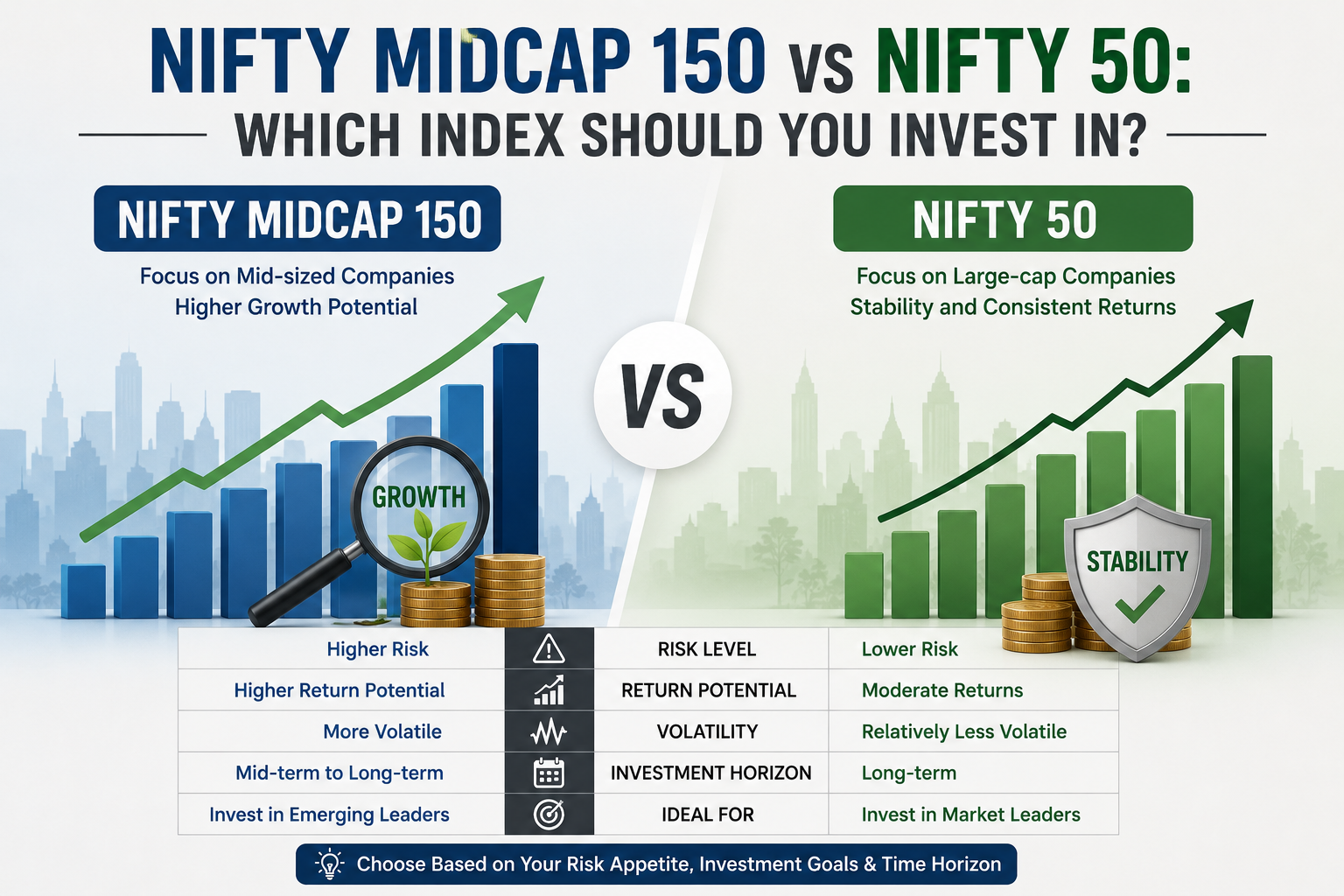
So a friend asked me this over chai last week, and honestly, I paused for a second before answering. Not because I didn’t know the textbook answer, but because the textbook answer kind of misses the point. Everyone wants a simple yes or no, right? Pick this one, ignore that one, done. But markets don’t really work like that, do they? The honest answer is “it depends,” and I know that sounds like a cop out, but stick with me here.
The Safe Old Uncle vs The Restless Cousin
Think of Nifty 50 as that dependable uncle who’s been working the same steady job for thirty years. Nothing flashy, no drama, just consistent paychecks. It tracks the fifty biggest companies on the exchange, the household names you already recognise without me telling you. Now Nifty Midcap 150 is more like the cousin who switches jobs every couple of years, chasing bigger opportunities; sometimes it pays off massively, sometimes you wince a little. This index covers companies ranked roughly 101 to 250 by size, firms that have outgrown the small fry stage but haven’t quite cracked the big leagues yet.
Here’s the thing, though. Numbers don’t lie, even when they surprise you. Looking at returns stretched across two decades, the average calendar year return for Nifty 50 sits around 14.8%, while Nifty midcap 150 has clocked something closer to 21.2%. That’s a meaningful gap. Not a rounding error, a real difference that compounds wildly over years.
Why Midcaps Keep Pulling Ahead
Now, here’s where it gets interesting. Across longer stretches, five years out to fifteen, midcaps have outpaced the large cap index by roughly three to four percentage points every single time, year after year, like clockwork almost. That’s not a fluke or a one-off lucky cycle. It’s structural. Smaller companies simply have more runway to grow, more room before they hit that size ceiling where growth naturally slows down.
And get this, even the floor returns tell a story. The worst-case seven-year stretch for midcaps still managed positive returns above five percent, while the worst-case for the large-cap index in that same window was basically flat, near zero. So even when midcaps have a rough patch, patient investors weren’t exactly drowning. They were just… waiting it out, somewhat uncomfortably maybe, but not losing their shirt.
But hold on, let me not paint this too rosy. Every coin has two sides, you know that already.
The Flip Side Nobody Talks About Enough
Volatility is the word that should be tattooed on every midcap investor’s wrist. These stocks swing harder, both up and down, and during crashes the pain is sharper. When markets fall hard, the large cap benchmark actually tends to hold up better, cushioning the blow more than the midcap segment does. I’ve watched friends panic sell midcap funds during a rough quarter, only to see the same fund roar back eighteen months later. Timing matters here; emotional discipline matters even more.
There’s also a valuation angle people quietly ignore. Right now the midcap segment trades at a price-to-earnings ratio above 33, noticeably richer than its own historical average and well above what the large cap index commands. That’s not a doomsday signal by itself; markets stay “expensive” for ages sometimes, but it’s a flag worth tucking away in the back of your mind.
What Actually Happens If You Stay Invested Long Enough
Okay, so here’s where my own bias creeps in a little; I’ll admit it upfront. Looking at systematic investment data across multiple market cycles, the pattern repeats itself almost annoyingly consistently. When the large cap index happens to beat the midcap one over a given stretch, the final corpus difference is usually modest, maybe five to fifteen percent higher. But when midcaps win, and they win more often than not, the final corpus can end up ninety percent larger. Read that again. Ninety percent. That’s not a small edge; that’s life-changing money on a long enough runway.
Does that mean you should dump everything into midcaps tomorrow morning? Absolutely not, and please don’t do that. It just means the asymmetry favors patience and stomach for bumps.
So Which One Should You Actually Pick
Real talk, I don’t think this is an either-or question at all. It feels more like a blending question, like making chai: too much milk and it’s bland, too little and it burns your tongue. Most seasoned advisors I’ve spoken with suggest anchoring your portfolio with the steadier large-cap index, maybe sixty to seventy percent of your equity allocation, then layering in midcaps for the growth kick on top.
If you’re younger, say in your twenties or early thirties, with decades before retirement even enters the conversation, leaning more aggressively into Nifty midcap 150 makes sense. Time smooths out volatility; it really does. I’ve seen it play out in my own family’s investments. But if you’re five years from needing this money for a house down payment or your kid’s college fees, please, for the love of all things sensible, don’t go heavy on the bumpy ride.
One more thing worth saying, and I mean this gently. Past performance numbers, however juicy they look on paper, never come with a guarantee sticker attached. Nobody, and I mean nobody, can promise the next twenty years mirror the last twenty. So build your allocation around your own timeline and your own sleep-at-night comfort level, not around whichever index posted flashier numbers last quarter.
I’m not a financial advisor, just someone who’s spent way too many evenings staring at index charts wondering why my portfolio dipped on a random Tuesday. So take all this as a starting point for your own homework, not gospel truth carved in stone.