
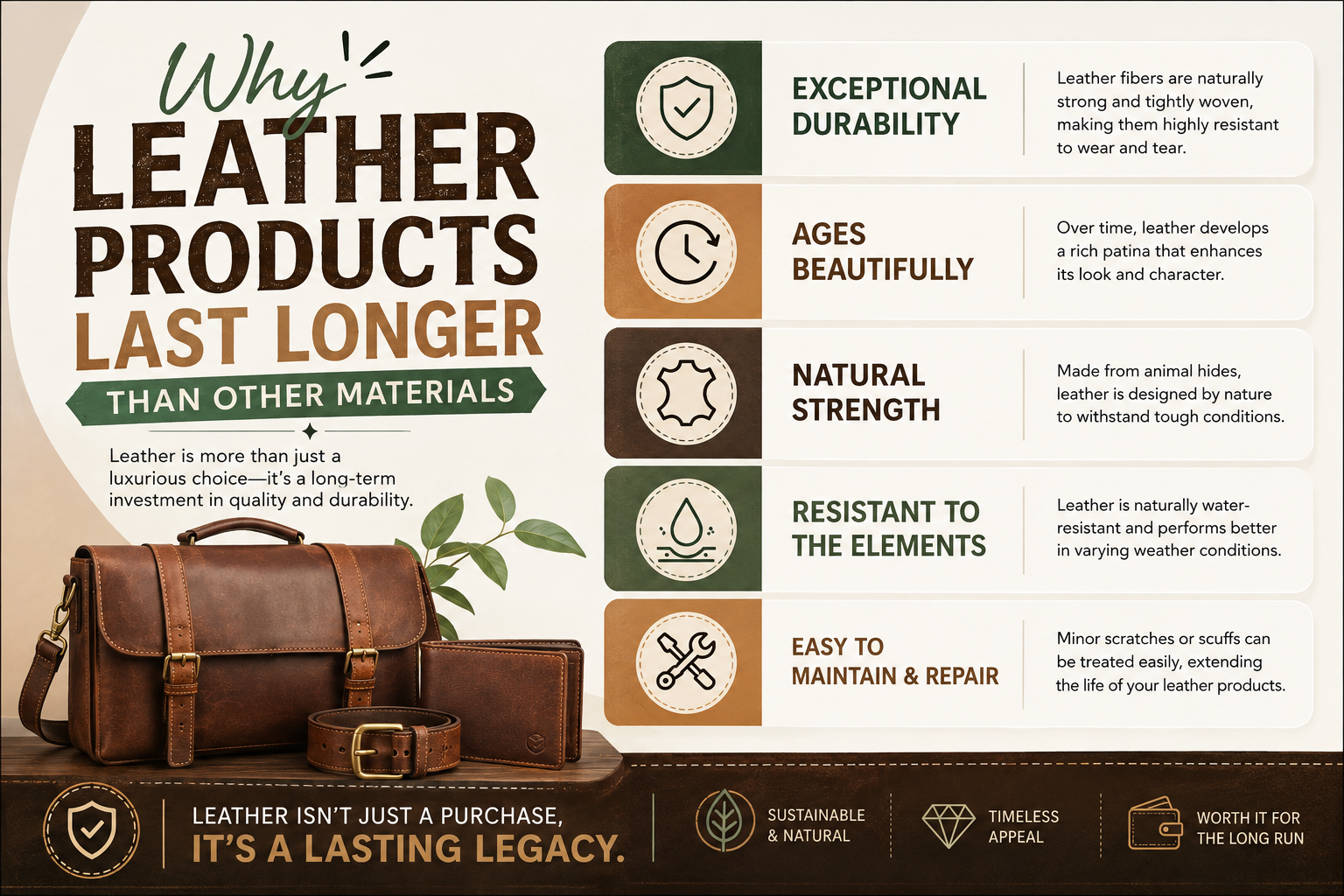
Open any closet, and you’ll find the evidence without even trying. The canvas tote from three summers ago has a hole in the corner. The peeling of the pleather jacket at the shoulders is similar to how sunburnt skin peels. But what about that old leather belt or wallet in the back? Still kicking, likely better looking than when it was purchased.
This isn’t luck.
This is chemistry, structure, and a process that has been honed over thousands of years in the manufacturing process. Now, let’s discuss why leather will never go out of style, at least not until the end of the world.
The Problem: Most Materials Are Built to Wear Out
The truth of the accessory business is that there is a lot of stuff that can’t be worn more than one time.
The sides of Canvas fray. Polyester-coated will crack with repeated folds. Synthetic leather, also known as PU or “pleather,” is a thin plastic film that is pasted over a fabric backing. As soon as this layer begins to peel, it’s too late. You’re not prolonging the usage; you’re only putting it off until later for the garbage.
What leather is makes it a problem-free choice. It’s not a coating. It’s not like a layer on top of something else. Made from a solid fiber throughout and does not suffer any apparent consequences of surface damage as do synthetics.
What’s Actually Happening Inside Leather?
The leather is composed of collagen fibers which are tightly packed together in a three-dimensional cross structure, analogous to the way threads are woven together in cloth but on a microscopic level.
This is hugely adaptable and robust, which is why leather can bend thousands of times without snapping or cracking. That’s in contrast to plastic-based materials that require chemical coatings to keep their pliability. With time, they start to dry, particularly in the presence of sunlight or temperature fluctuations.
After this, the material is brittle and begins to flake. This is not the case with leather. Feed it once in a while and the fibers remain flexible for years and years!
Patina: The Feature Nobody Else Can Copy
One of the strangest and most underrated things about leather is that it improves with age. The character of leather that darkens and softens with age, as a result of sun exposure, body oils, and handling, is known as patina. This can’t be done with a synthetic material. Plastic-based products have no character; they simply break down. A scuffed pleather bag appears to be damaged. A worn leather purse will be more “real” and usually more valuable.
That is why vintage leather furniture, leather jackets and leather bags are often more valuable than the brand-new leather bags and jackets made of synthetic materials. People are seen as valuable customers rather than a liability, a distinction not often found in any material.
It Handles Daily Abuse Better
Consider the things a bag, wallet, or pair of boots sees in the average day: tossed on car seats, dragged on the floor, shoved in overhead bins, rained on, sat on, etc. Most of the materials were not designed for the casual abuse. The use of leather was, for the most part, accidental, because it was of a natural origin. The hide was developed to protect the animal from scratches, punctures, and the elements, and from this the toughness is carried over to the finished product that you carry.
Take a brown leather backpack, for example. Canvas and synthetic leather would be ruined by the friction of the shoulder, or dropping on rough pavement or cramming full of books or laptops; quality leather doesn’t even take a dent. Instead, it simply penetrates, soothing the places you rub the most, and maintaining its strength elsewhere.
Stitching and Construction Matter Just as Much
Longevity isn’t only about the material itself; construction is a very important aspect of longevity. Leather from cheaply made leather products may be glued instead of sewn together or may be a combination of poor-quality leather scraps, known as bonded leather, which is only as tough as its weakest component and will quickly wear out. Brands that are committed to the long run employ full-grain or top-grain leathers, stress-point reinforcement and rust-resistant, durable hardware.
How Leather Compares Side-by-Side
| Material | Average Lifespan | Ages By | Repairable? |
| Full-grain leather | 10–30+ years | Softening, patina | Yes |
| Top-grain leather | 8–15 years | Slight patina | Yes |
| Canvas | 2–5 years | Fraying, staining | Limited |
| PU / pleather | 1–3 years | Cracking, peeling | No |
| Nylon | 3–6 years | Fading, tearing | Limited |
The gap isn’t small. Leather routinely outlasts synthetic alternatives by a factor of five or more, which changes the entire math on whether it’s actually the “expensive” option once you calculate cost per year of use.
Simple Habits That Stretch Leather’s Lifespan Even Further
You don’t need a specialty routine to keep leather in great shape. A few consistent habits make a massive difference over time:
- Condition every 3–6 months to keep the fibers from drying out and cracking.
- Avoid prolonged direct sunlight, which speeds up fading and dryness.
- Let it dry naturally if it gets wet — never use direct heat like a hairdryer or radiator.
- Store with shape support, like stuffing paper inside bags to prevent creasing in the wrong places.
- Clean spills immediately with a soft, slightly damp cloth before they set into the fibers.
None of this takes more than a few minutes here and there, and the payoff is a product that can genuinely last a decade or longer instead of getting replaced every year or two.
Why This Actually Saves You Money?
When considering leather vs towels, it’s easy to see that leather might seem more expensive and less functional. However, calculate the figures over five years. A replacement for that synthetic $40 bag will run about $130 over 18 months, and you have to keep buying new ones. A good leather bag that lasts for 5 years, and will have a resale value too, will actually benefit you on both the financial and waste fronts.
The Bottom Line
Leather is different in that it’s constructed differently at the fiber level which extends the lifespan, rather than simply being dressed up to appear tough on the outside. That is why companies like Alaskan Leather Company have been able to gain repeat customers, despite being relatively small and made up of craft makers. So when the stitching and hardware all match up to the quality of the hide, you’ll come up with something that is actually durable, not only for the first picture but for years of use.
Synthetic: follows trends, breaks easily with everyday use. Leather just keeps going: softening, ageing, aging up in ways nothing else on the shelf can come close. If you’re not ready to get rid of the same bag or wallet every couple of years, then take the advice, man! It’s mathematically correct, and leather is too.
Frequently Asked Questions
How long does real leather actually last?
With proper care, full-grain leather will last for 10 to 30 years, and sometimes more. It is one of the most robust materials that are used in the regular production of the items.
Does leather get weaker as it ages?
No, good leather does not become weaker with age; it becomes softer, more comfortable, and suppler! Fiber structure remains unchanged while the surface is changing.
What makes leather more durable than fabric
Leather has a dense, interwoven fiber structure that resists tearing and stretching, while fabric relies on woven threads that fray and loosen over time.
Can cracked leather be fixed?
Leather conditioner can often be used to restore minor dryness and small cracks. If the deep cracks occur, generally a professional leather repair service is required.
Is full-grain or top-grain leather more durable?
Full-grain is used from the very top of the natural grain layer and thus is more durable in the long-term, while top-grain is sanded slightly down and thus slightly less resistant to wear.
Why does leather smell different from synthetic materials?
Real leather has a natural, earthy smell from the tanning process. Synthetic leather often smells like plastic or chemicals due to the manufacturing materials used.
Does leather need to be replaced like other materials?
Rarely, if it’s cared for. Leather is one of the few materials that can be conditioned, repaired, and re-dyed instead of thrown out.
Is leather worth it for everyday use?
Yes, to most people. It can be used for a longer period with heavy use, which is more cost-effective than synthetic materials for this use.