
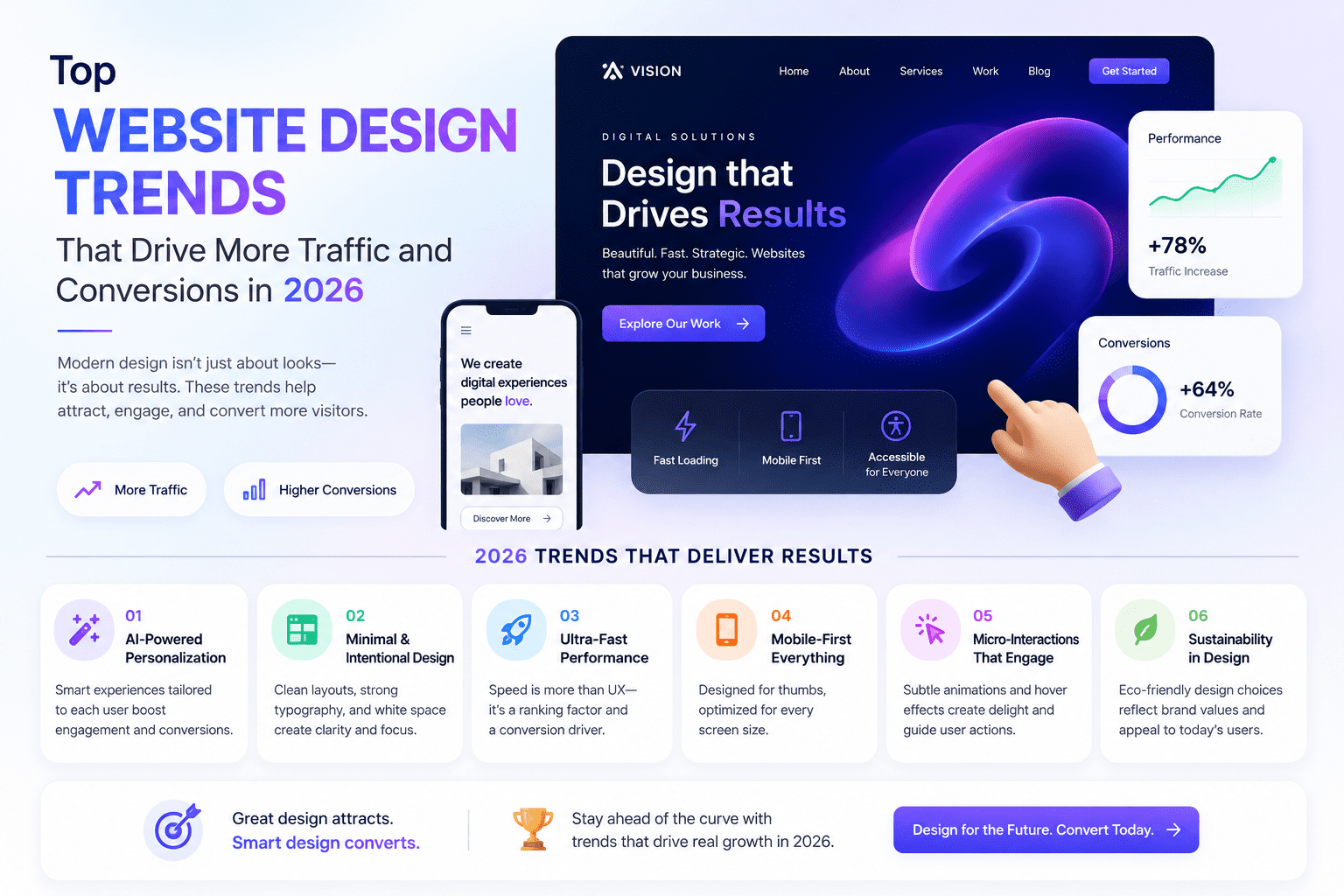
Businesses can no longer just lean on old websites to pull in visitors and start generating sales. By 2026, people expect a site that feels quick, simple to move through, mobile-friendly, and sort of designed around what they actually need. If the website doesn’t hit those expectations, visitors often bounce within seconds, and that means less traffic, weaker engagement and eventually fewer conversions, kinda all at once.
The problem is pretty clear. A lot of companies pour a lot into marketing campaigns but then forget how much website design matters for turning passersby into real customers. Google studies have shown that users usually form an opinion about a website in just milliseconds after they land on it. And if the experience is bad, bounce rates can rise, trust drops… even when the company is driving plenty of traffic.
That’s exactly why modern website design trends matter so much now. Based on market research, businesses that focus on user experience, mobile optimization, and overall performance tend to see better conversion results than competitors still using outdated layouts. And from what I’ve reviewed across various industry reports and case studies, the most successful websites in 2026 are the ones that blend functionality, speed, and user-focused design, to make a smooth path for customers from start to finish.
Why Website Design Matters More Than Ever in 2026
Website design is no longer just about how it looks . Honestly it affects search rankings, user engagement, lead generation, and even online sales more directly than people think . Search engines are now kind of increasingly rewarding websites that deliver a really strong user experience. So things like quicker loading times, solid mobile responsiveness , and navigation that makes sense help with better rankings and, in turn, improved visibility
A professional web designing company also knows that what gets designed changes how customers behave . Every little part, the page structure, the way the call-to-action gets placed , can affect whether someone sticks around, clicks , or actually converts
From what I know, companies that see website design as a business growth instrument not just a decorative asset, often end up with better digital marketing outcomes. In other words , treating it like growth, not just branding.
AI-Powered Personalized User Experiences
One of the biggest website design trends in 2026 is AI-driven personalization, which kind of feels like it has been “everywhere” lately. Modern websites can analyze visitor behavior and, basically, show customized content depending on user interests, where they are located, browsing history , and earlier interactions that happened on the site.
In a recent e-commerce case study, researchers found that personalized website experiences boosted conversion rates by more than 20% when compared with generic experiences. Rather than putting the exact same content in front of every visitor, businesses are now building dynamic experiences that fit each individual user’s needs, in a very direct way.
From what I have researched, tailored experiences can lower bounce rates and also nudge visitors to stay longer, exploring products and services. That supports traffic growth and conversion optimization at the same time, more or less.
Mobile-First Design Becomes the Standard
Mobile devices keep taking over the internet, like, worldwide. More than 60% of global website traffic now comes from smartphones plus tablets. So yeah, mobile-first design is basically not optional anymore.
When a website is made with mobile users in mind it tends to rank better in search results, also it feels smoother for people using it. Things like responsive layouts, touch-friendly navigation, images that are actually optimized and pages that load fast—those are the key pieces in today’s web designing.
A top web designing company now usually starts every new project by checking mobile performance first, then only later it expands the look for bigger screens. This method matches Google’s mobile-first indexing strategy and it helps businesses reach more organic traffic, in a very practical way.
Faster Loading Speeds Drive Better Results
Website speed is still, honestly one of the biggest ranking and conversion factors in 2026, research basically keeps showing the same thing. Like even a single second of delay during page loading can drop conversion rates, quite a bit.
People want websites to feel almost instant, not kinda slow, not “in a moment”. When a site takes too long visitors get annoyed , and then they simply leave more often. That’s why modern website design is mostly about speed optimization, using image compression , cleaner and more efficient coding approaches, content delivery networks , and also simpler page layouts that don’t drag.
According to market research, websites that load in under two seconds usually see a meaningfully stronger engagement level than competitors that are more sluggish. And faster pages don’t just help conversions directly, they can also boost search engine visibility, which then starts a sort of loop: more traffic, better outcomes, and improved conversion results.
Simplified Navigation Improves User Engagement
Complex navigation structures can throw people off a lot, like really during the whole customer journey, and it adds friction in ways that are easy to miss. In 2026 one of the strongest website design trends is simplifying navigation so visitors can find what they need fast, without all that extra wandering.
When you look at websites that work, they tend to have clear menus, sensible page groupings, a search option that stands out ,and navigation paths that feel natural. The main aim is to cut down the mental work and kind of nudge users toward the actions that matter.
From what I gathered in my research , companies that streamline website navigation often see lower bounce rates, plus better conversion results. That happens because people reach the right information more smoothly, without getting stuck or frustrated.
Interactive Design Elements Increase Conversions
Interactive website bits are getting a lot more popular lately, mostly because they boost engagement and kinda make it stick in peoples heads. Things like calculators, quizzes, hands on product demonstrations, and content that changes on the fly make people want to click around, instead of just sitting there consuming information in a passive way.
These kinds of interactive moments can also help companies gather useful customer clues, while at the same time stretching the time users spend on the site. When someone lingers longer, it often builds trust more solidly and that can push conversion rates upward.
In one recent case study from a software company, they mentioned a noticeable rise in qualified leads after they added interactive evaluation tools to their website. Visitors seemed more willing to finish those forms and ask for consultations once they had gone through tailored experiences , not just generic pages.
Accessibility Becomes a Business Requirement
Website accessibility is now kind of a key piece in modern web design, and honestly it matters a lot for businesses. People are starting to see that websites should be usable by everyone, not only people without disabilities but also those who rely on assistive tools.
Accessible design usually means readable fonts , solid color contrast , keyboard navigation support, alternative image text and general screen-reader compatibility. It goes past basic checklists though, because when it works well, it makes the whole experience better for every visitor , not just a subset of users.
From what I understand, accessible websites tend to bring in a wider audience and also higher user satisfaction. And search engines, they also tend to reward sites that deliver inclusive experiences in the first place.
Advanced Design Strategies for Adult Industry Websites
The adult entertainment industry keeps showing rapid online growth,so there is more demand for specialized design solutions. Companies in this area need unusual kinds of help with user experience, privacy, security, and rules compliance, which is a lot more than “just looks” .
Professional adult web design is mostly about building secure, easy to use experiences that keep visitor confidence steady while still meeting business goals. In practice, good adult website design uses quiet navigation, dependable payment handling, and well tuned systems for delivering content, across different devices.
An experienced adult website developer usually understands the technical side that comes with platforms that must manage high traffic volumes yet still hold performance and security standards in place.
From what I researched, businesses that invest in professional adult website development often see better user retention and more solid search visibility, when you compare them with competitors who rely on older platforms.
Security-Focused Design Builds Customer Trust
Cybersecurity concerns still kind of shape how people behave online. Visitors are getting more cautious about what personal details they share on websites that look a bit untrustworthy, or even shady at first glance.
Nowadays, website design tends to include clear trust markers , secure browsing protocols , privacy centered layouts, and data practices that are spelled out pretty plainly. Together these parts help build credibility and nudge users to finish transactions or go ahead and send the contact form.
Companies working in adult web development in particular can really benefit from solid security steps, since user privacy often ends up being a key factor in how customers decide where to go.
Also, those trust-building design cues can seriously move conversion rates, most notably for organizations that compete in crowded or fast changing markets.
E-Commerce Design Trends That Boost Revenue
Online shopping experiences keep moving forward, like it’s impossible to stand still. Businesses that want real growth through e-commerce have to adjust to what customers expect now, and also to whatever design standards are showing up next.
In modern adult e-commerce web design, people tend to focus on a more streamlined payment flow, smart product suggestions, quicker product discovery and mobile-first usability. These tweaks help cut down the “friction” moments , and in turn they push more conversions, more often than before.
Looking at case studies from several online retailers, a common pattern shows up. When the checkout gets simpler, cart abandonment often drops quite a bit. Companies that remove non necessary steps tend to get clear results in terms of purchases that actually get completed.
According to market research, shoppers are increasingly leaning toward buying journeys that keep things convenient , fast, and transparent during the entire process.
Data-Driven Design Decisions Deliver Better Results
A really important shift in how websites get designed right now is the growing dependence on data. Instead of picking design choices just on the basis of looks, companies tend to lean on analytics, heat maps, user recordings,and various testing tools to figure out what visitors are actually doing.
Data driven design also helps spot the friction points that stop people from converting. In practice businesses can keep leveling up site performance by watching how users move around pages and then tuning the layout details.
An experienced adult site design team will often use behavioral insights to refine the user path, and to push engagement higher, all while not degrading usability.
Conclusion
The most successful websites in 2026 are not always the most visually complex either. A lot of the time, it’s more about websites that put user experience first, plus performance, accessibility, security, and yes, personalization. In my research, I noticed that businesses that lean into these modern design styles usually end up with more traffic, better engagement, and higher conversion results.
And whether you’re dealing with a more traditional web designing company, or you team up with specialists in adult website design, putting money into newer website strategies can turn into a real competitive edge. Honestly, the future seems to go to companies that get how design affects customer behavior, and then use that understanding to shape an experience that pulls people in, keeps them interested, and turns that intent into action.
If you keep your focus on speed, mobile optimization, tailored personalization, security, and ongoing, data-driven refinements, you can build websites that don’t just match what users expect now, but also help you grow steadily over time and reach sustainable online success.