
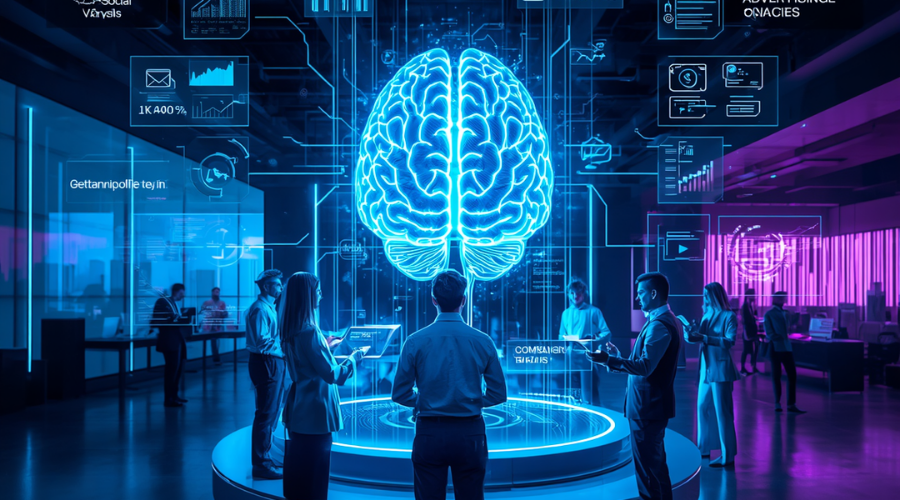
Artificial Intelligence (AI) is proving to be a key driver of growth in online advertising and marketing; the technology has progressed substantially, and most companies are using, or are soon to use, increasingly sophisticated services for processing large volumes of data, identifying buying patterns, and facilitating better decisions. AI helps marketers streamline difficult processes, automate repetitive jobs, and even surface patterns of customer purchase that take a lot of time and effort to detect. As companies broaden into different kinds of online media, organizations can respond efficiently to client needs; while AI does not seem to be a replacement for an online marketer’s work, it rather aids.
With new investments in various digital solutions that are still rising, technologies that revolve around artificial intelligence will be impacting the future of advertising as well as interacting with consumers. The Artificial Intelligence Market addresses these technologies in relation to the implementation of AI in planning, audience, content management, and measuring campaign effectiveness within organizations.
Understanding AI in Digital Marketing
Artificial intelligence is concerned with the development of computer systems that can carry out tasks normally associated with human intelligence. These tasks may include learning from data, recognising patterns, understanding natural language, prediction, and so on. When incorporated into digital marketing, AI systems can leverage technologies such as machine learning, natural language processing, computer vision, and predictive analytics for faster processing and analysis of information.
Unlike conventional software that works within a certain set of rules, AI systems become more intelligent over time as they process more information; these processes help marketers make more appropriate decisions by gaining more understanding of customers’ behaviors.
The amount of digital data continues to grow, and there are various ways in which the digital data can be interpreted into useful insights.
Delivering More Personalised Customer Experiences
Let AI give everything a personal touch. The days of online uniformity are well and truly over, and one of the many tactics used to achieve modern personalization is one of the most crucial. Instead of being subjected to what everyone else gets too, consumers these days expect a tailor-made experience online that caters to their personal tastes, interests, behaviors, and interactions.
And that’s where AI comes in.AI achieves personalization by learning about a customer based on patterns like click-to-purchase, website interaction history, behavioral patterns, and engagement. Based on these learned attributes and behavior patterns, AI can suggest products, optimize website elements, facilitate personalized communications, and generally improve every digital interaction throughout the customer lifecycle.
How do these personalization initiatives come to fruition? It’s all about analyzing real-time customer behavior, and AI’s automated analysis of those customer behaviors enables organizations to react faster to shifts in consumer preferences as and when they occur-without human intervention necessarily stepping in every time.
Improving Audience Understanding
Analyzing customer behaviour has always been a part of developing effective marketing strategies. AI enhances this by analyzing huge masses of data that are simply not feasible for us to process efficiently in a reasonable amount of time. Machine learning algorithms, using individual characteristics, website behaviour patterns, and customer interactions, discern trends.
This is where organizations can get to grips with who their audience cares about, the subtle shifts in this sentiment as they unfold, and to strategize opportunities to do it even better.
This moves the focus away from historical assumptions and to a basis that uses AI to inform business plans.
Enhancing Digital Advertising
The process of digital advertising is one of constant testing and optimisation. Using artificial intelligence, this process can be expedited and made more efficient, allowing computers to examine and recognise patterns in advertising performance and contribute their insights to further improve advertising campaigns.
Using artificial intelligence, advertising data such as response to the audience, engagement level, overall performance, and behaviour can be examined and used to understand which direction the advertising campaign should progress.
Instead of replacing the advertising strategists, artificial intelligence can contribute its analysis of the campaign and allow advertising strategists to make more informed decisions. This would then let them further develop the advertising campaign while also being able to respond to any changes that may occur much quicker than before.
Supporting Content Development
To create high-quality content, you need time, planning, a creative mindset, and editing efforts. However, AI is becoming more prevalent as technology that content creators now lean on to do the research or to define trending subjects,s as well as structure that can give you better grammar or clarity.
Some of the new features with AI include summarizing tons of research, figuring out and organizing relevant keywords as well as research topics, cs and giving the audience a basic structure of an article or blog post. We will explain some of the benefits in the following paragraphs, while also noting that human skill continues to be invaluable in generating original ideas. This would hopefully allow any team to work smarter and create valuable output.
Strengthening Search Engine Optimisation
The sophistication of search engines has and is driving new trends in optimising your content. By looking into search intent, popular keyword searches, or even your website, marketers now have the possibility of working out a clearer process of how best to answer search queries. Using sophisticated SEO AI can even highlight flaws in your website’s code for improving visibility, as well as giving suggestions of how your content should be in relation to the queries searchers are looking for.
It is important to mention that the AI also analyses the current search user behaviour, allowing companies to be ready for any changes in their customers’ search behaviours.
Although the data generated by the software is extremely helpful and can support ongoing searches, it does not fully replace the skills needed to achieve effective and high-end SEO marketing for your future success.
Making Email Communication More Relevant
However, emails are still some of the oldest forms of digitally written language that is a prevalent part of online marketing. AI is already changing how emails make meaning by revealing where an audience’s attention typically goes and therefore what messages need to be sent for a brand or organization that wants to get seen and heard.
Based on email marketing efforts and history-both the times when subscribers actually open messages and whether they tend to open an interaction-AI is often there to help suggest better, higher-quality, more human messages that allow us to improve audience affinity without conducting loads and loads of newA/B testing. However, in the wake of AI to help us better tailor and optimize the emails we send, nd there’s one thing that is as paramount as it gets to making better-quality messages that get a human to care and open: the overall quality of content you are communicating.
Analysing Social Media Conversations
Loads of content get generated on social media platforms daily,aily and so Artificial Intelligence supports advertisers in analyzing these bits of data through their patterns, rates of interaction, and, in general, tone or the sentiments shared within a conversation. Leveraging Natural Language Processing, AI helps interpret comments and texts to interpret the actual sense behind them, which enables organizations to gauge interest in topics, trends, and problems for their customers. It has been seen to enable marketers to comprehend the sentiments and respond empathically.
Using Predictive Analytics for Smarter Planning
Predictive analytics uses historical and recent customer information and trends in order to provide accurate forecasts of future possibilities. Beyond looking backwards and learning what has happened in the past, AI uses data to recognize trends that are likely to precede market shifts and certain patterns in customer interactions.
This forecasting offers value to marketers trying to estimate customer demand, identify predictable market or retail trends, and develop successful marketing campaigns. Predicting the future isn’t going to be exact, but predictive analytics offers helpful direction for decision makers striving for more proactive, rather than reactive, planning.
In the long-run, further developments can increase our understanding as more data becomes available.
Improving Marketing Automation
Technology has become essential in modern marketing, especially in automating repetitive tasks. Artificial intelligence takes automation to a new level by introducing adaptability, which makes it possible to react to customers’ actions and behaviors rather than following a static ruleset.
Thus, the ability to perform functions not usually open to software is manifested in the way marketing activities can be automated. This can include sending out emails, targeting specific customers, and recommending products. The opportunities provided by artificial intelligence can optimize marketing to a great extent while ensuring customers still feel personally attended to.
Ethical Considerations and Responsible Use
As you move toward widespread adoption of the technology, responsible use must continue to be front and centre. Personal information drives AI solutions, making it the most central piece of AI’s application for most businesses to get right. Whether personally identifying information (PII) is being gathered, retained, ed or processed by the technology, it must be doing so securely and ethically, ly and it will meet stringent industry standards as per regulatory guidelines.
Openness is the next – because our customers and their expect a reasonable explanation of how an automated decision impacted the digital experience they are interacting with.
That data fuels these AI models, els which are now the primary driver in the digital space customers traverse – bias. We must understand these models can inherently perpetuate our own biases. This is typically through the data on which they are trained. Constant monitoring, disparate training data sources, along with human review will help mitigate.
Challenges of Implementing AI
However, AI can create some big problems. For AI to work properly, it requires reliable, well-formatted data, and a large percentage of organisations struggle with embedding AI into their current systems. A lack of education within its workforce must be overcome.
Marketing teams must develop enough understanding to draw meaningful intelligence from the insights an AI generates – and to be sure they actually use this data in practice.
It is too risky simply to abandon strategy humans have and hand the reins to a bit of software. The key will still rest on creativity and intelligence, as only human insight can bring the required creative and strategic thought process.
The Future of AI in Digital Marketing
While we can anticipate more significant AI utilization in digital advertising and marketing, we can’t neglect future implications. Innovations that will arise within areas of machine learning, predictive analytics, natural language processing,g and computer vision will inevitably yield stronger advertising efforts, audience insights, and engagement possibilities, but will also call for better understanding through the aid of generative AI within aspects such as creative or language usage to establish efficient and quality-based efforts.
As guidelines evolve and customer behaviours change, businesses may lean toward more technological innovation combined with ethics, guidelines, and transparency around data sharing and usage.
Conclusion
Artificial intelligence is a powerful force currently changing how modern digital advertising and marketing work, enabling organisations to analyse more data, better understand their customers’ behaviours, and make more accurate decisions. Its role is growing exponentially, impacting audience analysis, communication, content creation, advertising, predictive analysis, and marketing automation.
Although it is hard to say how AI will develop in the future, its practical and sustainable application combined with human labour and expertise will help organisations create the most successful marketing strategies in the upcoming years.
Author Bio
Roshan Kumar is a Digital Marketing Professional at Expert Market Research, specializing in SEO, content marketing, and digital growth strategies. Passionate about SEO, business strategy, and content creation, he shares research-backed insights to help readers stay informed and make better business decisions.