
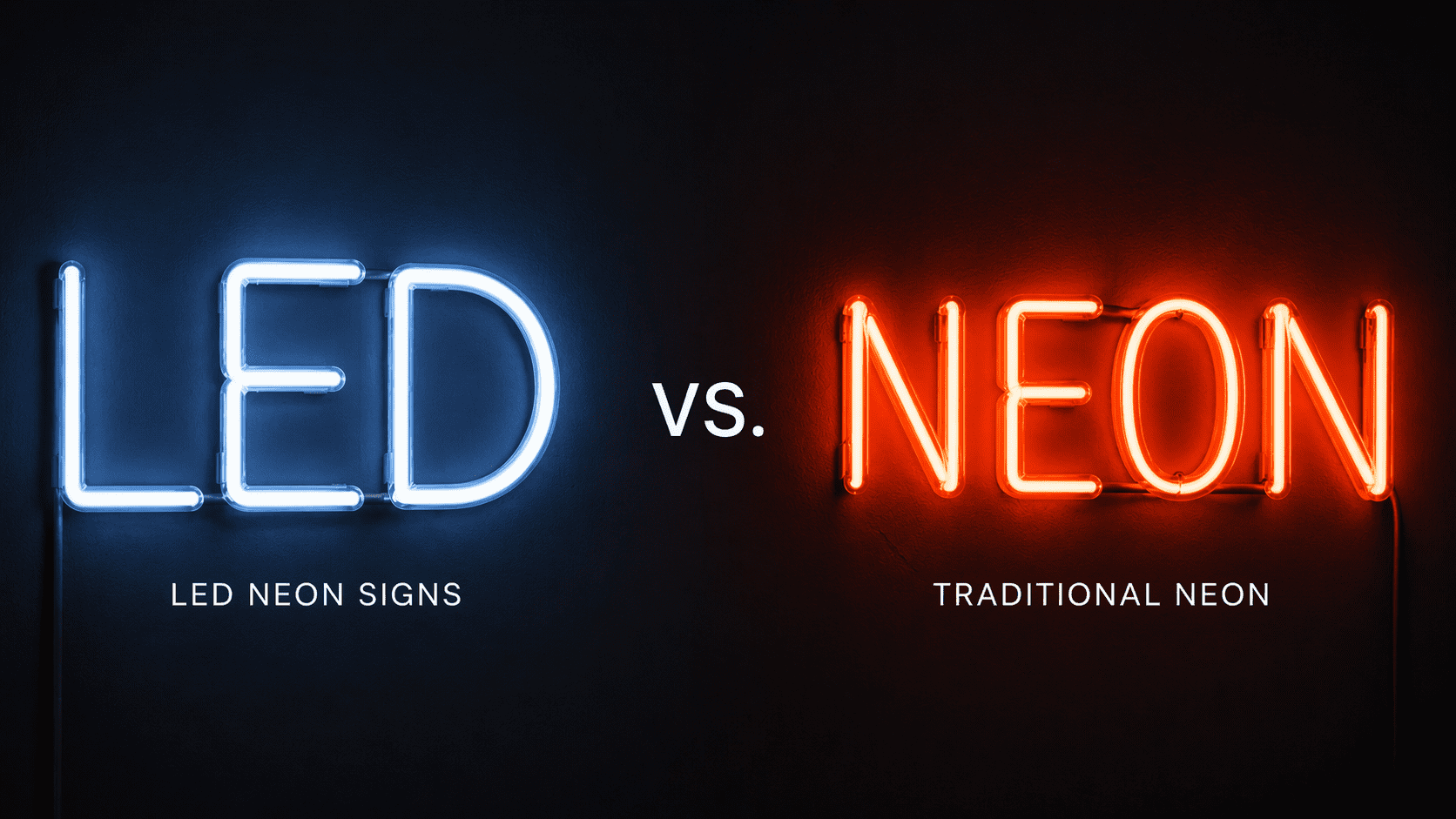
Walk past the right bar on the right street at night, and something just grabs you. That warm, slightly buzzy glow coming from the window. It’s hard to explain why neon signs do that – but they do. And yet, if you’ve gone shopping for one recently, you’ve probably realized pretty quickly that the word “neon” is being used to describe two completely different things right now.
That confusion is worth clearing up.
The Real Thing First
Traditional neon – the original kind – is a glassblowing trade. Someone physically heats glass tubing with a torch, bends it by hand into whatever shape is needed, and then pumps noble gases into the sealed tube. Neon gas gives you those warm reds and oranges. Argon mixed with mercury vapor gets you blues, purples, and greens. When electricity hits the gas, the atoms get excited and light up.
It sounds straightforward. It isn’t. A complicated sign can take a skilled craftsperson several days from start to finish, and there’s genuine artistry in the tube-bending alone. The transformers involved run at anywhere from 2,000 to 15,000 volts, which is part of why you don’t just hang one yourself and call it a day.
But here’s the thing – and this matters – the light that comes out of real neon is unlike anything else. It has a depth to it. A subtle, almost imperceptible pulse. Photographers have known this for decades. It’s why certain cafes and studios specifically seek out traditional glass rather than the alternative. The glow feels like it’s breathing.
LED Neon Is a Completely Different Product
I want to be direct here because a lot of sellers aren’t: LED neon is not neon. It’s flexible silicone or PVC tubing with LED strip lights inside, shaped to approximate the look of glass neon. The light is clean, even, and consistent. It doesn’t pulse. It doesn’t have that same depth.
None of that makes it bad. It makes it different. And for a huge range of applications, different is fine – or even preferable.
The LEDs run on 12 or 24 volts DC. You can handle it, ship it, and mount it without an electrician in most cases. It’s lightweight. Drop it, and it bounces rather than shatters. One section fails? You replace that section rather than the whole sign.
For context on the energy side: a mid-sized traditional neon sign might pull 400 to 500 watts. A comparable LED version often runs on 100 watts or so. If that sign’s running ten hours a day, that difference adds up over a year.
Where Things Get Genuinely Complicated
Durability is the practical argument for LED, and it’s a strong one. Glass cracks. Neon technicians – the people who can actually repair traditional signs – are becoming increasingly hard to find, especially outside major cities. If your glass sign breaks in a smaller town, your options narrow fast.
LED flex isn’t immortal either. Cheap versions develop uneven brightness over time, or you start seeing individual LED hotspots through the diffusion layer – little dots of light that make the whole thing look obviously artificial. Quality varies dramatically between manufacturers, more so than with traditional neon, where the production process is fairly standardized.
Customization is genuinely where LED has changed the industry. The reason custom neon signs are everywhere now – weddings, home offices, restaurants, pop-up shops – is entirely because LED flex lowered the production barrier. A decade ago, getting something bespoke made in glass was a significant commitment of time and money. Now, a smaller business can get a branded sign made quickly and affordably. That’s not a small thing.
The Authenticity Question (Which Is Real, Not Pedantic)
Some people will tell you this doesn’t matter. I disagree, at least partially.
There’s a growing number of customers – and business owners – who think they’re buying glass neon and receive LED flex instead. Reputable suppliers are usually transparent about this, labeling things clearly. But marketplace listings and budget suppliers often aren’t, and “neon sign” has become a catch-all phrase that technically describes both products now.
If you’re a purist, a collector, or a photographer who knows exactly what light quality you need, this matters a lot. If you’re furnishing a commercial space and mostly care about the sign looking good from ten feet away, it probably doesn’t.
When businesses evaluate LED neon signs for business use – window displays, interior branding, outdoor signage – the practical case tends to win: lower operating costs, easier installation, less maintenance. Most customers won’t know the difference. Some won’t care even if they do.
So Which One Do You Actually Need?
Honest answer: depends entirely on your situation, and anyone who gives you a blanket answer is probably oversimplifying.
Traditional glass neon makes sense if the aesthetic is the whole point. Vintage venues. Photography studios. Bars where the sign is part of the experience, not just decoration. Or if you’re someone who values the craft itself, the same reason some people buy hand-thrown pottery over machine-made ceramics. The process matters.
LED neon makes sense for almost everything else. It’s cheaper to buy, cheaper to run, easier to ship, easier to fix, and the visual difference is smaller than the traditional neon crowd sometimes admits. For most commercial settings, nobody’s standing close enough or long enough to tell.
One thing worth knowing: outdoor use is its own category. Not all LED flex is weatherproofed, and even glass neon needs proper sealing outdoors. Check the IP rating before you buy anything meant to face rain.
Before You Buy Either One
Glass neon is heavier than most people expect. Not “oh that’s a bit awkward to carry” heavy – more like “we should’ve hired someone for this” heavy. Large installs genuinely need proper mounting hardware and someone who knows what they’re doing. The sign itself surviving a bad mount job is not guaranteed, and the cleanup if it doesn’t is neither cheap nor fun.
With LED flex, the single most underrated thing you can do is buy from a supplier who actually picks up the phone. Or at least replies to emails within a day. Printing Limitless is one of the few that consistently gets flagged in this regard – real turnaround times, made-to-order flexibility, and they don’t vanish after the sale goes through. That sounds like a low bar. In this industry, it genuinely isn’t.
Because here’s what happens with cheap LED flex from a random overseas listing: the sign looks fine for six months. Then one section starts dimming faster than the rest. Then the diffusion layer starts to yellow slightly at the joints. Then you’re looking at a sign that cost you less upfront but now looks worse than nothing at all. The savings evaporate quickly once you factor in replacement costs – or worse, the cost of redoing your whole shopfront display.
The neon world has split into two genuinely different products, and both have earned their place. More people can afford good signage now than they could fifteen years ago, and that’s not a bad thing.
What shifted is just the language around it. “Neon” used to mean one specific thing. Now it doesn’t. Going in with a clear picture of what you’re actually buying – and what you actually need it to do – saves you money, time, and a fair amount of frustration down the line.
FAQs
What is the main difference between LED neon signs and traditional neon signs?
Traditional neon uses hand-bent glass tubes filled with gas that glows when electrified. LED neon uses flexible silicone tubing with LED strips inside. Glass neon has a warmer, deeper glow. LED neon is lighter, cheaper, safer to handle, and easier to maintain. Same look from a distance – very different products up close.
Are LED neon signs as bright as traditional neon signs?
For most settings, yes. LED neon is actually more consistent across the whole sign. Glass neon has a warmer, more organic glow that photographers and designers prefer – but for everyday commercial use, LED brightness is more than sufficient.
How long do LED neon signs last compared to glass neon?
Quality LED neon is rated for around 50,000 hours – over a decade of daily use. Traditional glass neon typically lasts 8 to 15 years. LED also wins on repairability since individual sections can be replaced rather than the whole sign.
Is it safe to install a neon sign yourself?
LED neon runs on low voltage and is generally safe for DIY mounting. Traditional glass neon runs on transformers up to 15,000 volts – professional installation is strongly recommended. Don’t cut corners on the glass kind.
Which type of neon sign is better for outdoor use?
LED neon, provided it carries an IP65 rating or higher. Not all LED flex is weatherproofed, so always check before buying. Glass neon can work outdoors but needs proper sealing and is far more vulnerable to moisture damage over time.