
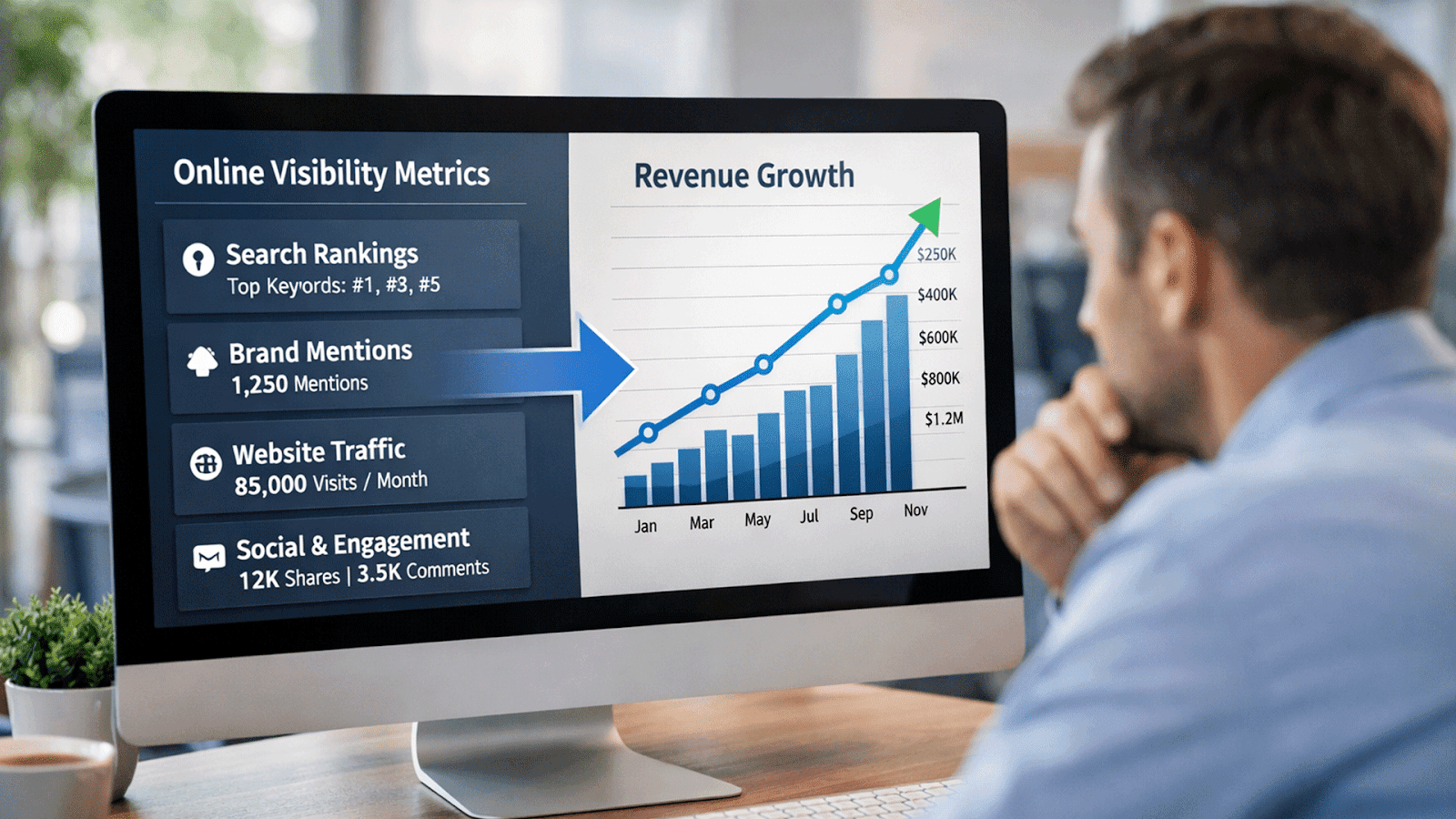
If you’re responsible for growth, visibility is no longer a “marketing metric.” It’s a revenue signal.
Most teams still track traffic, rankings, and impressions. Those numbers matter – but they don’t tell the full story. In 2026, visibility happens across traditional search engines and AI-powered answer platforms. Buyers often discover, evaluate, and shortlist vendors before ever visiting a website.
If your brand isn’t visible in those moments, revenue suffers quietly.
The key shift is this: visibility data must connect to business outcomes. Rankings alone don’t drive the pipeline. Recognized brands do.
Below are seven practical ways to track online visibility – and turn those insights into measurable growth.
1. Track Share of Search, Not Just Rankings
Ranking #1 for a single keyword doesn’t mean you dominate your category. What matters is how often your brand appears across your core topic space.
Instead of obsessing over isolated keywords, measure:
- How frequently your brand appears across high-value query groups
- Which competitors consistently outrank you
- Whether visibility is increasing within revenue-driving categories
For example, if your brand appears in 30% of decision-stage queries while a competitor appears in 60%, that gap represents lost opportunity – not just lost traffic.
Share of search trends often correlates with pipeline growth over time.
2. Monitor Brand Mentions in AI-Generated Answers
AI-generated answers from platforms like ChatGPT, Perplexity AI, and Google Gemini are reshaping discovery.
Users increasingly ask:
- “What’s the best tool for…”
- “Which platform should I use for…”
- “Top software for…”
They often receive summarized recommendations without clicking through to multiple websites. If your brand is mentioned, you enter the buying conversation early. If not, you’re excluded before evaluation begins.
Tracking AI visibility means:
- Monitoring which queries trigger brand recommendations
- Identifying which competitors are cited instead
- Mapping mentions back to specific content gaps
Platforms like Track My Visibility specialize in this layer of search, tracking brand mentions inside AI answers and connecting those insights directly to pages and queries that influence revenue.
3. Segment Visibility by Buyer Intent
Not all impressions are equal.
Awareness-stage queries may drive traffic but rarely produce an immediate pipeline. Decision-stage queries, on the other hand, often correlate directly with demos and deals.
Segment visibility into:
- Early research
- Comparison and evaluation
- High-intent, decision-focused searches
Then connect each segment to:
- Lead quality
- Conversion rates
- Revenue contribution
If your visibility skews heavily toward early-stage queries but you rarely appear in “best X software” searches, you may be building awareness without influencing buying decisions.
Revenue-focused SEO means measuring visibility where intent is strongest.
4. Connect Visibility to Page-Level Performance
Visibility data becomes powerful when tied to specific assets.
Instead of asking, “Are we visible?” ask:
- Which pages drive high-intent impressions?
- Which pages influence demos or pipeline?
- Which important pages rarely appear in search or AI answers?
Track My Visibility links AI visibility insights directly to real URLs and query groups. That means teams can prioritize updates based on revenue potential, not assumptions.
For example, if a product comparison page rarely appears in AI-generated recommendations, improving clarity, structured data, and outcome-driven messaging can directly impact buying-stage discovery.
5. Audit Technical Signals That Influence Visibility
Technical health isn’t just about SEO hygiene. It influences whether search engines and AI systems can interpret and surface your content correctly.
Track:
- Crawl errors and indexation issues
- Page speed and mobile performance
- Structured data implementation
- Internal linking strength
If high-value pages are poorly linked or missing schema markup, they’re less likely to be surfaced in search features or AI answers. Structured formatting and clarity also influence how LLMs choose content when generating recommendations.
Visibility gaps often stem from structural issues, not content quality.
Even with strong technical foundations, you need to confirm whether those improvements translate into AI visibility. Track My Visibility helps teams verify that technical fixes. By improving how often your brand appears in AI-generated answers.
6. Monitor Off-Page Authority Signals
AI systems evaluate brands based on ecosystem credibility, not just website content.
Track:
- Backlink quality, not just quantity
- Reviews on industry platforms
- Mentions in respected publications
- Third-party validation signals
When your brand consistently appears across credible sources, search engines and AI platforms are more likely to treat it as authoritative.
For example, if competitors are cited in industry blogs and appear in expert roundups while your brand does not, that disparity will often reflect in AI-generated recommendations.
Authority gaps frequently translate into visibility gaps, which then become revenue gaps.
7. Tie Visibility Metrics to Pipeline and Revenue
This is where most teams fall short.
Tracking visibility is valuable only if you connect it to outcomes. That means building reporting frameworks that show:
- Visibility trends vs. lead volume
- Decision-stage query presence vs. demo requests
- AI mentions vs. branded search growth
- Share of search vs. pipeline contribution
Over time, patterns emerge. Increased visibility in high-intent queries often precedes increases in qualified leads. AI recommendations can influence brand familiarity before users ever search directly.
Track My Visibility supports this connection by linking AI search visibility insights to specific pages and queries, helping teams prioritize optimizations that influence measurable growth.
The goal isn’t more data. It’s clearer cause-and-effect.
How AI-Generated Answers Influence Buying Decisions
AI-generated answers are changing the top and middle of the funnel. This shift reflects a broader evolution in search behavior, often explained through AI search vs traditional SEO dynamics.
When users ask tools like ChatGPT or Perplexity for recommendations, they receive synthesized responses based on structured, authoritative content across the web. These answers often shortlist vendors before buyers visit comparison sites.
This has three major implications:
- Brand discovery happens earlier in the journey.
- Being mentioned influences perceived credibility.
- Exclusion from AI answers reduces consideration.
Buyers increasingly trust summarized recommendations, especially for B2B software and services. If your brand appears consistently in these responses, you enter the conversation earlier – and with authority.
That early positioning often shapes final purchase decisions.
Conclusion: Visibility Is a Revenue Lever
Visibility in 2026 is bigger than rankings on a dashboard. It’s about whether your brand shows up when buyers are researching, comparing options, and asking AI tools for recommendations. If you’re not present in those moments, someone else is shaping the decision.
The teams that win don’t treat visibility as a vanity metric. They look at where they appear in high-intent searches, whether AI platforms are mentioning them, and how that exposure connects to demos, pipeline, and closed deals. Traffic alone doesn’t tell that story. Revenue does.
When you start connecting search share, AI mentions, technical performance, and authority signals back to real business outcomes, SEO stops feeling unpredictable. Tools like Track My Visibility help make that clearer by showing where your brand is being recommended, where gaps exist, and which pages actually influence buying-stage queries.
At the end of the day, visibility isn’t about being everywhere. It’s about showing up in the right conversations – the ones that lead to revenue.
Learn More: AI Writing Software for SEO: The Ultimate Guide
FAQs
1. How does online visibility directly impact revenue?
Online visibility determines whether your brand appears during high-intent searches and AI-generated recommendations. When buyers consistently see your brand in decision-stage queries, demo requests, and pipeline volume tend to rise. Visibility drives consideration, and consideration drives revenue.
2. Why isn’t tracking keyword rankings enough anymore?
Keyword rankings show position, but not full market presence. Buyers now discover brands across search engines and AI-powered answer platforms. If your company isn’t mentioned in comparison queries or AI-generated recommendations, rankings alone won’t reveal that missed revenue opportunity.
3. How do AI platforms influence brand discovery?
Platforms such as ChatGPT, Perplexity AI, and Google Gemini provide summarized recommendations when users ask for tools or services. These responses often shape shortlists before buyers visit websites, which means early mentions significantly influence purchasing decisions.
4. What visibility metrics should connect to pipeline performance?
Teams should evaluate how visibility in decision-stage queries aligns with demo requests, sales-qualified leads, and overall pipeline growth. When presence increases in high-intent searches, revenue impact typically follows within the next reporting cycles.
5. How can teams prioritize improvements that actually impact revenue?
Start by identifying where your brand is missing from high-intent queries and AI-generated answers. Then focus on strengthening the specific pages tied to buying decisions. Connecting visibility insights directly to revenue-impacting pages ensures effort translates into measurable growth rather than surface-level optimization.