
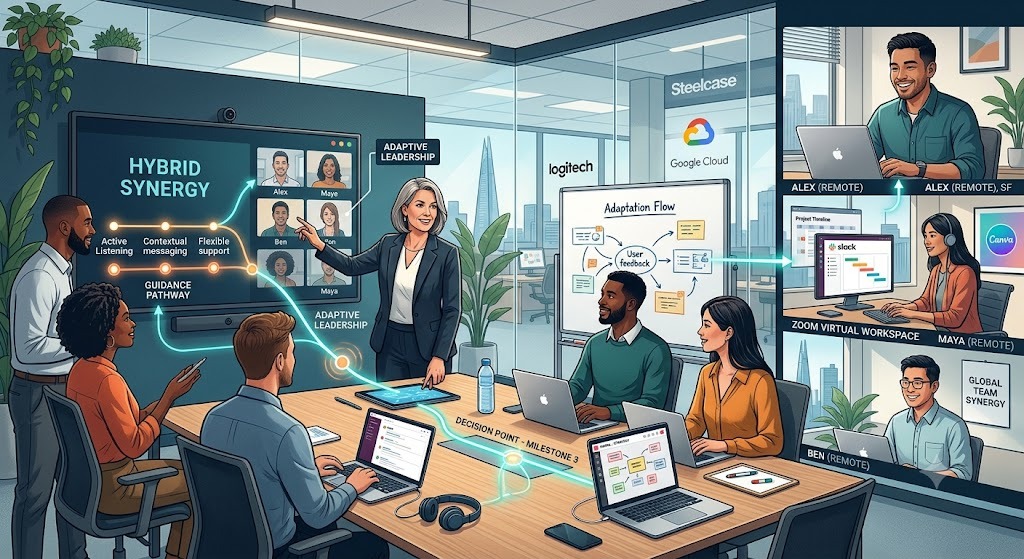
The Biggest Hybrid Leadership Mistake Is Treating Everyone the Same
For years, leadership advice has promoted consistency as one of a manager’s greatest strengths. Leaders were encouraged to establish clear expectations, maintain predictable communication, and manage every employee according to the same principles. Consistency created fairness, trust, and organizational stability. Yet the rise of hybrid work has exposed an uncomfortable reality: consistency, when confused with uniformity, has become one of the biggest barriers to effective leadership.
Hybrid work has fundamentally altered the conditions under which leadership operates. Employees no longer experience the workplace in the same way. Some collaborate in offices surrounded by colleagues, while others work remotely with fewer spontaneous interactions. New hires often require far more structured guidance than experienced employees, yet they may receive the same amount of managerial attention. Meanwhile, highly capable team members can become frustrated when unnecessary oversight replaces autonomy. Treating everyone equally under these circumstances may appear fair, but it frequently produces unequal outcomes.
This is precisely where situational leadership becomes more relevant than ever. Rather than asking leaders to behave consistently toward every employee, situational leadership asks a more useful question: What does this individual need from me today in order to succeed? That subtle shift transforms leadership from a standardized process into a dynamic capability built on observation, judgment, and adaptation.
The challenge is that many organizations claim to embrace flexibility while continuing to manage through standardized systems. Performance reviews, communication schedules, and management routines often assume that every employee benefits from the same level of structure. In reality, hybrid work has made individual differences far more visible, making one-size-fits-all leadership increasingly ineffective.
Hybrid Work Didn’t Change Leadership. It Exposed Leadership.
Much of the discussion surrounding hybrid work focuses on technology, collaboration platforms, or office attendance policies. These are important operational decisions, but they often distract from a more significant issue. Hybrid work has not created new leadership problems. It has simply revealed weaknesses that traditional workplaces were better at concealing.
In a fully office-based environment, proximity compensated for inconsistent leadership. Managers could notice when employees appeared confused, frustrated, or disengaged simply by walking through the office. Informal conversations filled communication gaps before they became serious issues. Team members overheard discussions, observed experienced colleagues solving problems, and absorbed organizational knowledge almost by accident.
Hybrid work removes many of those informal learning opportunities. Leaders can no longer assume they understand how employees are progressing simply because they attend the same meetings. Quiet struggles often remain invisible until performance declines. Likewise, highly capable employees may quietly outperform expectations without receiving the autonomy they have earned because managers default to the same routines for everyone.
This shift places greater importance on diagnostic leadership. Instead of measuring presence, leaders must learn to assess capability, confidence, motivation, and changing developmental needs. These are the very foundations of situational leadership, yet discussions about remote work technology and flexible scheduling have often overshadowed them.
The organizations thriving in hybrid environments are rarely those with the most sophisticated digital tools. More often, they are the ones whose leaders have developed the ability to recognize that leadership itself must become adaptive.
Situational Leadership Is Less About Style Than Observation
Situational leadership is frequently presented as a framework for choosing between directing, coaching, supporting, or delegating. While these categories remain useful, many organizations treat them as management techniques rather than diagnostic tools. The true value of situational leadership lies not in selecting a leadership style, but in accurately understanding what circumstances demand.
Effective hybrid leaders spend less time asking, “Which leadership style should I use?” and more time asking, “What is preventing this person from performing at their best?”
Sometimes the obstacle is capability. A new operations manager learning unfamiliar systems may need structured guidance and frequent feedback. Sometimes the obstacle is confidence. An experienced employee promoted into leadership may possess technical expertise but remain uncertain when making strategic decisions. Other times, the obstacle is motivation, workload, competing priorities, or unclear expectations. Each challenge requires a different leadership response.
This diagnostic mindset becomes especially valuable in hybrid environments because managers receive fewer behavioral signals. Employees are no longer constantly visible. Leaders must intentionally gather information through meaningful conversations rather than relying on assumptions formed through observation alone.
Consider two customer service supervisors working remotely. Both produce similar performance metrics, yet one thrives with complete independence while the other struggles with prioritization despite years of experience. Applying identical management approaches because their job titles are identical ignores the human differences that influence performance. Situational leadership recognizes that identical roles rarely require identical leadership.
The Hidden Cost of Managing for Fairness Instead of Effectiveness
Many managers hesitate to adapt their leadership because they worry employees will perceive unequal treatment. This concern is understandable. Fairness has long been associated with treating everyone the same.
Hybrid work challenges that assumption.
Imagine a newly promoted retail manager receiving weekly coaching sessions while an experienced regional manager meets with senior leadership only once each month. From a purely numerical perspective, the newer manager receives more attention. Yet few would argue this arrangement is unfair. Different responsibilities require different forms of leadership.
The same principle applies throughout hybrid organizations. Employees at different stages of development require different levels of direction, feedback, and autonomy. Providing identical support regardless of readiness often disadvantages both high performers and developing employees simultaneously. Experienced professionals feel constrained by excessive oversight, while less experienced employees receive insufficient guidance to build confidence.
The more productive definition of fairness is not equal treatment but equitable leadership. Every employee receives the leadership necessary to maximize their success, even if that leadership looks different from one person to another.
Organizations increasingly recognize this distinction in areas such as learning and development, where personalized training pathways have become common. Leadership, however, often remains standardized despite growing evidence that workforce needs have become increasingly individualized.
The future of effective hybrid leadership depends less on maintaining identical management practices and more on developing the judgment to recognize when different people require different forms of support.
Building Trust by Matching Leadership to Readiness
Trust has become one of the defining challenges of hybrid leadership, yet many organizations continue to approach it as though it were built primarily through communication frequency. Managers schedule more meetings, introduce additional check-ins, and expand reporting requirements in the hope that greater visibility will create stronger relationships. While well-intentioned, this approach often confuses activity with trust. Employees rarely feel empowered because they meet with their manager more often. They feel empowered when the leadership they receive reflects confidence in their abilities while remaining available when support is genuinely needed.
Situational leadership provides a more balanced approach because it recognizes that trust is neither granted universally nor withheld indefinitely. It develops as competence, confidence, and accountability grow together. An employee who consistently delivers high-quality work may benefit from greater autonomy, while another navigating unfamiliar responsibilities may gain confidence through more frequent coaching. The difference is not about rewarding one individual over another. It is about ensuring leadership evolves alongside employee development rather than remaining fixed regardless of progress.
Hybrid work makes this evolution especially important because managers cannot rely on physical presence as a substitute for meaningful leadership. A remote employee who receives thoughtful coaching, clear expectations, and increasing autonomy often feels more trusted than an office-based employee whose every decision requires approval. Empowerment is measured less by location than by the degree to which leaders intentionally adjust their involvement over time.
Replace Presence Management with Progress Management
One of the unintended consequences of hybrid work has been the persistence of presence-based leadership. Although employees may work from different locations, some organizations continue to evaluate engagement through online status indicators, response times, or meeting attendance. These measures provide a sense of managerial control, but they reveal remarkably little about actual performance or development.
Situational leadership encourages leaders to shift their attention from monitoring activity to enabling progress. Rather than asking whether employees appear busy, leaders begin asking whether individuals possess the clarity, resources, confidence, and decision-making authority needed to achieve meaningful outcomes. This subtle change transforms management conversations. Discussions become less focused on explaining completed tasks and more focused on removing barriers that prevent future success.
Consider an operations manager responsible for multiple retail locations. Instead of requesting daily updates from every store manager, the leader identifies which managers are fully capable of operating independently and which are navigating new challenges such as staffing shortages or technology implementation. Experienced managers receive broader objectives and greater autonomy, while newer managers receive targeted coaching and more structured feedback until they demonstrate increasing confidence. Resources are allocated where they create the greatest developmental impact instead of being distributed equally regardless of need.
This approach also improves productivity because leadership attention becomes intentional rather than reactive. Managers invest their time where it creates measurable value instead of attempting to supervise every employee with identical intensity.
Empowerment Requires Continuous Reassessment
Perhaps the greatest misconception surrounding situational leadership is the belief that employees permanently belong in one developmental category. In reality, readiness changes constantly. A highly experienced employee may require little guidance in routine operations but substantial coaching when leading a cross-functional transformation project. Likewise, a new employee who initially benefits from structured direction may rapidly develop into an independent contributor within months.
Hybrid work accelerates these transitions because technology, customer expectations, organizational priorities, and workforce dynamics evolve more quickly than traditional management cycles often anticipate. Leaders who fail to reassess employee readiness risk providing yesterday’s leadership to today’s challenges.
One practical way to avoid this trap is to incorporate developmental conversations into regular one-on-one meetings. Instead of focusing exclusively on project updates, leaders can ask questions that reveal changing needs. Which responsibilities now feel routine? Where do you still need support? What decisions would you like greater ownership over? Which obstacles are slowing your progress? These discussions provide richer insight than performance metrics alone and allow leaders to adjust their approach before frustration or disengagement develops.
Over time, these conversations also strengthen psychological safety because employees experience leadership as responsive rather than prescriptive. They learn that asking for guidance does not reduce autonomy and that demonstrating growth leads to increased responsibility.
Practical Strategies Leaders Can Apply Immediately
Situational leadership becomes most valuable when translated into everyday management behaviors. Hybrid leaders can begin by evaluating every team member across two simple dimensions: competence for the current task and confidence in executing it independently. This assessment creates a practical framework for determining whether directing, coaching, supporting, or delegating is the most effective response.
Communication routines should also become adaptive rather than standardized. High-performing employees may prefer monthly strategic discussions focused on long-term priorities, while developing team members benefit from shorter, more frequent coaching sessions that reinforce learning and address emerging challenges. Tailoring communication in this way demonstrates intentional leadership rather than unequal treatment.
Decision-making authority offers another opportunity to reinforce empowerment. Leaders should continually identify responsibilities that employees are ready to own independently. Delegation should not simply reduce managerial workload. It should become a deliberate developmental strategy that builds confidence while expanding organizational capability.
Finally, managers should evaluate success through learning as well as outcomes. Employees who occasionally make thoughtful mistakes while exercising sound judgment often develop more rapidly than those who simply follow instructions without independent thinking. Situational leadership recognizes that sustainable performance depends on developing decision-makers, not merely task completers.
The Future of Leadership Will Belong to Those Who Adapt the Fastest
The conversation surrounding hybrid work has matured. Organizations are no longer asking whether hybrid models can succeed. Instead, they are asking what kind of leadership enables people to perform consistently across increasingly flexible environments. The answer is unlikely to be found in stricter policies, additional oversight, or more standardized management practices.
The leaders who create resilient organizations will be those who become skilled observers of human development. They will understand that leadership is not defined by consistency of behavior but by consistency of purpose. Their objective remains constant: helping people succeed. The methods they use evolve according to the needs of the individual, the demands of the situation, and the realities of an increasingly dynamic workplace.
Situational leadership is therefore not simply another leadership model competing for attention. In hybrid environments, it represents a practical way of thinking about leadership itself. It reminds managers that empowerment is not something leaders grant through policies or motivational speeches. It emerges when leadership continuously adapts to help people perform at their highest potential. As work becomes more flexible, diverse, and decentralized, the ability to adapt may become the defining leadership capability of the next decade.
Author Bio
Judson Mante is a fitness specialist at BudPop with a strong focus on strength training, recovery, active living, and modern wellness education. Passionate about helping people build healthier and more sustainable lifestyles, he creates practical and research-informed content around fitness performance, mobility, nutrition, and everyday wellness habits. Through this work, Judson aims to make wellness and fitness information more approachable, balanced, and useful for readers looking to improve their overall well-being.