
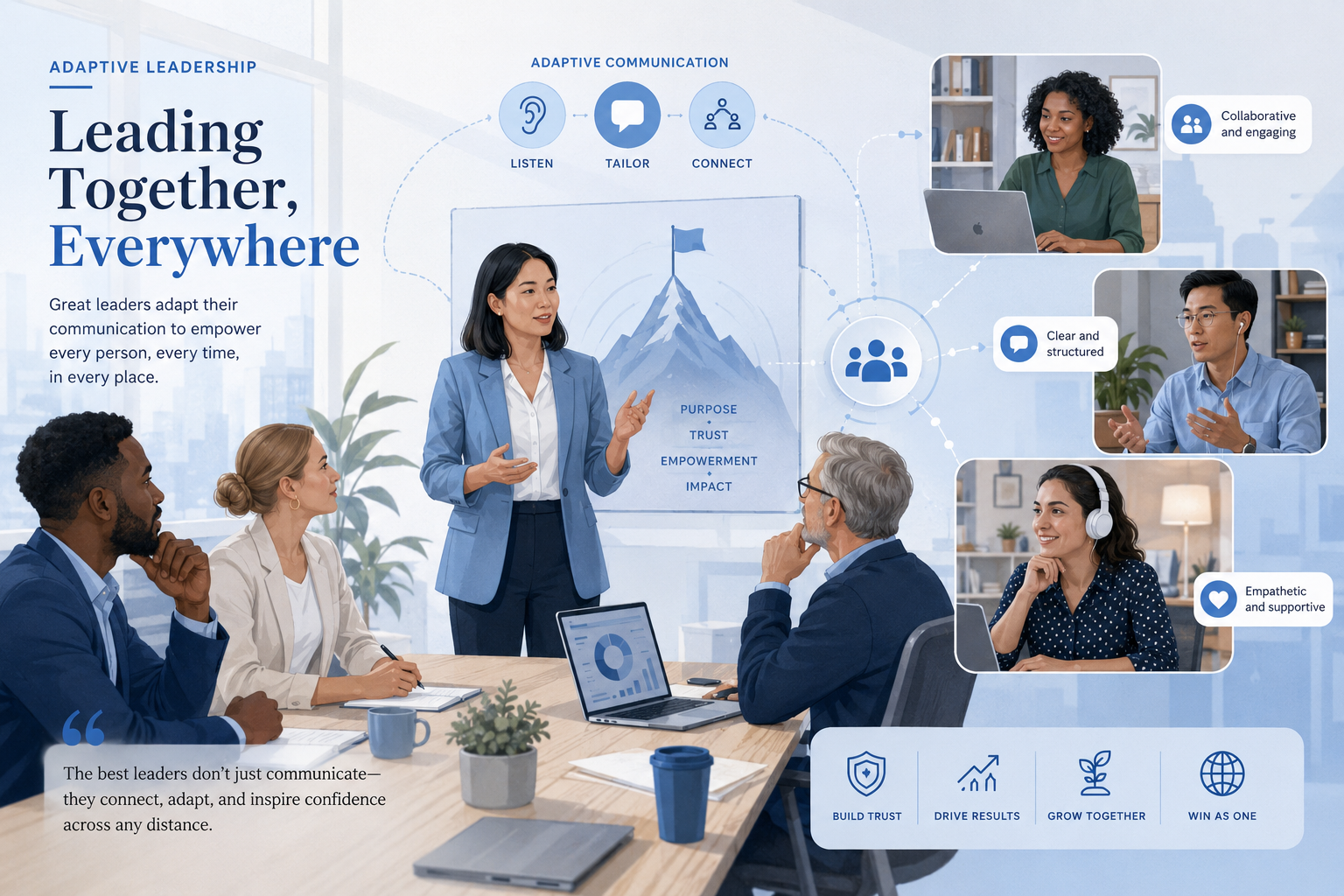
The biggest misconception about hybrid leadership is that employees should all be managed consistently.
For decades, consistency has been treated as one of leadership’s highest virtues. Leaders were encouraged to apply the same expectations, communication styles, and management approaches to everyone in the interest of fairness. That philosophy made sense when teams worked side by side, information flowed through physical offices, and managers could rely on observation as much as conversation.
Hybrid work has fundamentally changed those conditions.
Today’s teams rarely operate within identical circumstances. One employee may spend most of the week collaborating in the office while another contributes remotely across multiple time zones. A new hire may require frequent coaching, while an experienced specialist needs little more than strategic direction. Applying identical leadership approaches to employees experiencing vastly different work environments can unintentionally create disengagement rather than equity.
This is why situational leadership deserves renewed attention. Not because it is a new framework, but because hybrid work has transformed it from a useful management technique into an essential leadership capability.
The leaders creating resilient hybrid organizations are no longer asking how they can treat everyone the same. They are asking how they can create the conditions each needs to perform at their best while maintaining fairness across the team.
Hybrid Work Changed More Than Location
Many organizations initially approached hybrid work as a logistical challenge. They invested in collaboration software, redesigned meeting schedules, and developed flexible attendance policies. While these changes addressed operational concerns, they often overlooked a more significant transformation.
Hybrid work altered how leaders receive information.
Managers previously gathered countless informal signals throughout the day. They noticed body language during meetings, overheard conversations that revealed emerging problems, recognized when employees seemed overwhelmed, and observed how teams collaborated naturally. Much of this information disappeared when work became distributed.
Instead, leaders now rely heavily on scheduled interactions, digital communication, and performance outcomes. The reduction in informal visibility makes it easier to misinterpret employee capability, engagement, or confidence.
A quiet employee on a video call may be deeply engaged or completely disconnected. An individual who rarely asks questions may be highly independent or struggling in silence. Traditional leadership assumptions become increasingly unreliable when visibility declines.
Situational leadership offers an important advantage because it encourages leaders to diagnose before directing. Rather than assuming what employees need based on tenure, personality, or work location, effective leaders continuously assess competence, confidence, motivation, and changing circumstances.
In hybrid environments, diagnosis becomes more valuable than observation.
Leadership Style Should Be Dynamic, Not Fixed
Many leadership development programs encourage individuals to discover their leadership style, whether transformational, servant, democratic, or coaching-oriented. While understanding personal tendencies has value, hybrid work exposes the limitations of viewing leadership style as a permanent identity.
Employees rarely require the same leadership approach throughout a project, let alone throughout their careers.
A newly promoted supervisor may need clear direction during the first month, collaborative coaching while building confidence, and complete autonomy once experience develops. Similarly, a high-performing employee may temporarily require closer guidance when joining a new cross-functional initiative or navigating unfamiliar technology.
The leadership challenge is not choosing the correct style once.
It is recognizing when the style should change.
Situational leadership recognizes that leadership effectiveness depends less on who the leader naturally is and more on how accurately the leader responds to evolving employee needs.
This adaptive mindset becomes particularly important in hybrid organizations where circumstances shift continuously. Employees move between home and office, teams reorganize rapidly, priorities evolve, and technology changes workflows almost overnight. Static leadership struggles in dynamic environments.
Adaptive leadership becomes a competitive advantage because it evolves as work evolves.
Fairness Is Often Misunderstood
One of the greatest concerns leaders express about situational leadership is maintaining fairness.
If one employee receives extensive coaching while another enjoys significant autonomy, does that create unequal treatment?
The concern is understandable, but it reflects a common misunderstanding.
Fairness does not necessarily mean providing identical support. It means providing equitable support that enables individuals to succeed under different circumstances.
Organizations already accept this principle in other areas. New employees receive onboarding, while experienced professionals do not. Individuals pursuing leadership positions participate in development programs that others may never need. Employees recovering from illness receive accommodations without creating perceptions of unfairness.
Leadership should operate similarly.
Different developmental needs require different leadership responses.
The challenge for managers is ensuring that employees understand the reasoning behind varying approaches. Transparency reduces misconceptions while reinforcing that leadership adjustments are based on performance needs rather than personal preference.
When employees recognize that support is responsive rather than arbitrary, trust often increases rather than declines.
The Hidden Cost of Over-Managing Remote Employees
Another unintended consequence of hybrid work has been the rise of digital micromanagement.
Without physical visibility, many managers compensate by increasing virtual oversight. More meetings, more status updates, more check-ins, and more reporting become substitutes for confidence.
Ironically, these practices frequently reduce the autonomy that hybrid work was intended to create.
Employees spend increasing amounts of time demonstrating productivity instead of creating value. Managers become overwhelmed with monitoring activities instead of solving strategic problems. Teams gradually equate responsiveness with performance, even when neither reflects meaningful outcomes.
Situational leadership offers a healthier alternative.
Rather than increasing oversight for everyone, leaders evaluate who genuinely requires frequent guidance and who benefits from greater independence. High performers often flourish when trusted with broader decision-making authority, while developing employees receive structured coaching without creating unnecessary bureaucracy across the entire team.
The distinction is subtle but significant.
Leadership becomes targeted rather than standardized.
Situational Leadership Requires Better Conversations, Not More Conversations
One misconception surrounding hybrid leadership is that distributed teams simply require more communication.
Quantity, however, rarely solves the problem.
What hybrid teams often lack is contextual communication.
Situational leaders ask different questions because they seek understanding rather than updates. Instead of asking, “How is the project progressing?” they ask, “What part of this work feels most uncertain?” Rather than asking whether deadlines will be met, they explore whether employees possess the clarity, authority, and resources necessary to meet those expectations confidently.
These conversations reveal information that traditional status meetings rarely uncover.
They expose confidence gaps before performance declines. They identify unnecessary obstacles before frustration grows. They allow leaders to adjust support proactively instead of reactively.
In hybrid environments, the quality of leadership conversations increasingly determines the quality of leadership decisions.
Technology cannot Replace Leadership Judgment.
Artificial intelligence, workforce analytics, collaboration platforms, and productivity dashboards continue expanding managers’ access to data. Organizations can now measure engagement, meeting participation, response times, workload distribution, and countless other performance indicators.
While these tools provide valuable insights, they cannot determine the leadership response.
Analytics may identify declining productivity, but cannot explain whether the cause is burnout, unclear expectations, insufficient capability, competing priorities, or personal circumstances.
Only thoughtful leadership conversations can uncover those distinctions.
Situational leadership complements modern technology because it transforms data into informed action. Information becomes the starting point rather than the conclusion.
As organizations increasingly invest in workplace technology, the uniquely human ability to diagnose individual needs becomes even more valuable.
Technology can identify patterns.
Leadership interprets people.
Building Adaptability Across the Organization
Perhaps the most overlooked opportunity presented by situational leadership is its influence beyond individual managers.
Organizations frequently invest in leadership development by teaching communication techniques, delegation frameworks, or performance management processes. While valuable, these skills often assume relatively stable environments.
Hybrid work has demonstrated that stability can no longer be assumed.
Organizations therefore benefit from developing adaptability as a core leadership capability.
Managers who regularly assess changing employee needs become more comfortable adjusting their own behaviors. Teams become more accustomed to feedback, experimentation, and evolving responsibilities. Decision-making becomes more responsive because flexibility is embedded into leadership itself rather than reserved for exceptional circumstances.
Over time, situational leadership evolves from an individual management technique into an organizational capability.
That capability becomes increasingly difficult for competitors to replicate because it depends less on policies than on leadership judgment.
The Future of Leadership Will Depend Less on Authority and More on Adaptability
Hybrid work has exposed an important truth about leadership that extends far beyond flexible work arrangements.
Employees no longer operate within standardized environments, follow identical career paths, or develop at predictable rates. The modern workplace is increasingly characterized by variation rather than uniformity.
Leadership models built around consistency alone struggle within that reality.
Situational leadership offers a more durable framework because it accepts complexity instead of attempting to eliminate it. It recognizes that effective leadership is not measured by applying the same approach to everyone, but by accurately understanding what each situation demands while maintaining fairness, accountability, and shared purpose.
As organizations continue redefining how work happens, leadership itself must become more adaptive than prescriptive. The managers who thrive will not necessarily be those with the strongest personalities or the most polished communication styles. They will be the ones capable of reading changing circumstances, adjusting thoughtfully, and helping every employee perform at their highest level, regardless of where they work.
That may ultimately become the defining leadership skill of the hybrid era.
Author Bio
Erin Zadoorian is the Co-Founder of Exhale Wellness, where he focuses on building high-quality hemp and cannabinoid products for modern consumers. His work centers around product innovation, transparency, and educating customers about CBD and THC alternatives, helping people make more confident and informed choices in the cannabis space.